
Most screenwriters have drafted a scene where a character says exactly what they feel or they explain exactly what's happening. Is this a bad thing? Not necessarily, depending on the character or the exact scenario, but there might be a better way to write this dialogue.
A common note you'll receive in screenwriting development is that a certain line or exchange is too "on the nose." On-the-nose dialogue is discouraged because it reads flat and often stilted. It's not how real people speak, and it's the fastest way to drain tension from a scene that should have intrigue and complexity.
Subtext fixes this.
Subtext adds another layer to your dialogue and keeps things from being too surface-level. Most acclaimed screenwriters make use of subtext, and it can be a very powerful storytelling device in your writing.
What Is Subtext in Screenwriting?
Subtext is the space between what a character says and what they actually mean. Two people can discuss dinner reservations while one of them is deciding whether to leave the marriage. Two men can argue about advertising while the real subject is who matters most in the room. The surface conversation is essentially a cover story, and when done effectively, the reader is clued into the deeper meaning.
Subtext isn't limited to just dialogue: theme, structure, character goals, and even action can all act as breadcrumbs to another world beneath. Most importantly, subtext is a reflection of your characters and their deepest desires. Because of this, creating subtext demands total clarity about your characters' wants and why they can't say it directly. Once you know this, the dialogue almost writes itself around the space.
How to Write Subtext in a Screenplay
Start with contradiction: your character's words and their behavior tell two different stories. A character who insists they're fine while they obsessively clean or fidget with something is telling you something their words aren't. A character who manages the strictest discipline at their job but can't maintain a relationship outside of work suggests there's something wrong or unresolved.
In addition to contradictory action and circumstances, tone is something else you can use to convey subtext. A flat "sure" delivered after a long pause carries different weight than an enthusiastic one. Write the pause into the description or into the dialogue (this is where parentheticals come in handy). Sometimes all it takes is a single discordant beat to change the entire tone or implication of words.
There's also the power of the unsaid line. A character who changes the subject the instant something gets close to the truth is revealing the location of their hidden wound. Silence after a question can land harder than any answer you could write, because the reader fills that silence with whatever they already suspect is true about the character. Don't fill every space in your scenes with clarifying dialogue. The space is doing work your exposition can't.
Conflicting agendas are another opportunity for subtext, and it's essential for story conflict (another thing that's highly desirable in screenwriting). Put two characters in a scene who each want something different from the exchange, and they'll talk past each other in a way that feels alive instead of choreographed. One character is trying to manipulate the other to do their dirty work. The other is trying to leverage their loyalty to achieve a different goal. Neither reveals this to the other, but if the characters' emotional through lines have been tracked, the reader will recognize the contradictory agendas without any expository dialogue spelling it out. As a result, the conversation takes on a different characteristic: it becomes a secret duel between the characters.
This is "show don't tell" dialogue. Ideally, we've learned things about the characters beforehand, whether through action or implication, and it tells us everything we need to know. Another reason why this is desirable is that it generates tension and anticipation. Readers will be waiting for the moment your characters' intentions are exposed, and the conflict comes to the surface.
So subtext in dialogue not only creates conflict, but also signals drama.
Examples From Master Screenwriters
The subtext examples below come from screenwriters who often used it in their dialogue (as well as in their overall structure and storytelling).
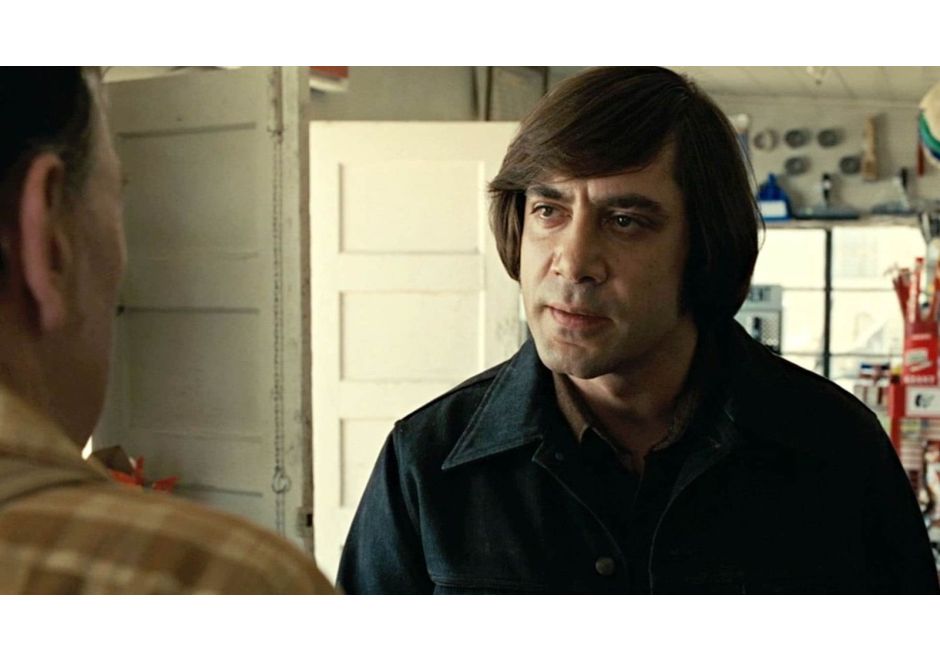
The Coen brothers' screen adaptation of Cormac McCarthy's No Country for Old Men builds one of the film's tensest scenes through terse dialogue at a gas station counter. Anton Chigurh (Javier Bardem) buys a bag of cashews from an elderly proprietor. The old man tries to make friendly small talk, but it rubs Chigurh the wrong way. The proprietor attempts to smooth things over and move on from it, but Chigurh lingers and starts throwing back the old man's words in a subtly antagonistic fashion. There's nothing threatening in Chigurh's words; the threat exists underneath them. Every one of Chigurh's remarks edges the proprietor closer to something that unsettles him. The old man's answers get shorter and more anxious as Chigurh stands there, eating his cashews, and begins interrogating him:
PROPRIETOR
Will there be anything else?
CHIGURH
You already asked me that.
PROPRIETOR
Well… I need to see about closin'.
CHIGURH
See about closing.
PROPRIETOR
Yessir.
CHIGURH
What time do you close?
PROPRIETOR
Now. We close now.
CHIGURH
Now is not a time. What time do you close?
PROPRIETOR
Generally around dark. At dark.
Chigurh stares, slowly chewing.
CHIGURH
You don't know what you're talking about, do you?
PROPRIETOR
Sir?
CHIGURH
I said you don't know what you're talking about.
By the time Chigurh produces a quarter and tells the man to "call it," the conversation has already told us everything we need to know without ever stating explicitly what's being decided. The proprietor asks what he stands to win, and Chigurh answers with a single word: "Everything." Neither man says the phrase "life or death," and neither has to. The whole scene runs on the quiet suggestion that Chigurh is a dangerous man and capable of murder. When the proprietor wins the coin flip, we know what he avoided.
Aaron Sorkin's The Social Network opens with Mark Zuckerberg (Jesse Eisenberg) and his date Erica (Rooney Mara) at a campus bar. On the surface, the scene is about Harvard's final clubs and which one Mark should try to join. However, his obsession with the clubs betrays a deeply insecure young man who equates acceptance into one of these micro-institutions with confirmation of worth. Every club Mark name-drops is really an argument for his own value, made sideways instead of head-on, and the constant subject-hopping, IQ scores to rowing, exposes the full scope of his insecurities.
Erica's frustration comes from how hard she has to work to be part of a conversation that keeps sprinting toward the same unstated point:

MARK
Would you like to talk about something else?
ERICA
No, it's just since the beginning of the conversation about finals club I think I may have missed a birthday.
(can't get over it)
There are really more people in China with genius IQ's than the entire population of—
MARK
The Phoenix is the most diverse. The Fly Club, Roosevelt punched the Porc.
ERICA
Which one?
MARK
The Porcellian, the Porc, it's the best of the best.
ERICA
Which Roosevelt?
MARK
Theodore.
ERICA
Is it true that they send a bus around to pick up girls who want to party with the next Fed Chairman?
MARK
You can see why it's so important to get in.
ERICA
Okay, well, which is the easiest to get into?
Mark doesn't respond well to Erica's earnest attempt to help him. She's simply suggesting something concrete and achievable instead of an abstract fixation. He snaps, "Why would you ask me that?" and this defensiveness is the first crack in the surface. The moment his need for validation becomes explicit instead of merely implied.
What begins as subtext rarely stays that way once a character feels exposed. Mark spirals from this point on, and he tells Erica that she only asked which club was easiest because she assumes it's the only one within his reach. The conversation that starts as trivia about final clubs ends as a breakup, and that shift from implication to confrontation is worth studying: once a character finally says the thing the scene has been circling, the subtext becomes text, and the scene becomes something else.
The promise of this transformation is what keeps the reader leaning in; it's the anticipation of the moment that the real conversation happens. Sorkin makes the reader wait three pages for it, letting it slowly crest, and when it happens, it's more powerful.
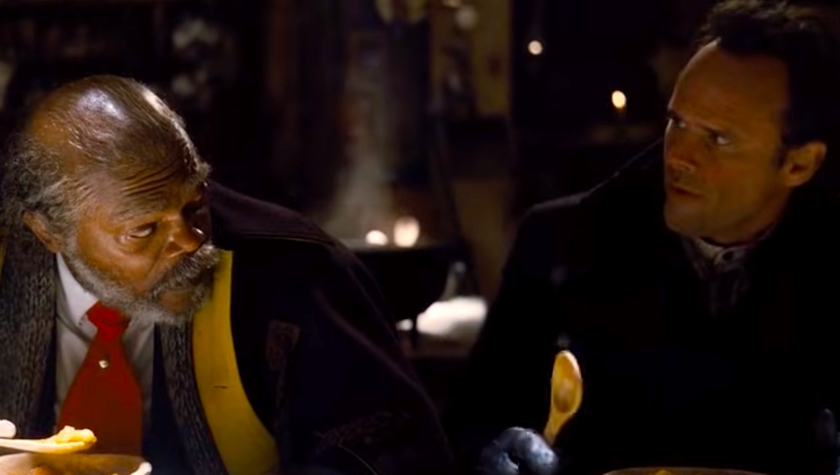
Quentin Tarantino's The Hateful Eight is largely fueled by subtext (at least in the first half). One of the best examples is the scene where Chris Mannix presses Major Marquis Warren about a letter he says Abraham Lincoln wrote in direct correspondence. Chris never accuses Warren of lying outright. He simply asks Warren to confirm the claim over and over, in slightly more incredulous phrasing each time, until the premise starts to buckle under its own weight:
CHRIS
So... you gotta letter from Abraham Lincoln?
MAJOR WARREN
Yes.
CHRIS
The Abraham Lincoln?
MAJOR WARREN
Yes.
CHRIS
Abraham Lincoln? The President of the United States…?
MAJOR WARREN
Yes.
CHRIS
…of America?
MAJOR WARREN
Yes.
CHRIS
Wrote you a letter, personally?
MAJOR WARREN
Yes.
CHRIS
Personally? As in, "Dear Major Warren"?
MAJOR WARREN
No. Personally as in, "Dear Marquis".
CHRIS
"Dear Marquis"? Abraham Lincoln-the-President-of-the-United-States-of-America?
MAJOR WARREN
Yes.
In addition to inserting humor into an otherwise very dark script, Chris's repetition conveys disbelief without ever directly stating the accusation. Major Warren holds his ground for as long as he can, but after a while we start to wonder ourselves, 'Is the Lincoln letter real?'
The context does as much subtextual work as the dialogue itself. Chris is a former Confederate soldier. Warren is a black Union veteran, only a few years removed from a war fought over the equality Chris's questioning is quietly denying him. Read the lines without that history, and Chris just sounds needling. Read them with it, and every one of Warren's terse answers belongs to someone forced into this position his entire life, while Chris's mounting disbelief becomes a refusal to accept that a black man could have corresponded with the President as an equal. The dialogue supplies one layer of meaning. The characters and time period supply another.
As with the examples from No Country for Old Men and The Social Network, the Lincoln letter exchange goes on for several pages and thrives on our anticipation of what's being suggested will come to the foreground. It does, and we do learn the truth about the Lincoln letter. Now just imagine if the scene began with Chris openly accusing the Major of lying? Sure, Warren would probably still deny it, and there'd be some back and forth, but it wouldn't inspire the same intrigue or anticipation; it'd be remote and one-note.
Subtext brings the reader into your narrative, letting them live in the space between truth and denial. When what was implied is finally revealed, the reader is satisfied in a way they'd never be if everything was laid out for them without any need of participation.
Rewriting 'On-the-Nose' Lines
Here are three before and after lines to help you see the difference between on-the-nose dialogue and subtextual dialogue.
Before: "I'm scared you're going to leave me."
After: "You packed heavy for a weekend trip."
The anxiety relocates into an observation about a suitcase, and the other character now has to decide whether to answer the real question or dodge it. The line is small enough to brush off and specific enough that it won't be forgotten.
Before: "I don't think you're interested in my career."
After: "Funny, you never asked how the pitch went."
The line becomes an opening instead of an accusation. The other character can apologize, deflect, or get defensive, and any of the three tells you something about how they feel. The rewrite hands the scene's next beat to the reader's imagination instead of dictating it.
Before: "I'm proud of you, even though we don't talk much anymore."
After: "Saw your book display the other day. Great cover."
Pride and distance are conveyed in both sentences, but the first one spoonfeeds it, whereas the revised one allows you to consider the estrangement and nature of the characters' relationship.
Hitting the Sweet Spot with Subtext
The above subtext examples are effective but pretty straightforward. The more you write dialogue and pay attention to what's obvious vs. what's engaging, the more you can branch out and experiment. Sometimes what you've written might be too abstruse, and the reader won't get what you're suggesting. The most effective subtext in dialogue is when what's not being said outright is right beneath the surface: it's being expressed, just not directly.
Hitting the sweet spot takes time. If you're stuck on certain lines, re-read them, think about them, and keep rewriting until you're satisfied. You can also use Final Draft's Alt Dialogue feature and compare and contrast different lines. When read back-to-back, the choice is likely to be clearer. Also, never forget about your character and how they'd say something. Are they direct and confrontational? Or are they introverted and keep things close to the chest? This should factor into the level of subtext you apply to their dialogue.
Because ultimately, subtext isn't about withholding information.
It's about communicating something deeply important in a subtle and natural way.