
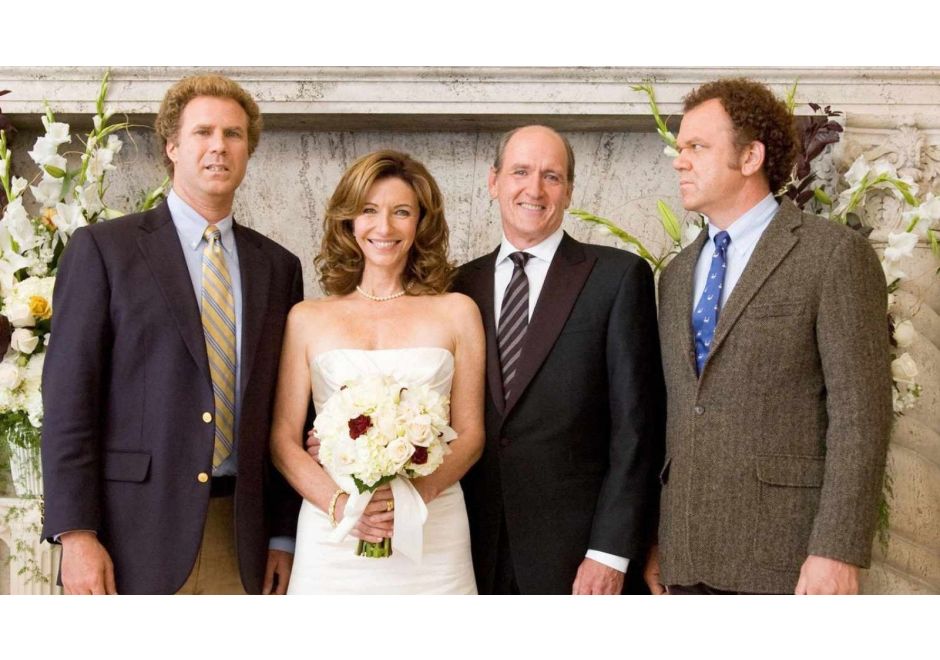
Good dialogue isn’t always just about what a character says. Sometimes it’s about what they could have said, and didn’t.
Every line of dialogue is a decision. A character chooses to confront or soften. To joke or to accuse. To deflect, confess, dominate, retreat. They could be protecting themselves or testing the other person.
If a character is insulted, they have options. They can fire back. They can laugh it off. They can pretend not to hear it. They can pivot the conversation. Each choice tells us something different about their pride, insecurity, intelligence, history, and emotional control.
When you begin thinking about dialogue as a series of choices rather than a stream of words, your characters will suddenly feel more alive. And they will become more distinct.
Writers often struggle with characters “sounding the same,” and the issue isn’t just vocabulary. It’s the decisions they’re making. If every character reacts to a situation in the same way — matching tone, matching aggression, matching wit — their dialogue flattens into uniformity.
Distinct dialogue begins with recognizing that every moment contains multiple viable lines. Choosing among them is what shapes your character’s voice and will reveal what makes them unique.
It can also distinguish two characters from one another. They might be entangled in the same situation, but what they choose to say is an opportunity: an opportunity to show how they’re different, or perhaps the same — but in a deeper or even ironic fashion.
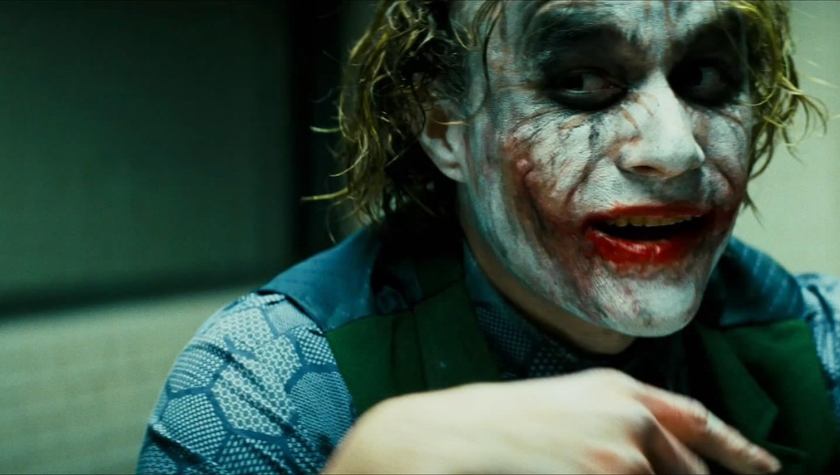
Take the following exchange from Christopher and Jonathan Nolan’s The Dark Knight. Batman (Christian Bale) chooses to speak to the Joker (Heath Ledger) like he’s a typical criminal. The Joker chooses to make a deeper connection with his adversary. And why is he doing this? The Joker is seeking to corrupt (in the same fashion he successfully corrupts Harvey Dent).
Even before revealing his core philosophy, it’s clear Batman is underestimating the Joker and his psychological tactics:
BATMAN
You're garbage who kills for money.
THE JOKER
Don't talk like one of them- you're not, even if you'd like to be. To them you're a freak like me... they just need you right now.
One man is a wall. The other man is a destroyer of walls.
The more intense the moment, the more revealing the choice.
An Ensemble Cast, an Ensemble of Choices
If your screenplay involves numerous characters, it can be even more challenging to distinguish them from one another. Once again, this is when thinking of every line as a distinct choice can assist you.
Look at the scripts written by Quentin Tarantino: they often involve an ensemble cast of characters and often quite distinct from one another.
In Inglourious Basterds, Hans Landa (Christoph Waltz) doesn’t threaten loudly. He speaks politely, even warmly. His menace comes from patience and precision. He elongates conversation. He lets silence stretch. He asks questions he already knows the answers to. By the time he’s finished, his opponents are mentally overwhelmed and are forced into submission:
COL. LANDA
You are sheltering enemies of the state, are you not?
PERRIER
Yes.
COL. LANDA
You’re sheltering them underneath your floorboards, aren’t you?
PERRIER
Yes.
This opening exchange establishes Landa’s interrogation tactics, and when he attempts to replicate them with other characters (Shosanna, Lt. Aldo) we see them make different choices that distinguish them.
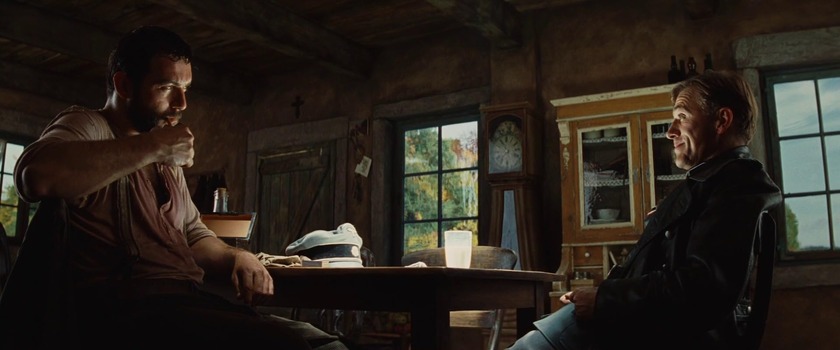
In The Hateful Eight, characters argue constantly, but their tactics differ. Some needle. Some posture. Some tell long stories to shift the room’s attention and destabilize others psychologically. Some use mockery. Some use restraint. The tension escalates not just because of what is said, but because of how it is delivered.
For example, when Major Warren’s (Samuel L. Jackson) Lincoln Letter ruse is exposed, it’s largely met with cynical laughter. However, bounty hunter John Ruth (Kurt Russell) responds with hurt feelings and doesn’t bother hiding them from the others:
MAJ. WARREN
This letter had the desired effect of disarming white folks. They believed the Lincoln Letter because they wanted to believe the Lincoln Letter, and white folks will believe anything they WANNA’ believe.
John Ruth
Call it what you want, but I call it a dirty trick.
Every choice a character makes in how they respond to new information and the increasingly tense atmosphere, dictates their fate in The Hateful Eight.
Having this mindset when you write dialogue, adds depth and subtext to it. By giving your characters options before locking in a line, you make their differences more pronounced. Their words will read intentional rather than incidental, and they’ll suggest hidden multitudes.
Testing Lines with Alternate Dialogue
Arguably, comedic screenplays are where dialogue choices are most vital.
Comedy thrives on choice. Both in terms of the characters’ dialogue, but also in the writer’s selection. A joke lives or dies on rhythm. One extra word can dull it. A sharper verb can sharpen it. If a character’s words betray ignorance or arrogance at a crucial moment, their lines become more than revelatory: they can become an engine.
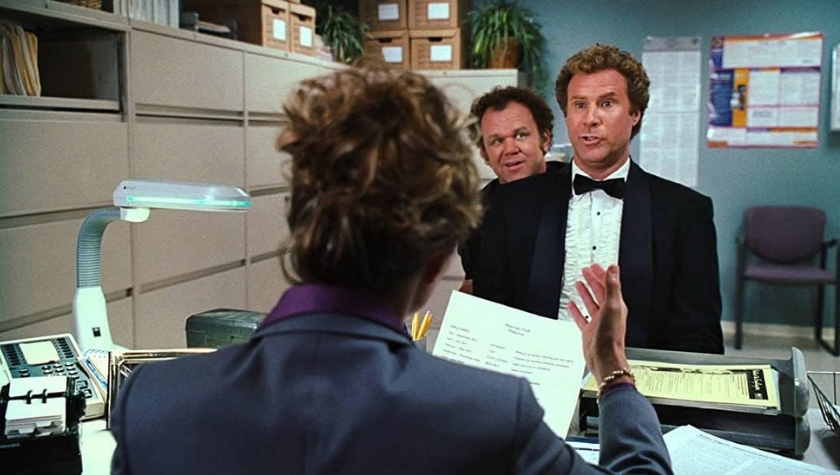
In Adam McKay’s Step Brothers, much of what makes the film works is the way dialogue feels spontaneous and oddly specific. As revealed by its many alternate scenes, McKay had numerous lines to choose from when working with his editor: the best example being the various takes of Brennan (Will Ferrell) and Dale’s (John C. Reilly) job interviews. Though a lot of this sprung from on-set improvisation, many comedic screenwriters write alternate lines to see what lands best.
What you think is funny might hit others differently. This is why you should never settle for the first wave of dialogue that seems to work. You may miss the one line that defines the character more clearly or connects with your readers more thoroughly.
Whether it’s a comedic or dramatic script, alternate lines give you more options, and this is where choice in dialogue becomes most crucial.
Consider Each Line Before Committing
The first line that works is rarely the only line that works.
When writing, pause at important exchanges and ask yourself, ‘What else might they say?’ Write the harsher version. Write the restrained version. Write the version that avoids conflict entirely. Write the version that pushes the conflict further than feels comfortable.
You are not adding clutter. You are testing the edges of your characters.
If two characters experience the same insult, they should not respond with the same tone. One might lean into sarcasm. Another might go quiet. Another might retaliate instantly. Another might shift the conversation strategically. Consider each line before committing.
Exploring alternate lines can lead to greater exploration of your characters. Rather than defaulting to whatever feels easiest in the moment, take pause and test things out. What lands better? What sounds more naturalistic? What line inspires a greater emotional response?
Making Alt Dialogue Part of Your Workflow
All of this experimentation sounds ideal, but in practice screenwriters often avoid it because managing alternate lines can feel chaotic. Drafts become cluttered. Pages multiply. Good lines get deleted and forgotten. Revisions become messy. You begin to lose focus.
But there’s a way to make writing and saving alt dialogue an easy part of your workflow.
Final Draft’s Alt Dialogue feature allows you to keep multiple versions of a line inside the same script without losing track of them. Instead of cutting a line to try something else, you can attach an alternate to it. Nothing is lost: you’re simply creating more options.
Highlight a line of dialogue you want to experiment with. From the Format menu, choose Alt Dialogue. A small plus sign appears next to that dialogue: click on it and the original line will disappear (but no worries, it’s saved). Simply write a new line of dialogue and it will be automatically assigned a number. Click on the arrows to navigate between the different lines (a number over each arrow). This allows you to switch between different lines to see what works best.
You’re not creating separate drafts. You’re not duplicating scenes. You’re preserving options within the flow of the script. Alt Dialogue doesn’t make the choice for you. It enables you to do so, and without disrupting how you write and work.
Alt Dialogue: Their Choice, Your Choice
By thinking of dialogue as a series of choices rather than a stream of words, you naturally begin to distinguish character voices, deepen relationships, and reveal greater depth in their personalities.
Exploring alternate lines, testing rhythm, and considering how different characters respond to the same situation can sharpen both realism and dramatic tension.
Whether you’re writing a heated confrontation, a tense ensemble scene, or a comedic exchange, giving your characters options before committing to a line will lead to dialogue that feels more intentional, more distinctive, and possibly more resonant to readers.
Alt Dialogue makes this process easier. It gives your characters a choice, but more importantly, it gives you one.