
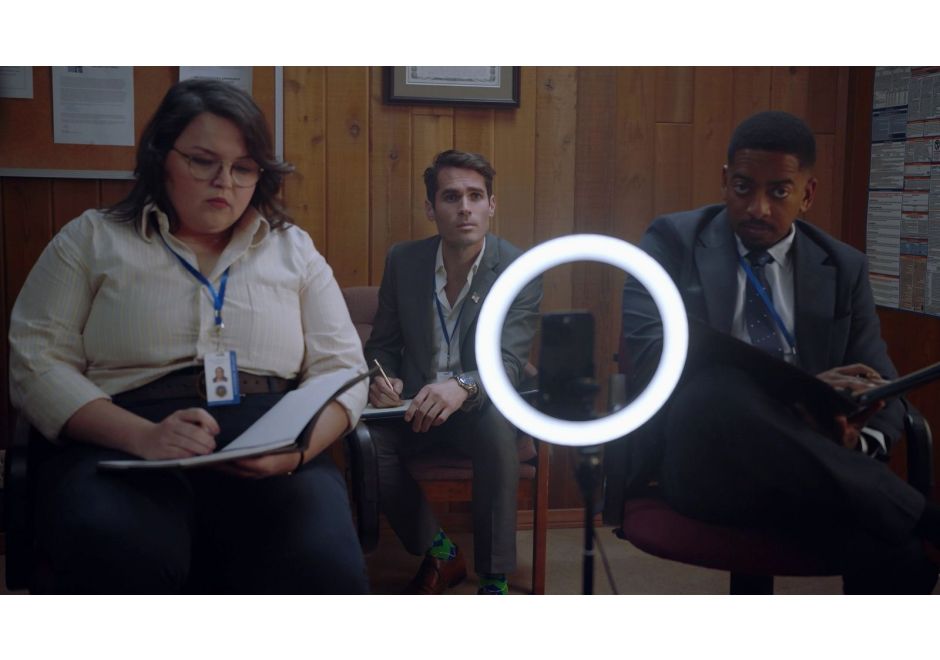
Jim Cummings and PJ McCabe have spent 20 years figuring out how to write well together.
Their episodic project, The Screener, premiered at this year's Sundance Film Festival, and it has a premise and point of view that haven't really been seen before. While it is a showbiz comedy, it's slightly more focused on the darker side of the entertainment business, not the carefree romps we saw in Entourage or The Studio.
What happens when a film industry leak results in actual criminal prosecution?
The show follows Minnie (Shereen Lani Younes), a filmmaker whose movie gets leaked online by an opportunistic insider. She decides to press charges. Cummings plays the reluctant district attorney roped into the case.
The series was co-directed and co-written by Cummings and McCabe.
Cummings broke through in 2016 with Thunder Road, a single-take short about a police officer delivering a eulogy at his mother's funeral. The film won the Sundance Short Film Grand Jury Prize. He expanded it into a 2018 feature that took home the SXSW Grand Jury Award. McCabe, a Philadelphia-born actor and filmmaker, started as a performer in films like 13 Cameras and Funeral Kings before transitioning into writing and directing alongside Cummings. Together, they've built a production model that sidesteps traditional Hollywood gatekeepers.
It stands to reason that Cummings and McCabe's team aren't sharing links for this one, so it's been a hot ticket in town, one I was lucky enough to nab. After a buyers' screening held at the team's mountaintop home base, I sat down with Cummings and McCabe to discuss how they created The Screener.
How 'The Screener' Started
If you keep an eye on any goings-on in the industry, you're probably aware of some of the biggest leaks that have happened over the years.
Quentin Tarantino's first draft of The Hateful Eight screenplay was infamously circulated, leading him to temporarily shelve the project. Now he goes to extreme lengths to protect his work. Hugh Jackman's first standalone X-Men film, X-Men Origins: Wolverine, was uploaded online a week before release, which was disastrous for the film.
"I was always seeing it in the press," Cummings said. "There were leaks. The Power of the Dog leaked from TIFF, along with another Netflix film. Skinamarink leaked from a smaller horror festival. ... And I was like, 'Why hasn't anybody done anything about this?' It feels like it's so against filmmaking."
To the pair, the real-life inspiration presented a rich world of conflict and drama to explore for a series.
"It escalated quickly," McCabe said. "It was just such an interesting world. It's a huge world. It's so complex. We love just researching anything, to really dive into the legality of all this."
From the opening scene, the surly satire of the industry begins (what's the projectionist's name? Who cares), and the seemingly inherent hierarchy is set up, showing us who kowtows to whom at a talent agency and in the city.
"PJ and I are always thinking about power dynamics and how everything is laid out, how much fealty an assistant has to their boss, to lie for them if they're going to jail," Cummings said. "And there's just so much comedy and drama in that."
They chose the character of Minnie to provide the emotional foundation of the series because she is such an outsider to this system as a queer Muslim indie director, and it's easy for the audience to root for her.
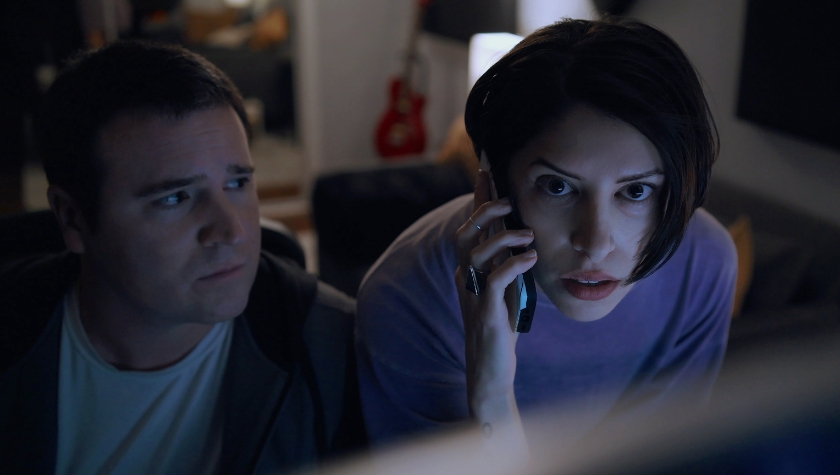
Why They Wrote 'The Screener' as a Series
The scope and complexity of their idea made it a good fit for a series rather than a feature. (The show is completed and in the can, although just the first three episodes screened at the festival.)
"I wrote the first 30 pages," Cummings said, "and then it was functioning as its own in that I sent it to PJ, thinking that maybe it could be something we could expand into a feature. And then we just talked about it as a series."
The first episode is a tense bit of setup on the agency side, showing viewers how the leak happens. In episode two, we meet DA Tony Avaluto (Cummings) and get another version of workplace conflict on the legal side.
"There's something so interesting about doing 30 minutes with the few people in a different work environment, and then hard cut to an entirely new cast of characters," Cummings said, "and that really works in television."
Structurally, the episodic format made sense for the investigation's story, too.
McCabe said, "The chapters function like the steps of the case. It's a crime investigation leading up to the trial and everything. So it just functions that way."
Writing Strong Conflict
There is so much conflict built into this kind of legal/workplace comedy already, especially one set in the industry. Agents take advantage of their assistants, who pressure lower-level employees in the mailroom or projection booth, but when lawyers get involved, the agents aren't so bold anymore and hurry to shuffle blame.
Beyond that, Cummings and McCabe never miss an opportunity to inject extra friction in a scene, which makes every beat more interesting.
Cummings said, "With the conflict in scenes, PJ and I write a lot of it out loud, or we'll take a thousand notes about a scene and figure it out while we're doing it, and then we rewrite and rewrite and rewrite until it's perfect. 'Perfect.' Until it's good enough to shoot."
For instance, there's a moment when Minnie and Avaluto meet for the first time during her deposition, and he sits silently in the background until he asks her a pointed question.
"For that scene in particular, we really wanted to have Tony come in and vocalize something that the audience is not expecting him to say. The first words he says to Minnie are, 'Did you leak the film?' Doesn't even introduce himself," Cummings said.
McCabe added, "Which the audience would not have probably thought of at that point, I wouldn't think."
The veiled accusation leads Minnie to end the meeting in frustration, feeling like the law isn't on her side.
"It's like, 'Oh, f*ck, that is the strangest thing to say in an introduction,'" Cummings said. "And it's like, she might not get any support. She might be totally on her own."
It is a standout, unexpected moment of the episode, and gives a fairly straightforward scene an emotional button to keep propelling the writing forward.
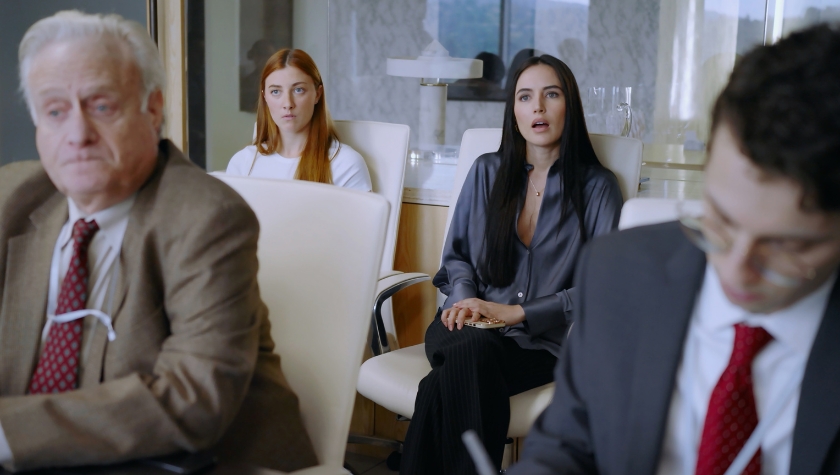
What They Learned About Structure
As a complex series with a large cast and many simultaneously spinning plates, the writing duo had to cover a lot of character setup, exposition, and relationship dynamics very quickly.
"Certainly, moving forward, I think PJ and I kind of cracked the code on how to write something well," Cummings said. "Took us 20 years of knowing each other—"
"Something cracked on this one," McCabe agreed.
They were deliberate about giving information piecemeal, as it would be in reality, to engage the audience's attention. Cummings pointed to one early scene in the DA's office when Avaluto spars with his team members. In the scene, Katherine (B.K. Cannon) stomps off after Avaluto says something rude.
"All it takes is Tony saying, 'I said stupid,' to his counterpart," Cummings said. "And then it's like, 'Oh, you're not allowed to say that word in the office.' That was a whole thing. He called Katherine stupid once, and she said, 'You're never allowed to use that word.' Oh, it breaks my heart. It's so beautiful. It's so sad."
It's all about giving the viewer just enough to encourage curiosity.
"We really love that stuff," Cummings said, "to be able to show up late and leave early in the writing. It forces the audience to play detective, and then that's fulfilling for them. They feel smart."
Advice for Screenwriters
Cummings insists on taking the words off the page and into some kind of performance in order to polish the writing.
"Do it out loud," he said. "For a long time, I would go to a coffee shop and put on headphones and listen to music and hear voices in my head of the characters. And then it would only take showing up on set to realize that it sucked and that it doesn't sound good coming out of human vocal cords."
There are a dozen ways to achieve this, whether you stage a table read or just read pages in the privacy of your office.
"We have two laptops and a table, and we workshop what the dialogue would be and then—'That's stupid. What if we weave this?' And then we read it back, doing it out loud, and I'm like, 'I'm already getting bored. These two scenes can be one. Cut this bit as it's more concise to remove that stuff. Make this one sentence rather than six,'" Cummings said. "Honestly. Doing it out loud and reading it a thousand times, reading it out loud, recording it as a podcast, putting in music and sound design so you can hear the screenplay, and not just have it be black words on a white page."
"It's very important," McCabe said. "I know not everyone's an actor, but if you can put it on your feet, too, it's even better. We'll literally just pace around in his garage playing the characters, acting out the scenes until it feels realistic ... you'll find cool screenwriting gems that you might not have thought of before for the characters to do. And it helps keep it interesting. If you get bored reading your own screenplay, then it's wrong."
If it's an investor or producer you need to convince, invite them over and read your script to them, they said.
"Somebody can misinterpret a text message. Don't let them misinterpret an entire screenplay," Cummings said. "You can record it on an iPhone in a closet and put in some music and stuff, and then you'll understand what's working and what isn't. I think everybody should do it auditorially."
Be Brave
When asked if they had anything else they wanted readers to know about their project, McCabe laughed about how secretive they've been about the whole thing.
After a thoughtful pause, they came back to taking risks, which they certainly have with this project.
Cummings said, "Be braver than us. For a long time, I wanted to come and do Sundance and be like, 'Oh yeah, f*ck the system,' or whatever, or like, 'F*ck the status quo.' ... I feel so happy about the people that we worked with and the human story of Minnie, and I'm like, if I treat it like it's not that big of a deal, the next generation will think, 'Okay, well, if Jim and PJ did it, it'll be okay if we do it.'"
McCabe agreed. "Yeah. Less of an attack on the bad guys and celebrating the good guys."
"And indie film," Cummings said. "Long live indie film."