
A fight scene isn’t “action coverage.” It’s character, story pressure, and cinematic clarity — delivered through violence, speed, and consequence.
The best fights don’t read like choreography notes or a Wikipedia recap of who punched whom. They read like story beats that happen to be physical. You can feel intention in every move, you can track where everyone is, and you can sense what the fight is really about even when no one says a word.
So when you’re writing a fight scene, your job is deceptively simple: make it readable, make it emotional, make it visual, and make it inevitable.
A screenplay fight scene has three simultaneous responsibilities:
- It must be clear. The reader should never be confused about who is doing what, where they are, or what changed from one beat to the next. Confusion kills momentum.
- It must escalate. Not just “more punches.” Escalation means the situation turns: a fighter adapts, an advantage flips, a new tactic is revealed, a weakness gets exposed, an injury changes strategy, a truth surfaces. The fight should evolve.
- It must express character. Fighting style is personality under stress. Some characters swarm. Some stalk. Some improvise. Some panic. Some get cruel when they’re losing. Some get brave when they’re cornered.
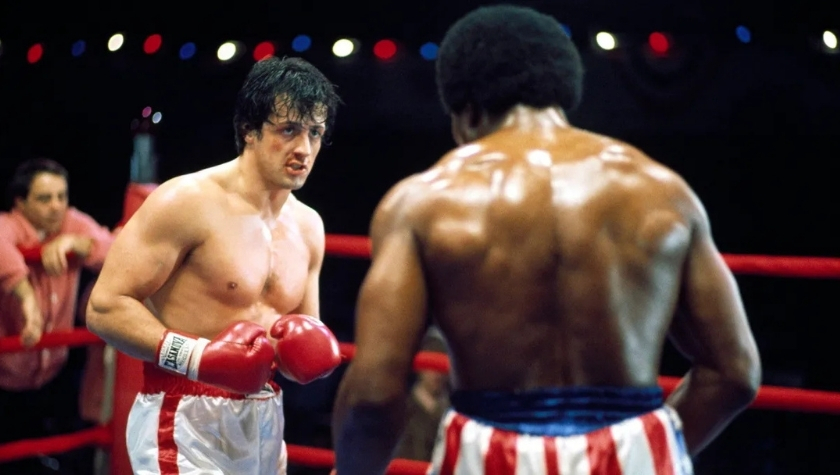
You can see all three priorities in the way Rocky frames violence as hard-earned, grounded punishment. Screenwriter Sylvestor Stallone writes the impact in plain language, then lets the accumulating damage do the dramatic work:
Rocky drops low and catches Apollo with a pair of terrific body punches.
A crack is heard. A glaze of pain covers Apollo’s eyes.
Notice what’s not there? No over-designed choreography. No flourish.
It’s cause-and-effect: hit, consequence, shift.
That’s the core craft principle: write the fight like story beats, not like a stunt list.
The Boxing Ring as Canvas
Boxing is the cleanest fight form for screenwriters because the “geography” is built in. The ring is a contained arena. The rules are simple. The rounds create natural escalation. This is why boxing scenes are such a great study in how a screenwriter can use the ring as a canvas.
In Rocky, Stallone’s writing favors blunt, sensory accumulation. The drama is in the endurance. His language stays simple, then spikes when something changes, like Apollo’s ribs breaking, or the moment the champion is suddenly forced into survival:
Blood is running from Apollo’s mouth… he continues to fight.
That line is doing more than describing gore. It’s telling you who Apollo is. He hides weakness. He refuses to give Rocky the satisfaction. The fight becomes psychological: survival, pride, image.
Rocky II leans harder into spectacle and momentum. Stallone frequently uses “another angle” framing, announcer-style commentary, and a sense of the fight being witnessed — not just experienced. It’s bigger, more performative, more mythic:
Apollo slams Rocky back into Rocky’s corner and begins to work him over.
Even the verb choice —“slams,” “work him over”— pushes you into a more heightened, arena-energy mode. It’s not just two men fighting; it’s an event for the ages.
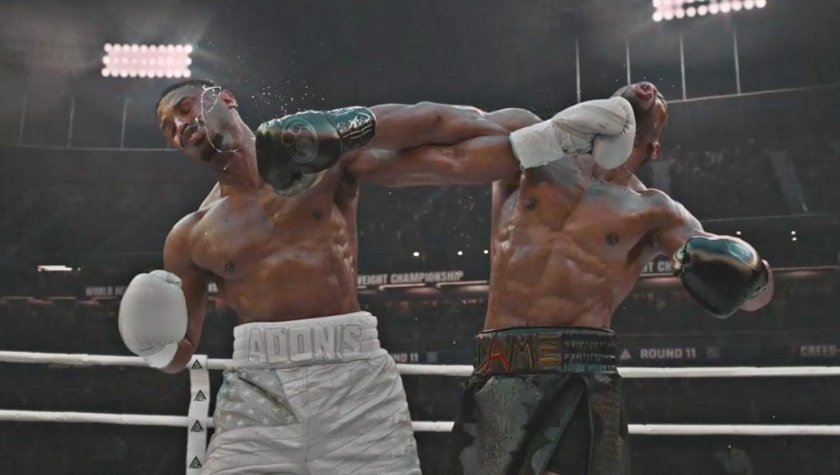
Kennan Coogler and Zach Baylin’s writing in Creed III builds on Stallone’s style, while tracking the characters’ inner struggle and being open to stylization:
When Dame forces Adonis into the ropes, expressing his anger with body blow after blow, we’re suddenly aware…
THE RING’S ROPES NOW APPEAR AS THE BARS OF A PRISON CELL.
Damian’s speaking with pain. Every punch is a cry. A moment of shame he’s endured. Pounding them into…
Adonis, who absorbs them, understanding their meaning.
This isn’t just a description of blows: it’s the culmination of the story. Two men — once close friends, now rivals — working out their issues in the ring.
Regardless of what kind of fight scene you’re writing, always take the emotional temperature.
East Meets West
Martial arts fights tend to tempt writers into over-choreography because the moves are inherently more “designed.” But the goal stays the same: clarity, escalation, character.
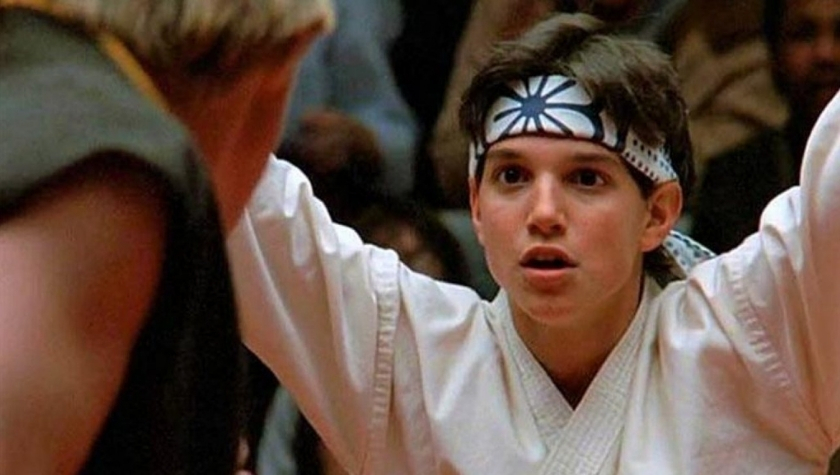
Robert Mark Kamen’s script for The Karate Kid maintains clear stakes and emotional through-lines. The All Valley final fight succeeds because of this: Daniel’s determination, Johnny’s pressure, Kreese’s menace, and the crowd’s energy is all part of the balance. The writing keeps you oriented while keeping the conflict personal:
Daniel throws two kicks, not taking his eyes off Johnny.
That’s not choreography. That’s subtext. It’s defiance, fear, focus, rivalry — compressed into a simple physical beat.
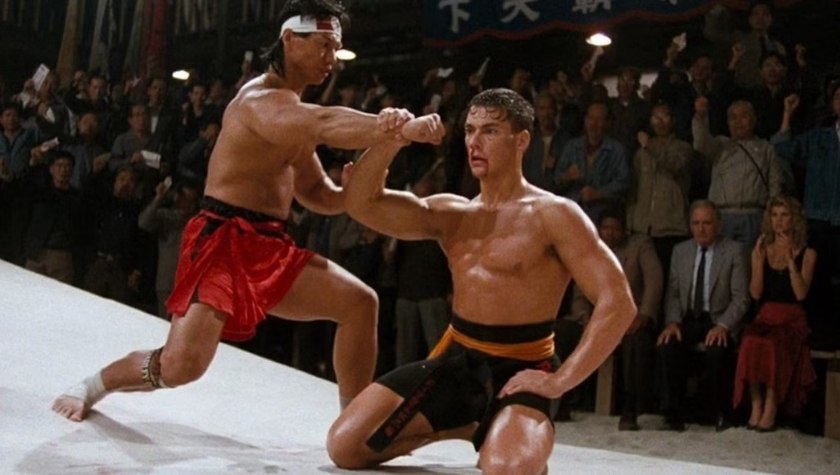
Bloodsport, written by Sheldon Lettich, Christopher Cosby and Mel Friedman, thrives on escalation. The final Frank Dux vs. Chong Li match is built like a ritual with “final boss”excitement. It’s not chaos. It’s a face-off with stakes and intimidation baked into the language:
The two finalists converge. Their eyes lock.
When Chong Li speaks, the threat is both personal and mythic:
CHONG LI
You break my records. Now I break you… like I break your friend.
Even the fight beats emphasize bold, readable action over intricate choreography:
He sprints up the roof… and plunges feet first toward Frank.
That’s how you write a fight scene that reads fast and easy: simple word choices, clear and direct action — while bolstered by mythic framing.
Even when the tone is lighter, the same rules apply: clarity and escalation. In the Rush Hour script, written by Ross LaManna and Jim Kouf, the set pieces are fueled by timing and contrast: one fighter improvising, the other panicking, the environment becoming the third combatant. The action and jokes always land cleanly:
Lee spins, disarms a gunman in one fluid motion.
Carter charges in behind him, tries to mimic the move —
— slips, crashes into a table, sending it splintering.
CARTER
I meant to do that!
The beat works because the cause-and-effect is precise. Lee’s competence creates the setup. Carter’s attempt creates the reversal. The environment amplifies the failure. The laugh doesn’t interrupt the fight — it escalates it. The rivalry sharpens. The energy never drops.
Super Charged Fighting
Whether it’s sci-fi, fantasy or absurdly postmodern, you might want to write fight scenes with super-powered characters: i.e. they’re superhuman and their moves defy earthly logic. The mistake writers make here is assuming that because the fight is heightened, the writing should be cluttered. Heightened fights still need clarity. In fact, they need more clarity to ground the fantastical elements.
The dojo fight in the Wachowskis’ The Matrix is a masterclass in clarity and escalation because it’s not just a fight — it’s a story argument. Morpheus is teaching. Neo is resisting. Every beat is about limitation vs possibility:
Neo… hurls himself at Morpheus.
Morpheus attacks him… taking Neo apart.
The escalation is internal as much as physical. Neo gets frustrated, then adapts, then finally lands something:
A single blow catches Morpheus… knocking off his glasses.
Simple. Visual. A clear “turn.” The reader feels the shift instantly.
Similarly, Thor: Ragnarok, written by Eric Pearson, Craig Kyle and Christopher L. Yost, favors simplicity when detailing the action. The Thor vs. Hulk arena fight reads with broad strokes, but the beats are still clean and escalating. You can track the action because the verbs are big and visual (“whipping,” “pummeling,” “launching”):
Hulk… is whipping him against the arena floor. Over and over and over again.
Then the fight pivots into a mythic “power reveal” moment — vision, electricity, burst:
His eyes glow white with electricity… Thor… knocks Hulk back with a burst of lightning.
That’s how you write comic-book action without drowning the reader: big readable beats with clean through-lines and clear turning points.
Even when it’s a massive fight with numerous, super-powered combatants going at it, a concise through-line with a focus character at the center will guide readers smoothly through the chaos.
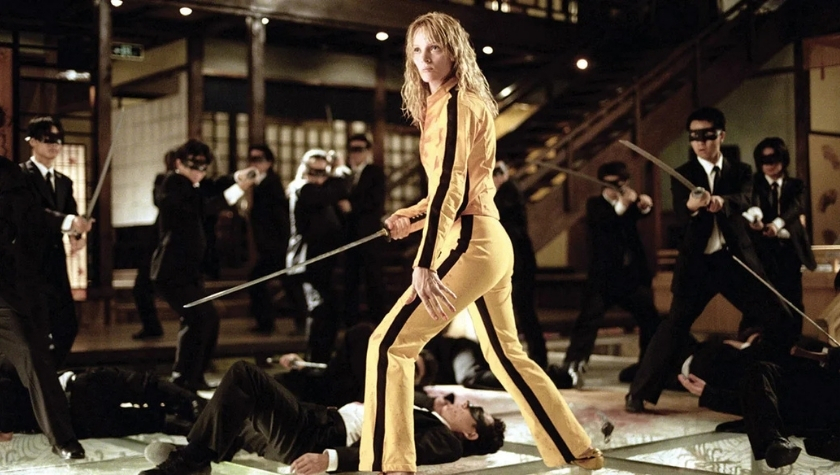
Look at how Tarantino leads us through one of the biggest set pieces in Kill Bill: Vol. I when the Bride takes on the Crazy 88:
The BRIDE
Inside the circle of combatants who surrounded her. She whips the sword out of the floor and raises her blade diagonally in front of her. Her eyes are reflected in the shiny steel.
Holding her sword in the diagonal position, The Bride can see reflected in the shiny blade, whoever stands behind her.
The six Crazy 88 Attack…
The BRIDE
does a Zatoichi-like SWISH-SLASH-SWISH with her steel blade.
Despite the numerous opponents involved and over-the-top nature of the fight, Tarantino gives us clear images and geography to follow. Every frame of the scene is visualized swiftly and concisely.
Don’t Lose Your Characters in the Fight
You might’ve noticed a running theme here: don’t lose your characters in the fight. This is a good mindset for a screenwriter to have in general. A fight scene is still a scene. In other words, it’s your protagonist’s story and every scene should be revealing who they are and how they feel about what’s happening — whether it’s drama or fisticuffs.
Take the script for Road House, written by R. Lance Hill and Hilary Henkin, where every fight is a character philosophy test. Every time he throws down, Dalton’s identity manifests in his approach to violence:
Nothing lands, Dalton’s reflexes quicker and movements smoother, more flowing and natural, beginning to break James’s balance at will, subtly pushing him, pulling, trapping him off balance. By martial arts standards this is a protracted fight, but only because Dalton dictates it so.
This is character. A thesis statement. Physical conflict as a worldview.
This is even more the case with Robert Siegel’s script for The Wrestler. During one of its many emotional scenes, Randy “The Ram” Robinson says he’s “a broken down piece of meat.” However, this doesn’t stop him from giving 100% when he wrestles for his public:
Randy hits Kid Loco with everything he’s got. Dropkicks. Elbows. Bodyslams. He pours it on, unstoppable.
The fight scenes are written with technical detail and knowhow, but Randy is never lost in the description: he’s always there, pushing himself to the limit.
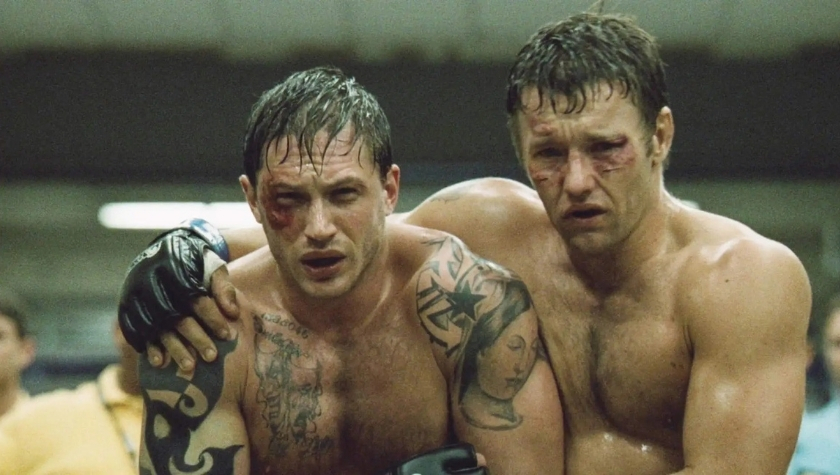
This character-driven approach to a fight scene also hits powerfully in Warrior, written by Gavin O’Connor, Anthony Tambakis and Cliff Dorfman, where the climax is about emotional submission, not physical dominance. The violence in the final Brendan vs. Tommy fight is inseparable from love, guilt, and pleading. The key beats are written as desperate emotion amid physical action:
As an anguished Tess and a shaken Paddy look on, Brendan CHOKES his brother. As he does, he pleads with him.
BRENDAN
I’m sorry, Tommy! I’m sorry!
Tommy continues to struggle.
BRENDAN
Tap, Tommy! Tap!
Tears pour down Tommy’s face. Brendan is crushing his wind pipe. Tommy’s eyes bulge.
BRENDAN
I love you, Tommy! I love you!
Tommy, about to pass out, no more air to breathe, slowly opens his left hand, looks at Brendan, and TAPS his shoulder on the Conlon family crest. Finally submitting.
A fight scene doesn’t become memorable because of the “moves.”
It becomes memorable because of what the moves cost or accomplish.
And the Winner Is…
If you want to write a great fight scene, write it like any part of your story.
Keep it readable. Keep it escalating. Keep it visual. Keep it tied to character goals — external and internal — so every punch is doing narrative work.
Use the ring when you want structure. Use martial arts when you want designed contrast and mythic ritual. Use stylized spectacle if your script demands it. But no matter the approach, don’t lose your characters inside the violence. From their first fight to the big, climactic throwdown, we should be following the protagonist on their journey.
Because the best fight scenes aren’t about choreography.
They’re about what’s at stake for your characters.