
In my article, "Writing Across Formats", I discussed the advantages of diversifying your projects. If you limit yourself to only writing screenplays, you’re limiting your opportunities and your own creative development. When you write in a different medium, it develops a different storytelling muscle, and the writers who work across formats tend to return to the screenplay sharper, more nuanced, and with an artistic range that shows on the page.
One of the best examples of this is iconic filmmaker and Oscar-winning screenwriter Quentin Tarantino.
Noted mostly as a director and screenwriter, Tarantino has, in recent years, been consistently writing across formats. And not just as a filmmaker dabbling in other mediums for fun, but as a professional who takes each project seriously on its own terms. In addition to his films, Tarantino has written comic books, novels, film criticism, plays, and even co-hosts a podcast. Each project is given the same focus and dedication he brings to his screenwriting and directing, and some of these side projects are on their way to becoming movies.
The Django/Zorro Comic Book and Sony Deal
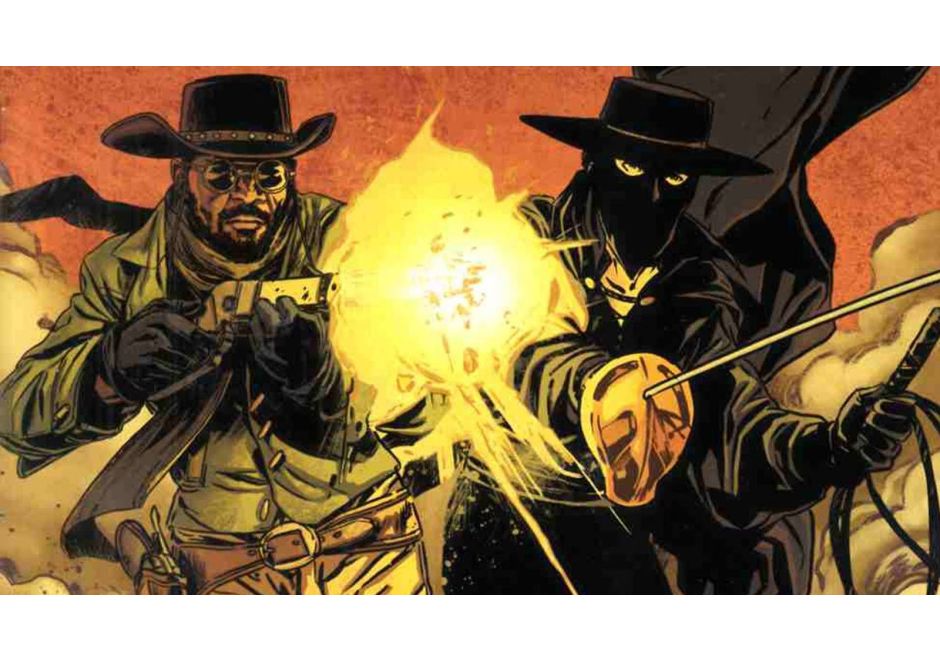
Sony Pictures recently hired Oscar-winning scribe Brian Helgeland (L.A. Confidential, Mystic River) to write a feature film based on Django/Zorro: a seven-issue crossover comic book series that Tarantino co-wrote with Eisner Award-nominated creator Matt Wagner. The comic served as a sequel to Django Unchained, following bounty hunter Django Freeman as he develops a kinship with the aging Don Diego de la Vega: Zorro himself. Tarantino won’t direct the film, but it carries his blessing and is moving forward at Sony.
Many times, a movie is more likely to be produced if it’s based on an established IP (intellectual property). Whether it’s a comic book, novel, or video game, it can serve as a “proof of concept” and lead a production company or studio to invest in the project. Despite Tarantino and Jamie Foxx both publicly expressing interest in him reprising his role as “Django” — and in seeing Antonio Banderas reprising his role as Zorro — the chances of this film being made looked slim. But now, the Django/Zorro comic series has generated real momentum toward a film adaptation, and it's in active development with a screenwriter attached and a major studio behind it.
So Tarantino didn’t just flex his creative muscle by co-writing a comic book series; he created a viable IP that resulted in a movie being produced. And being a visual medium, comic books often make for successful film adaptations (one of the reasons so many are made).
The Novelization
The comic book collaboration wasn’t Tarantino’s only excursion outside of screenwriting.
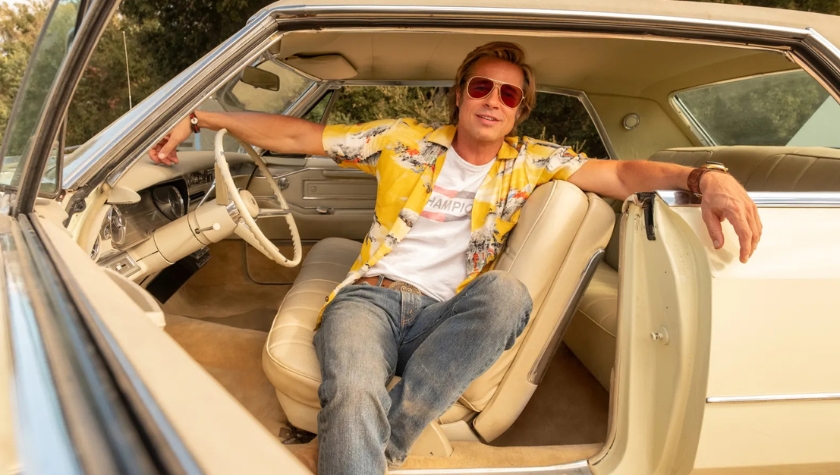
After the release and success of Once Upon a Time... in Hollywood, he did something very few filmmakers have ever done: he wrote a novelization of his own film. Not a straightforward prose translation of the screenplay, but a genuine expansion of it, pulling from years of character research, backstory, and material he always knew would never make it into the movie itself.
During the five or six years Tarantino spent writing the screenplay, he kept generating material destined for the editing-room floor (if ever filmed at all). He needed to know about the history of his characters, even if the audience never would. Tarantino explained to Deadline that after deciding to write a novelization, Once Upon a Time... in Hollywood made the most sense: “I have all this stuff and I was like, 'Whoa, this is definitely the one to do.’”
Released well after the movie’s theatrical run, the novelization wasn’t a tie-in product; it exists as a standalone piece of fiction that offers readers a richer and stranger version of the story than the film alone could convey. As a novel, it allowed for deeper dives into Cliff Booth’s wartime history and moral ambiguity, the full mythology of Rick Dalton’s career, and an expanded portrait of Sharon Tate’s world. Readers who loved the movie found an entirely different experience waiting for them on the page.
That’s what a novel can do that a screenplay can’t: present a fuller and expanded world. Writing a novel not only helps you with your prose, but it also helps you with your worldbuilding. Tarantino, whose films always present fully defined characters and worlds, understands this.
Film Criticism
He followed the Once Upon a Time... novel with ‘Cinema Speculation’: a nonfiction work of film criticism and personal memoir built around his movie-going education as a child in the early 1970s. This was an entirely different kind of writing challenge; not storytelling, but critical thinking committed to the page. Tarantino had previously written online reviews for films being shown at his New Beverly Cinema theater, but ‘Cinema Speculation’ was his first time writing an entire book of criticism
Part analytical essay, part coming-of-age story, the book examines the films that formed him — Deliverance, The Getaway, Taxi Driver, Rolling Thunder — not just as cinematic touchstones but as lived experiences. Films he saw with his mother at age seven. Films that shaped his sense of how people talk, how violence lands, and how stories can end without resolution. He described the project simply to Deadline: “I set out to do a bunch of analysis for movies and ended up telling you a little bit of my life story.” The distinction between the two, it turned out, was minimal.
Writing seriously about movies forces you to articulate why they work or don’t, which is a different mental exercise than simply watching them. Imagine a racecar driver who doesn’t know how a car engine operates or a geneticist without knowledge of DNA. A screenwriter who can’t explain why he loves or hates a certain movie isn’t any different. Whether reading it or writing it like Tarantino, film criticism is a great way to deepen your understanding of your craft.
And Now… Theater
Tarantino has taken the medium-jumping even further by entering the world of theater.
The Popinjay Cavalier is a play that Tarantino wrote and plans to direct in the future. It’s described as a swashbuckling comedy set in 1830s Europe, produced by Sonia Friedman Productions and Sony Pictures Entertainment, with a West End premiere planned for early 2027. He’s already said publicly that if the play succeeds, it may become the basis for his tenth and final film as a director.
So, Tarantino might be developing his final movie through a stage production first: the same path David Mamet and Aaron Sorkin walked before translating their theatrical work to the screen. Stage writing strips away every cinematic crutch and forces your characters to earn the scene through dialogue alone. If The Popinjay Cavalier becomes Tarantino’s last film, it will have been tested in the most unforgiving medium available before a single frame is shot.
The Podcast
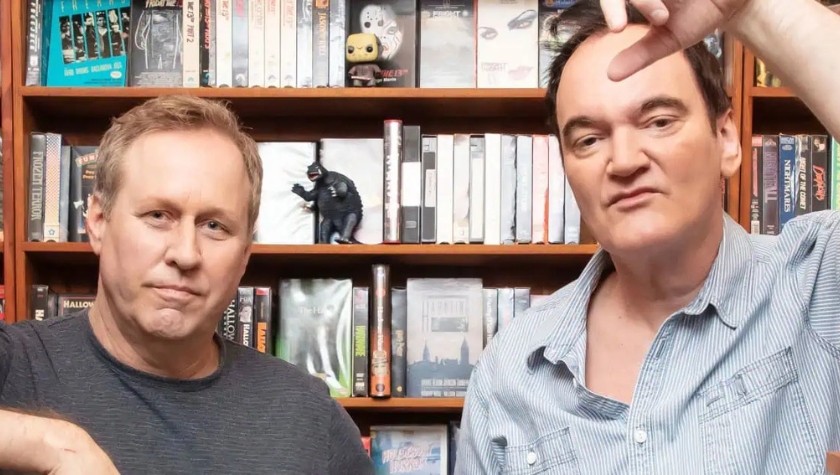
If all that wasn’t enough, Tarantino also launched The Video Archives Podcast with his longtime friend and Pulp Fiction co-writer Roger Avary. The show is built around the collection of VHS tapes and DVDs from the long-closed Manhattan Beach video store.
The Video Archives is where Tarantino and Avary both met and worked in their early twenties, the same store that served as the unofficial film school for both of their careers. The podcast is informal, conversational, and enthusiast-driven. It’s also a real creative output: a different kind of public voice that keeps Tarantino’s ideas about cinema alive and circulating in a format that reaches a potentially different audience than his films or books do.
In the same way, creating YouTube videos can help you develop a unique voice as a screenwriter, and podcasting can likewise. Also, similarly to writing film criticism, it can sharpen your insights about your craft.
He Never Stopped Writing Screenplays
And what’s most impressive is that, while working across all these different media, Tarantino kept doing what he’s best known for: penning screenplays.
Tarantino wrote The Adventures of Cliff Booth — the Once Upon a Time... in Hollywood follow-up— produced by Netflix, directed by David Fincher, and with Brad Pitt reprising his Oscar-winning role. Tarantino chose not to direct it, explaining to The Hollywood Reporter he needed to find “uncharted territory” for his final directorial project.
Still, it is a Tarantino-written screenplay, and it further expands Cliff Booth’s world (in the same way, the Once Upon a Time... in Hollywood novelization did).
He also wrote the screenplay for The Movie Critic. The unproduced script is set in 1977 California and is loosely based on a real figure who wrote film reviews for an adult magazine. The project came very close to being produced with Brad Pitt attached to star, but Tarantino ultimately pulled the plug on it (deciding it wasn't the best choice for his final film). Nonetheless, The Movie Critic was written, demonstrating that even while working across a plethora of formats, the man was still generating original feature screenplays.
His final film as a director is still coming. Whatever form it takes, it will be written by someone who has spent the last several years feeding his imagination from every direction possible.
It All Shows Up On Screen
None of the above medium exploration should be surprising: Tarantino’s films have always drawn from a wider range of sources than cinema alone.
His comic book sensibility surfaces in the visual flash of his action sequences and in the panel-like precision of how he frames a scene’s information. His novelistic instincts show in the density of character mythology and structural fluency, never built on conventional three-act thinking. His love of grindhouse cinema, spaghetti westerns, blaxploitation, and martial arts films — genres he absorbed obsessively through the Video Archives collection — is reflected in his many homages and hefty grab bag of influences. And his dialogue carries the rhythm and nuance of stage writing.
The overall result is a body of work that feels much fuller and more imaginative than screenwriting that springs solely from Hollywood movies.
Diversifying Improves Your Writing
Diversifying your creative projects deepens your investment in screenwriting rather than distracts from it. Graphic storytelling clarifies your visual language. Prose teaches you how to enhance your worldbuilding and expand your narrative framework. Film criticism increases your screenwriting knowledge. Writing for the stage improves your dialogue and character work. And even less directly-connected formats, like podcasting, can help you develop your voice.
Pushing your own creativity into unfamiliar territory — much as Quentin Tarantino has — won’t just make you become a more versatile screenwriter.
It’ll make you a better one.