
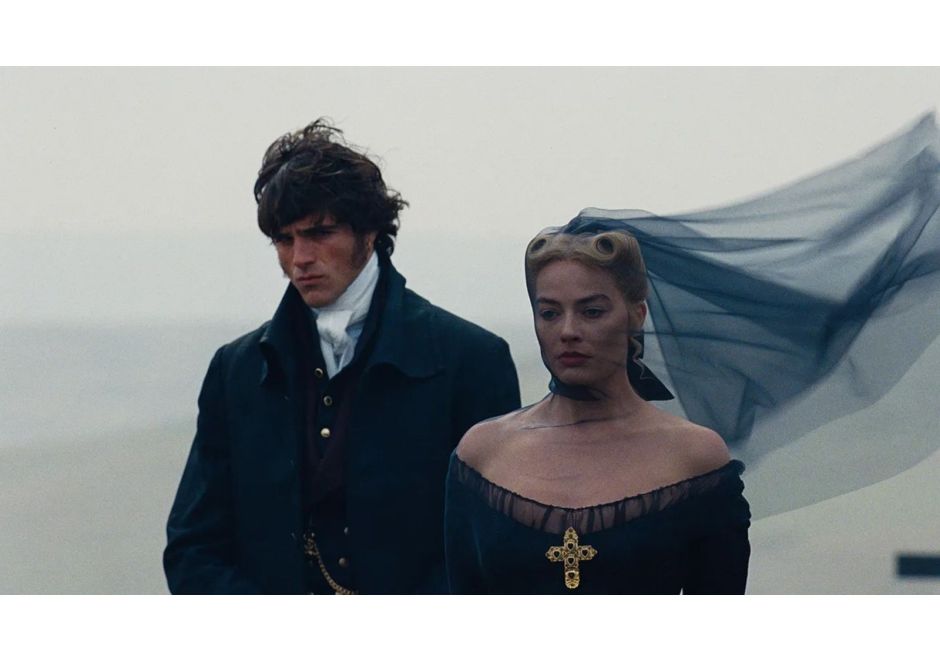
With the Valentine’s Day release of Emerald Fennell’s Wuthering Heights (2026), romantic 19th century writer Emily Bronte will be box office business almost 200 years after her death. She and her sisters, Charlotte and Anne, are responsible for writing some of the most enduring romantic novels of modern history, and repeated cinematic adaptations of their work have much to do with their lasting legacy.
But Hollywood’s love affair with period romance extends far beyond these prodigal sisters. Since its inception, cinema has been used to translate 19th century romantic literature to the big screen, from Jane Austen to Thomas Hardy to Leo Tolstoy and the Brontes. The headstrong protagonists, deep sense of longing and love, unrequited and otherwise, and sumptuous costumes and settings, make these classic stories timeless and eternally ripe for big screen treatments. The steamy, starry new adaptation of Wuthering proves that this subgenre remains as alluring to contemporary audiences as ever.
Here are 8 essential 21st century adaptations of 19th century romance novels.
'Vanity Fair' (2004)
To be exact, William Makepeace Thackeray’s Vanity Fair, published as a serial between 1847 and 1848, is not a romance novel, but a biting satire of 19th century British society. The 2004 film adaptation from director Mira Nair, however, sands down the cynical edges of the original, for better or worse, and indulges in many of the pleasures of lush period romance films. Reese Witherspoon plays social climber Becky Sharp, one of the great literary characters, but in a lighter, more likable mold than other adaptations. Nair lends some Bollywood-esque visual flourishes, amplifying the novel’s Indian colonialist themes, and though lovers of the book may find fault in the toned down satire and newly invented ending, Nair’s distinct point of view, stylistic flair and colorful period costumes and production design make the film a visual feast to delight in these two decades after its initial release.
'Pride & Prejudice' (2005)
Jane Austen’s novels are some of the most adapted in movie history and the wildly popular author will make several more appearances on this list. Her 1813 novel, Pride and Prejudice, in particular, has served as the basis for a wide variety of 21st century films, including the hilarious modern day adaptations, Bridget Jones’s Diary (2001) and Gurinder Chadha’s Bollywood-style musical, Bride & Prejudice (2004). Perhaps the most popular adaptation, however, is Joe Wright’s 2005 version starring Keira Knightley as Elizabeth Bennett and Matthew Macfadyen as Mr. Darcy. Future stars Rosamund Pike and Carey Mulligan help round out the Bennett family, with the late great Donald Sutherland as an unforgettable Mr. Bennett, and Wright’s golden hour English location photography is like a warm blanket for Austen fans. The film was a box office hit that earned 4 Academy Award nominations, and recently sent fans flocking back to cinemas during a 20th anniversary re-release, proving its enduring appeal.
'Jane Eyre' (2011)
Charlotte Bronte’s Jane Eyre, published in 1847, is one of the most adapted books of all time, including a wonderfully gothic 1943 version starring Orson Welles and Joan Fontaine. The definitive recent film adaptation is Cary Joji Fukunaga’s 2011 adaptation, which was designed and shot with meticulous, moody period detail, garnering an Academy Award nomination for the costumes. But it’s the lead actors, budding stars Mia Wasikowska as Eyre and Michael Fassbender as the brooding Rochester, that most bring the film and its complex central relationship to life. Jane Eyre received warm critical plaudits upon release and wound up on several year-end best lists, making it the most resonant recent screen adaptation of the great Bronte novel.
'Anna Karenina' (2012)
After the success of Pride and its Oscar-nominated follow-up Atonement (2007), Joe Wright and Keira Knightley reteamed a third time, returning to 19th century literature for a 2012 adaptation of Leo Tolstoy’s 1878 novel, Anna Karenina. Knightley plays the tragic heroine whose passionate love for Aaron Taylor-Johnson’s Count Vronsky leads to her undoing. The film received four craft Oscar nominations owing partly to Wright’s bold method of framing the film’s story in a rustic theater space, and won for its costumes. The stylized staging and Tom Stoppard screenplay make for an unforgettable cinematic experience, and while Wright and Knightley have continued to excel on their own, after making three classic literary adaptations together, fans are no doubt hoping for the period romance dream team to reunite.
'Far From The Madding Crowd' (2015)
Prior to writing and directing the Oscar-winning Another Round (2020), Danish filmmaker Thomas Vinterberg directed one of the great underseen period romance films, adapting Thomas Hardy’s 1874 novel, Far From The Madding Crowd (2015). While the book had been famously adapted by John Schlesinger in 1967 with Julie Christie as the fiercely independent lead, Vinterberg’s lush, naturally lit location photography and the sizzling longing between Carey Mulligan’s Bathsheba and Matthias Schoenaerts’ lovesick farmer, Gabriel, make this modern version a stirring revision. The film didn’t receive the box office and accolades of its contemporaries, but it remains a gorgeous gem to be rediscovered by fans of the genre.
'Love & Friendship' (2016)
American independent filmmaker Whit Stillman became known in the 1990s for his witty comedies of manners, like Metropolitan (1990) and Barcelona (1994), so it should’ve come as no surprise when he took so naturally to adapting Jane Austen for 2016’s Love & Friendship. Though written in 1794, Austen’s novel, Lady Susan, was published posthumously in 1871, and follows the calculating title character, played to perfection here by a career-best Kate Beckinsale, as she schemes to find wealthy husbands for her and her daughter. Stillman applies his famed wry dialogue bonafides to Austen’s romantic satire of high society and it’s a match made in heaven. The film was a minor hit after its Sundance premiere and its reputation has only grown with time.
'Emma.' (2020)
Right beside Lady Susan in Austen’s gallery of meddlesome, headstrong women, is the titular protagonist of Emma, published in 1816. While the book has inspired adaptations as varied as the teen comedy classic Clueless (1995) and the following year’s Gwyneth Paltrow-starrer, Emma (1996), photographer-turned-filmmaker Autumn de Wilde’s debut feature, Emma. (2020) is perhaps the best to date. Featuring an all-star cast lead by Anya Taylor-Joy and an ensemble that includes future stars Mia Goth, Josh O’Connor and Callum Turner, and a stand-out Bill Nighy as Mr. Woodhouse, de Wilde’s film is expertly measured, equal parts shrewd and romantic, and styled to perfection with her photographer’s eye. While it snuck in a short theatrical run just before the Covid-19 shut-down, Emma. deserves rediscovery, and is one of the finest period romances of this decade.
'Wuthering Heights' (2026)
While Emily Bronte’s 1847 classic Wuthering Heights has been adapted many times, notably by William Wyler in a beautiful 1939 treatment starring Laurence Olivier, and more recently in 2011 under the stripped down, earthy direction of Andrea Arnold, it’s safe to say it’s never been done like Emerald Fennell. After her first two provocative satires, Promising Young Woman (2020) and Saltburn (2023), the Oscar-winner returns with her biggest budget and stars yet. Margot Robbie and Jacob Elordi play the tragic central lovers in a gigantic, lurid adaptation scored by a Charli XCX soundtrack. Fennell’s Wuthering Heights promises to be one of the most talked about films of the year, and a fierce confirmation that big screen reimaginings of these two-century old romance stories are as resonant as ever.