
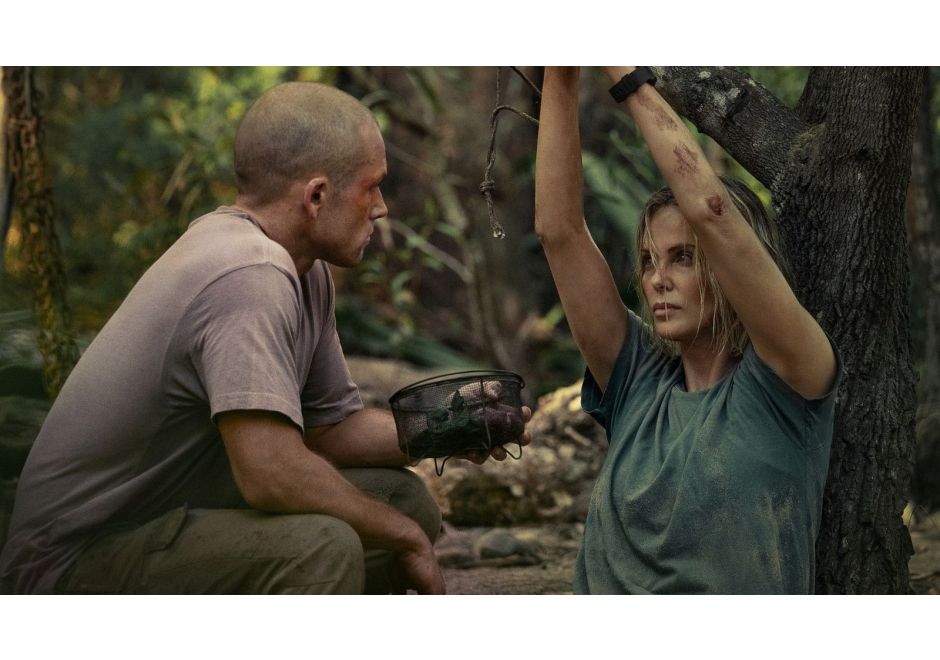
If you love survival stories as much as we do, you’re in for a treat with Apex, a new thriller starring Charlize Theron and Taron Egerton.
The story centers on recently widowed Sasha (Theron), whose daredevil sense of adventure tests all human limits. What she might call daring borders into danger when she attempts a solo trek deep in the caves of Australia’s Blue Mountains. Little does she know she’s about to come face to face with a serial killer, Ben (Taron Egerton), whose homemade beef jerky isn’t FDA approved. We sat down with the writer, Jeremy Robbins, to find out more about crafting both predator and prey in this deadly game set in the Outback.
For screenwriter Jeremy Robbins, the trek to his first produced feature was a slow grind, not unlike the grueling climb his protagonist endures when the film begins on the side of a steep mountain in Norway. After going to film school at Columbia University, Robbins built a steady career in television over eight years, including writing on USA Network’s The Purge. Then the pandemic hit.
“Much of the TV stuff that I was doing got shut down, the room that I was in didn't reopen. The TV stuff I had been developing, we didn't take out. I was sort of at this place where I was standing in this room, wondering, what do I want to write when no one's asking for it? When no one's telling me to write it, it's not a rewrite for somebody else, it's not for a showrunner?”
The answer led him back to the stories he had always loved growing up which were survival thrillers. Stories about endurance, about pushing past the breaking point, about what it means to stay alive when everything is working against you. That instinct became Apex, about a rock climber who finds herself hunted in the wilderness, forced to rely on her skill, instincts, and grit to survive.

“I was just writing something that I loved,” Robbins says. “I was writing the kind of movie that I really wanted to see.”
For most of us during the Covid lockdown, the world seemed like a scary place. As Robbins watched loss unfold on the news, he tried to see the positive side of those who survived. “There is something about that kind of resilience that is really hopeful,” he says.
The idea for Apex first came to him as a simple image. Robbins remembers pitching the opening scene to his wife while they were on vacation: A man and woman inside a tent. The zipper opens, and instead of stepping onto solid ground, they’re suspended on the side of a mountain. It’s a shocking visual that immediately communicates danger. His wife encouraged him to write it, and over the course of the pandemic, Apex became his focus.
After finishing the script, Robbins moved into attaching producers and exploring different versions of the project. There were moments of momentum, including interest from actors and directors, but nothing stuck.
“It was kind of on a slow train to nowhere,” he says.
Then something unexpected happened. After stepping away from Apex for nearly a year, writing other material and gaining distance, he returned to it with a clarity that had been impossible while he was working on it every day.
“I had so much perspective that you never get when you’re working on a script,” he says.
That distance proved invaluable. Instead of second-guessing, Robbins knew exactly what the story needed. The rewrite he delivered from that place of clarity became the version that finally moved forward, eventually landing in front of Charlize Theron and director Baltasar Kormákur. That time away from the script allowed his brain to come back to it with a new perspective.
Robbins grew particularly interested in the psychology of the kind of person whose relationship to fear is fundamentally different from the rest of us. He really pushed his character Sasha to the edge in her need for danger. But that also meant he needed to push his antagonist to the extreme as well.
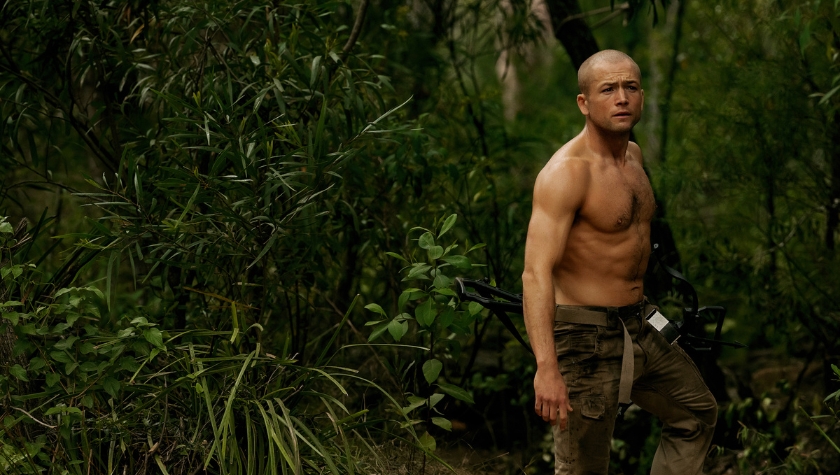
He saw Sasha and her predator, Ben (Egerton), not as opposites, but as reflections of each other. “With one little turn, you go from hero to villain and it's really hard to tell the difference sometimes. I really see Sasha and Ben as two sides of the same coin, and if you just move a little bit to the left, you end up as Ben, and a little bit to the right, you end up as Sasha, and that kind of psychology. Someone who's pushing the limits beyond what you and I can understand, but to them is normal, where is that line? What was so exciting to me about that character, was that she doesn't really know where that line is and she's trying to find it.”
In other words, Ben isn’t just a threat, he’s an extreme version of Sasha’s own philosophy. To survive, she must briefly become like him, then reject that path. It makes for an incredibly satisfying battle of wits and brawn.
Throughout the script, Robbins leans heavily on action rather than exposition or dialogue. Instead of explaining Sasha’s emotional state, particularly her grief over her recently deceased husband, he lets the audience understand her through what she does, what she endures, and how she responds under pressure.

“How can we learn about this person through what she does?” he says. It’s a question that sits at the heart of great action writing.
Rather than treating Ben as a traditional serial killer, Robbins approached him as a fully realized character with his own logic and worldview. “I wanted to treat him as if he’s the hero of his own story,” he says. By stripping away the label and focusing on motivation, Robbins created a character who feels even more dangerous because he believes what he’s doing is just.
But perhaps the biggest lesson that Robbins took from Apex had nothing to do with character or genre tropes. It was about instinct.
“If I had asked people permission to write this movie, I’m sure they would have given me 100 reasons not to,” he says.
Instead, he trusted his own taste. He wrote the movie he wanted to watch, and he created something that resonated beyond the page. It’s a reminder that the work that breaks through is often the work that starts as something personal. Something you would write even if no one were asking for it.
Apex streams on Netflix April 24.