
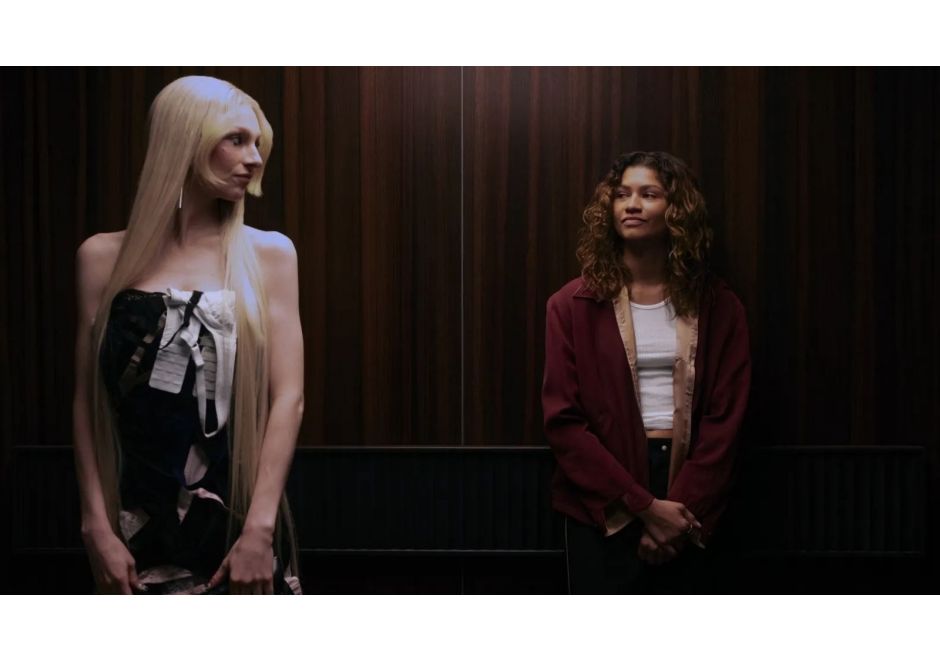
Last Sunday, HBO’s Euphoria wrapped its third and final season. The season’s pivot from high school psychological drama to a Tarantino-esque crime drama steeped in Western iconography, drug cartel violence, and overt biblical references puzzled many fans who expected more of the same.
But if you step back and examine what series creator Sam Levinson constructed across these eight episodes, an ambitious and coherent tapestry comes into focus. Levinson expanded the canvas he was working with by using bedrock stories in our culture — both biblical tales and frontier myths — to make a statement about where America is today, especially regarding addiction issues.
A Deeply Biblical Season
The season announced its intentions with the following logline: “A group of childhood friends wrestle with the virtue of faith, the possibility of redemption, and the problem of evil.” Episode titles referenced scripture and the Western genre in the same breath: “The Ballad of Paladin,” “Stand Still and See,” “In God We Trust.” Actress Sydney Sweeney, who plays Cassie, said in pre-season press: “It’s about God.” Underlining this is Rue’s concluding voice-over and a shot of the American flag and Texas homestead: “May God bless us all.” And the religious references weren’t an ironic or provocative ploy from Levinson. The entire story is built around this framework.
The Bible isn’t a superficial presence in Season 3: the book itself is read, discussed, and passed between characters. Rue (Zendaya) discusses it with Lexi (Maude Apatow) and leaves her copy at Lexi’s apartment. By the finale, Lexi is working through it herself and searching for meaning, despite her initial cynicism. “In the Bible, everyone's dying of all different things,” she says. “They just keep going, and that’s the beautiful part.” She could very well be describing Season 3.
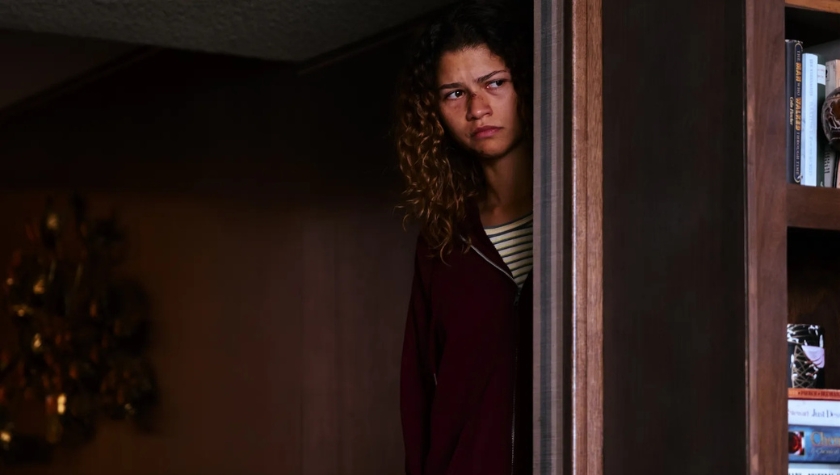
Rue’s arc is the most structurally biblical. Five years after Season 2, she’s living on the border, working off a debt to drug lord Laurie (Martha Kelly) as a mule: enslaved to a system of addiction and obligation she cannot exit cleanly. The entire season is an Exodus narrative. Levinson makes this explicit in Episode 6, “Stand Still and See” — a title drawn from Moses calming the Israelites as Pharaoh’s army closes in — when Rue, having survived another near-death situation, stares at a burning bush. God spoke to Moses before freedom could come. Rue is standing in that same place, caught between the danger she has just survived and the Red Sea she still has to cross. The vision isn’t presented ironically; it’s real, or at least real to Rue.
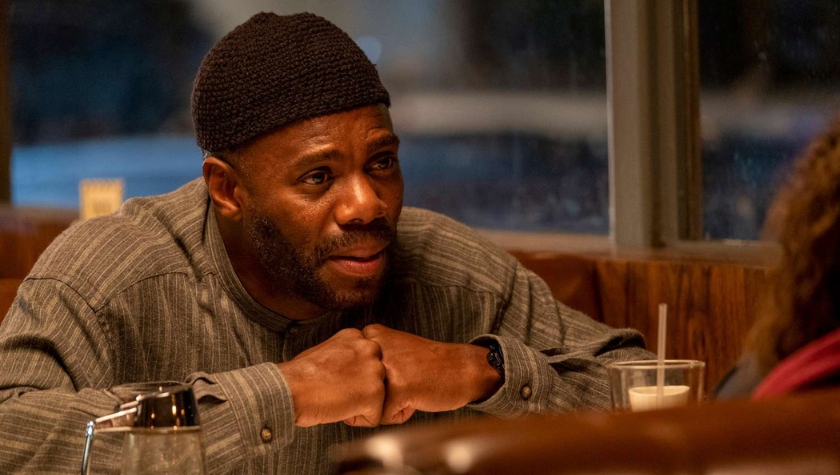
One of Rue’s last scenes in the finale depicts a dream or hallucination in which Rue sees herself coming home to her mother, Leslie, who is reading the Bible. Rue reaches out to this vision as we hear the Book of Genesis audiobook playing in the real world (Rue’s replacement for the physical Bible she left at Lexi’s). Levinson treats this pivotal moment as a homecoming and rebirth after a fall. When Rue is seen again — smiling angelically at her sponsor, Ali played by Colman Domingo — it’s after a prayer at a Christian family’s home where she briefly found peace in her life.
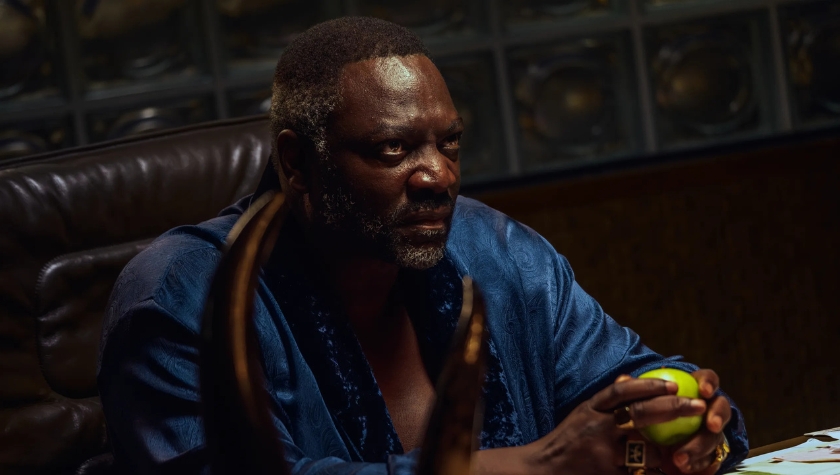
But before this rebirth, Rue must travel through sin, as all the characters do throughout the season. A strip club named the Silver Slipper is the focal location — the proverbial “den of sins”— and its proprietor is a fallen angel. Alamo Brown (played wonderfully by Adewale Akinnuoye-Agbaje) is a corrupting presence and influence, but one who has fallen from grace. In a flashback sequence, Alamo is shown as an innocent young man who took the wrong path after his mother coldly abandoned a good man and father figure. As a result, Alamo grew up to be a strip club magnate and drug kingpin, and the central antagonist of Season 3. From Alamo’s snakeskin Speedo to a literal serpent taking the life of one of the main characters, Levinson’s meditation on sin is clear: every character is susceptible to it. Alamo knows this — a believer of God despite his transgressions — and exploits it. Our flesh and souls become a commodity.
Cassie (Sydney Sweeney), who married Nate (Jacob Elordi) five years after high school, is also working in the sex industry. Much has been made in the media of her OnlyFans plotline, but little has been written about the satire and symbolism behind it. Cassie is likewise a slave of sorts to Maddy (Alexa Demie). Once a high school friend and rival, Maddy becomes Cassie’s fixer and de facto handler throughout the season. The finale reveals that Cassie has turned the home she shared with her husband into an OnlyFans content house. Maddy is positioned as the house’s “madame” and is essentially transformed into an Alamo Brown in her own right. Once again, flesh and souls become a commodity. Will Maddy and Cassie find salvation?
Cassie’s last scene shows her grieving before a camera ringed by a halo of light. Fittingly, this is after her sister Lexi discussed the Bible with her, as well as Rue’s fate. Cassie talks of Rue’s smile — the very one we see at the end of the episode — and how seeing a smile can inspire you to smile. Grace can touch us and transform us. Perhaps this suggests future redemption?
Regardless, Levinson is challenging us to contemplate such things, and also to explore the myths at the core of America: the Old West and divine providence.
Old West Meets New West
If the soul of Season 3 is a biblical story, its flesh is undeniably a Western. From horse chases through the desert to a final gun duel at the Silver Slipper (a modern stand-in for a Western-style “cathouse”), you’re likely to think more of spaghetti western director Sergio Leone than the first two seasons of the series. An entirely different aesthetic, Levinson transformed the series into a Nuevo Spaghetti Western, which has baffled some fans and critics. But for the headier themes Levinson was tackling, the Western makes for a perfect framework. America is now the Wild West yet again, and the returning characters — now thrust into this landscape as adults — have to navigate it.
Alamo Brown, at one point referred to as a “black cowboy,” is at the center of this Euphoria as Western conceit. Levinson modeled him on the great Western villain archetypes: an outlaw operating on pure frontier morality. The strong take what they want, and violence enforces the social order. His place of business, the Silver Stripper, is nestled in the heart of the Mojave Desert (the Central Valley of California and a place where people go to transgress or transcend). From his cowboy hat to his pervading ethos, Alamo knowingly evokes the Old West. He drew a parallel between how things were and how they are now, and constructed an entire world around it. Levinson likewise knowingly reconstructs mythology: if you’re going to examine America, what better way than via the Western?
Of course, for every “black hat,” there needs to be a “white hat.” Rue’s sponsor, Ali (Colman Domingo), stands firmly between the biblical and Western themes of the season, functioning as both the white hat and a Job figure: a man of hard-won righteousness who loses the person he was trying to protect, descends into a crisis of faith, briefly relapses, confesses at a meeting, and then commits the defining act of the season. The climax of the finale has Ali arriving at the Silver Slipper in his Marine Corps uniform in an act of vengeance. He’s declaring himself an instrument of justice: Old Testament and frontier style. Ali and Alamo face off in a gunslinger duel. Good versus evil. A story as old as David and Goliath or High Noon.
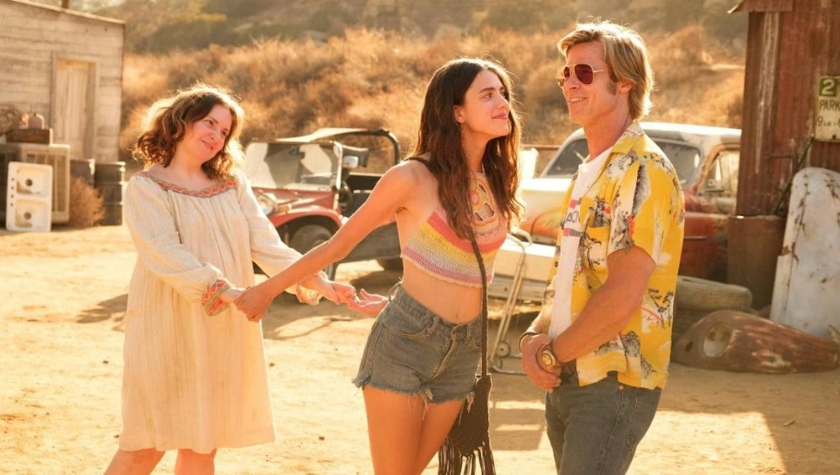
And Levinson doesn’t simply replicate the Old West in Season 3; he recontextualizes it much like Quentin Tarantino did with Once Upon a Time… in Hollywood. That film took place in 1969, but used Western iconography throughout — a cowboy actor, a showdown at Spahn Ranch — and contrasted it with the “hippie” generation that was threatening to dismantle the world this mythology built. Tarantino was asking what happens to a culture when its foundational stories become unsustainable. Levinson is asking the exact same question, but rather than focusing on the Hollywood industry, he’s juxtaposing Generation Z — young people born amid cultural division, fentanyl addiction, and technological monetization — against this landscape. Do you become a slave? Do you prostitute yourself? Or do you go in a different direction and seek salvation?
Finally, Rue’s voice-over and the closing pastoral image — evoking God, the flag, and a homestead — leaves us to ponder: was the American frontier truly a divine providence?
More importantly, how can we make it one today?
Using Religion and Mythology in Your Screenwriting
With Euphoria Season 3, Levinson committed to recontextualizing religion and myth on a grand scale, resulting in a story that operates on multiple levels simultaneously. That’s what the most powerful screenwriting does.
The Bible, the Old West, Greek tragedy, and fairy tales are not museum pieces, but living documents that can be used in your writing. They carry pre-existing weight that does work in your screenplay before your characters speak a word. When you layer a contemporary story over a mythological framework, the framework earns resonance that the plot alone could never build. Rue standing before a burning bush doesn’t require viewers to have attended seminary. The burning bush is in our cultural bloodstream. The same can be said of a snake in the garden or a pistol-wielding showdown.
The technique is not new to great screenwriting. The Lion King is Exodus in the African savanna. The Matrix is a Christ story in a hacker’s trench coat. The Shawshank Redemption turns a prison into Eden, reflecting Creation, Fall, and Psalms of Deliverance. Chinatown transplants frontier corruption mythology into 1930s Los Angeles. The above recontextualization works because it’s structural rather than superficial. The core of these stories are built upon a foundation of religion and myth that is deeply embedded in our culture, and will continue to be for our foreseeable future.
When you’re writing a script that draws on mythological or any strong cultural framework, be mindful and respectful of the foundation. Commit to the myth structurally. Let it shape your plot mechanics and your character arcs, not just your imagery. If your story is about enslavement and liberation, make it about that from the first page and thread it consistently throughout; from the way your protagonist moves through the world you’re creating to the obstacles they confront on their mythical journey.
When taking this approach, ask yourself the following: What is an enduring tale reflected by your contemporary story? What mythology already carries the emotional truth your characters are living? And have you embedded it thoroughly enough that the reader feels it before they can even name it?