

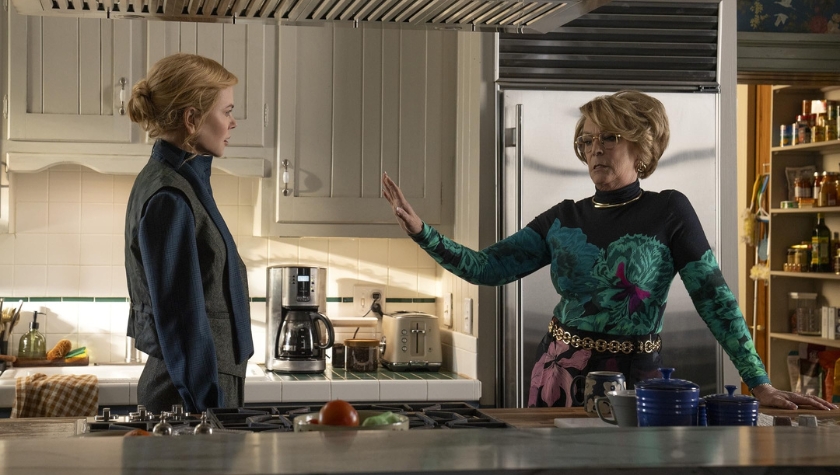
Based on the bestselling novels by Patricia Cornwell, the new series Scarpetta, (which means “little shoe” in Italian), is about a female forensic scientist and stars Nicole Kidman, Jamie Lee Curtis and Bobby Cannavale. For showrunner and creator Liz Sarnoff, it’s been a long, five-year journey. We are happy to report that it’s been worth the wait.
Sarnoff has written some of the best TV shows in recent memory, including Barry, Lost, Crossing Jordan and Deadwood. But now she steps into this beloved, female-centric crime franchise, led by her instincts, personal experience and wisdom bestowed on her by the legendary David Milch.
Learning to Show Up: David Milch and the Discipline of Writing
Sarnoff describes herself as a late bloomer. After working in physical film/TV production and being an assistant, she made a life-altering decision to commit fully to writing after her mother passed away when Sarnoff was 31.
“I sort of stopped my life a bit to decide what I should do with it, because I was sort of futzing around until then. I took a year off doing various things like ‘The Artist’s Way’, and ‘A Course in Miracles’, and I watched a lot of NYPD Blue. I came out wanting to be a TV writer, and I just started writing like crazy,” she says.
When she got a job working for David Milch, it blew her mind. “He would leave me the craziest answering machine messages, like, ‘I'd be so appreciative if you'd come in today and help me work on the pilot.’ And I was like, ‘I think I'm in a dream, but I'm going do it!’”
That pilot was for a short-lived show called Big Apple that Milch did in between NYPD Blue, and Deadwood. “That was my first job. I went to New York with him, we did eight episodes, and it was the greatest learning experience of my life,” she says.
What Milch taught her, she says, was nothing less than everything.
His philosophy was simple and demanding: respect the creative process. Milch often repeated the idea that visions come to prepared spirits. Preparation meant showing up every day and making yourself available to the work. Sarnoff took that lesson literally. She writes every morning, seven days a week, a practice she has maintained for decades.
Equally important was Milch’s insistence that everything begins and ends with character. Plot, genre, and structure are meaningless without people who feel real, are damaged and striving for something more. “Everything we wrote,” Sarnoff says of that early period, “was basically just damaged people being willing to take another chance.” That idea would become the foundation of Scarpetta.

Why Kay Scarpetta Became the One She Had to Write
Sarnoff first read Cornwell’s novels in the 1990s, sharing them with her mother. Even then, Kay Scarpetta stood out, not just as a brilliant forensic pathologist, but as a woman carrying contradictions. She was powerful yet vulnerable, morally unyielding yet emotionally scarred, capable of spending her days confronting violent death and her nights cooking elaborate meals.
What drew Sarnoff back to Scarpetta years later was how fully lived-in the character felt. She says, “Scarpetta has an incredible moral barometer,” particularly when it comes to abuse of power, and she refuses to look away from injustice, even when doing so costs her personally. Just as compelling, though, was how Scarpetta changes over time.
When Sarnoff revisited the later novels, she became fascinated by the distance between who Scarpetta is early in her career and who she becomes decades later. That realization led directly to one of the show’s boldest structural choices.
Why Two Timelines Were Essential
Scarpetta unfolds across two distinct timelines: one following Kay early in her career, and another set roughly 25 years later. For Sarnoff, this wasn’t a gimmick, it was the core of the show.
“A woman at 30 and a woman at 55 are very different people,” she says. Sarnoff herself was in her mid-fifties when she wrote the pilot, looking back at her younger self on the Deadwood set: confident, energized, and unaware of how much she still had to learn. That personal reflection shaped how she approached Kay Scarpetta.
Structurally, Sarnoff grounded the timelines in the books themselves, drawing from the very first novel (Postmortem, 1990) and the 25th book (Autopsy, 2021), written after Cornwell took a break from the series. This allowed the show to honor the source material while letting the relationships, regrets and hard-earned wisdom play off each other.
The timelines aren’t totally separate, however. Questions raised in the present are answered in the past, and vice versa. The audience is encouraged to actively connect the dots, understanding how earlier choices have consequences decades later. For Sarnoff, this dialogue between timelines keeps both versions of Scarpetta alive and essential.
Writing Characters at Two Ages
Writing two versions of the same characters was definitely challenging for Sarnoff, but great casting choices really helped. Watching actors embody the same characters decades apart became one of the joys of production, with performers consciously aligning gestures, rhythms, and accents to create continuity. Sometimes the resemblance was uncanny, especially with Bobby Cannavale having his own son, Jake Cannavale, play the younger version of his character Pete Marino. Other times it was subtler, rooted more in attitude than appearance, but it’s all done incredibly well.

Advice for Writers
To give advice, Sarnoff goes back to her time with David Milch. “He would say, ‘The muse needs to know where to find you!’ It's about showing up and being open to the impulse to write. Every day. And I think what I always tell writers is: write. That's what I did. I woke up one day, out of nowhere, and was like, I want to be a TV writer, and I just started writing like crazy.
Sarnoff also says to make sure that your characters have authentic emotional lives. “The thing that I sort of miss [in TV shows today] is a real emotional reality to things. I find that more modern shows tend to gloss over the moments that make or break a life and concentrate more on minutiae.”
And if Scarpetta has taken five years to bring to the screen, Sarnoff would argue that the wait was part of the work. Writing, like Kay Scarpetta herself, demands patience, moral clarity and the willingness to keep showing up long after the easy answers are gone.
Scarpetta streams on Prime Video March 11.