
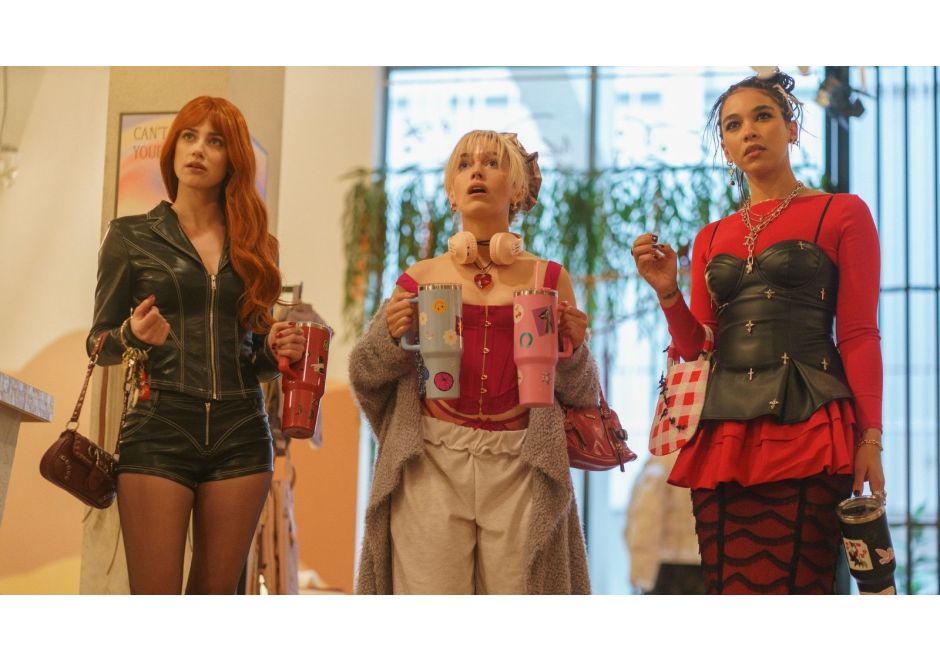
Before it became one of the buzziest horror-comedy premieres at SXSW this year, Forbidden Fruits was something much smaller and less bloody: an off-Broadway play called Of the Woman Came the Beginning of Sin and Through Her We All Die. How did a play about Eve’s biblical role as temptress with no on-stage violence turn into a full-blown, blood-soaked slasher movie with witchy mallrats scraping brain matter out of their fishnet stockings? We sat down with playwright and co-screenwriter Lily Houghton to find out.
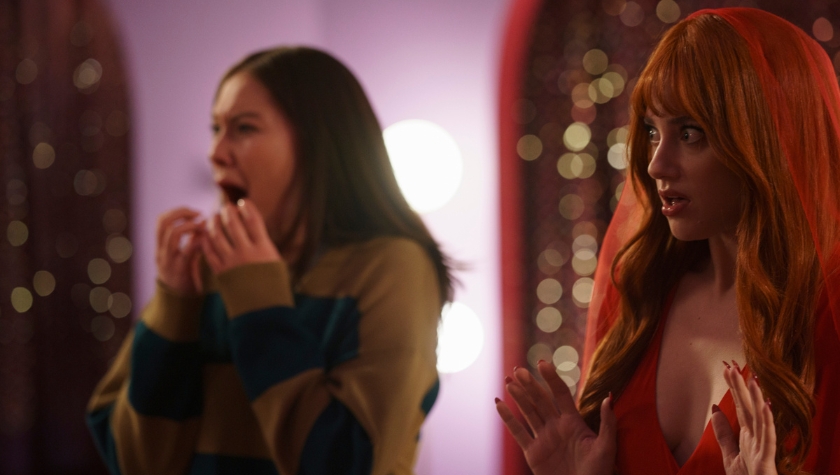
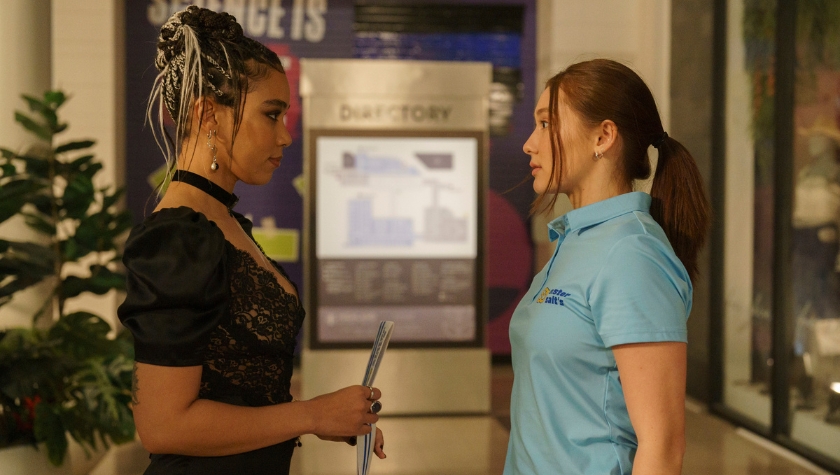
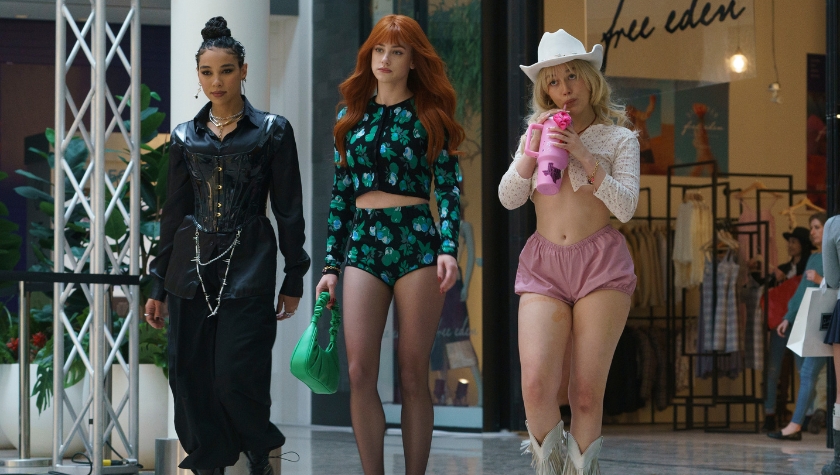
Forbidden Fruits takes place in a clothing store called Free Eden, where Apple (Lili Reinhart), leads a secret witch cult with coworkers Cherry (Victoria Pedretti), and Fig (Alexandra Shipp). When new hire Pumpkin (Lola Tung), questions their sisterhood, each member is forced to confront her inner darkness or meet violent ends. Produced by Diablo Cody, the movie is directed by Meredith Alloway with the screenplay written by Alloway and Houghton and it’s campy, devilish fun.
Shifting from Stage to Screen
Raised in New York City by parents working in nonprofit off-Broadway, Houghton grew up surrounded by playwrights like Edward Albee, Sam Shepard and August Wilson. “I really just sort of learned by being in rooms,” she says.
But even being in those rooms with such high-caliber talent, she didn’t see herself reflected.
“I’ve always been hyper-feminine and I didn’t see myself or my voice on those stages,” she says. “When I did, it was sort of dismissed as silly.”
So she started writing her own material, specifically for women like her.
“I was writing plays for my girlfriends, who had such shitty parts. It was always in relationship to men. I was way more interested in the dynamics between women.”
Houghton felt at home writing plays but when the pandemic hit, all theaters were closed. She took a risk and pivoted to writing for the screen.
“I mean, it's a totally different medium, and I had no formal training in it. And so that was just really, really lucky that all of a sudden playwrights became cool [to hire] in LA. It was not an industry I knew anything about.”
After getting an agent, she was staffed on the TV show The Body that premieres on Netflix later this year. Of course, there was a learning curve. “Theater, TV and film are so drastically different in terms of the way that things are made. I feel like with plays, I can bring in two scenes of something. And we just sort of figure it out together in a workshop process. But film and TV is a very isolated insular act.”
It was a joy to work with her director/co-writer Meredith Alloway on Forbidden Fruits because she had a similar, collaborative mentality.
“I think one of the things that was so lovely about this is we already had something to play with – the script of the play. There are scenes that are directly lifted from the script of the play, and we were able to do a verbal pitch [to film producers] and we would send that. But when we started actually writing it, we would sit with the play and really talk it through, almost as you would in a theater workshop.”
Grief and Anger as Creative Engine
The film’s surreal, hyper-feminine retail world wasn’t just invented, Houghton lived it.
She wrote the original play while working in a clothing store. She was stationed in a basement fitting room where girly pop songs were played on a loop and employees were required to call customers “Babe” or “Love.”
At the same time, she was processing profound grief after the sudden death of her father. “I was going through a really hard time, and sort of felt this pressure to cry beautifully when actually I just was so angry.”
That mix of emotions became the thematic spine of the story. “I was kind of just depressed, and was like, what would happen if the world ended upstairs? And it was just me and these women and we created a new society together.”
That “new society” eventually evolved into the coven-like structure at the center of Forbidden Fruits: a system of rules, rituals, and power dynamics that drives both the character conflict and the horror.
Finding a Champion for the Weirdness
If there’s a defining moment in Forbidden Fruits’ journey from stage to screen, it’s Lily Houghton’s collaboration with Diablo Cody. For Houghton, Cody wasn’t just a producer, she was a fierce defender of the film’s unconventional instincts and Houghton’s voice.
“When we pitched it to her, her biggest thing was leaning into the weirdness and leaning into the play,” Houghton says.
When other potential producers wanted to lose the film’s more stylized elements, like monologues delivered directly to camera, Cody pushed in the opposite direction.
“Diablo said, ‘You absolutely must keep this, you have to keep the weirdness of the play.’”
Cody understood the quirkiness of the characters was the story’s power. She saw that those elements weren’t indulgent, they were the writer’s voice and something to lean into, not eschew. Cody also gave Houghton permission to add the more violent aspects that would satisfy a horror film audience.
“She was involved in every single element of it, she would give us notes all the way through and also advocate for us if there were things that other people didn’t understand,” Houghton says.
That kind of advocacy is rare. For screenwriters, having a collaborator who can both understand the material and defend it in the room can be the difference between a powerful film and one that’s just blah.
“Meeting Diablo made me feel like a writer. She looks at me and sees a writer,” Houghton says with a huge grin. It’s clear Cody made her feel seen.
In an industry that often pressures writers to conform to what’s selling in the marketplace, Cody’s guidance reinforced that a writer’s job isn’t to dumb down your work, it’s to push it as far as you can. And because Forbidden Fruits goes to the edge, it may just be the cult classic that young women need right now.