
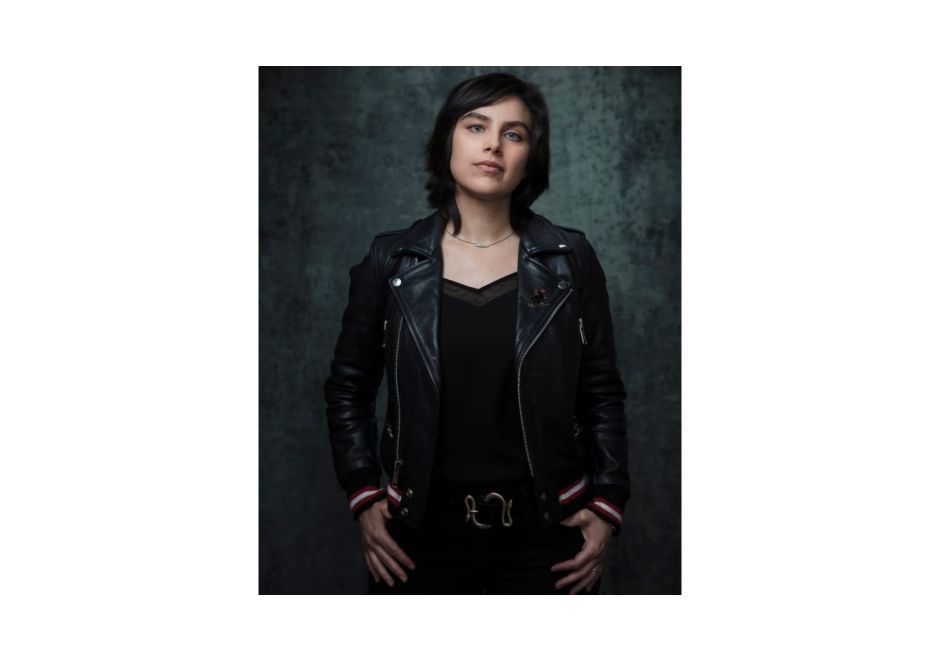
For writer-director Natasha Kermani, The Dreadful began with a desire to explore isolation, dependency, and the stark emotional reality of two women left behind by war. Loosely inspired by a Shinto-Buddhist tale that was adapted into the 1964 Japanese masterpiece, Onibaba, Kermani boldly takes this terrifying tale into cold, windswept gothic territory.
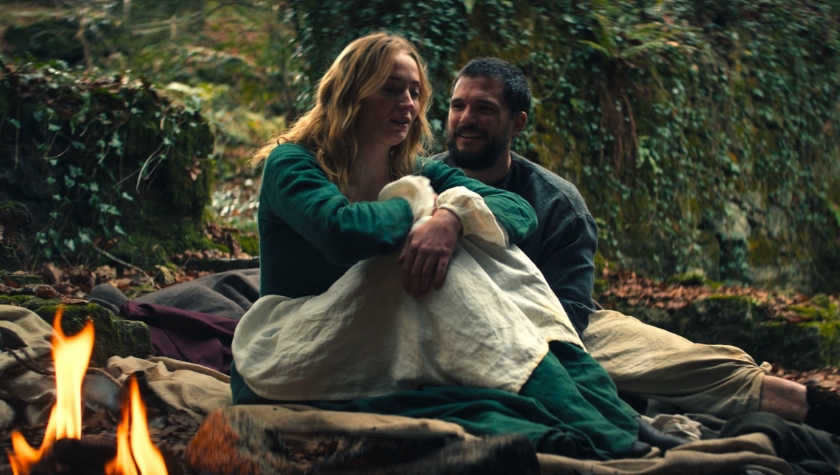
Set in medieval England and anchored by three powerful performances from Sophie Turner, Kit Harington, and Marcia Gay Harden, The Dreadful is a triangular power struggle between a young wife, her mother-in-law, and the husband who abandons them to test his courage on the battlefield.
“I think a lot of mythologies have these archetypes,” Kermani says. “The older mother-in-law, sometimes associated with the crone, and then the younger woman who’s sort of trapped between that character and some other cosmic force.”
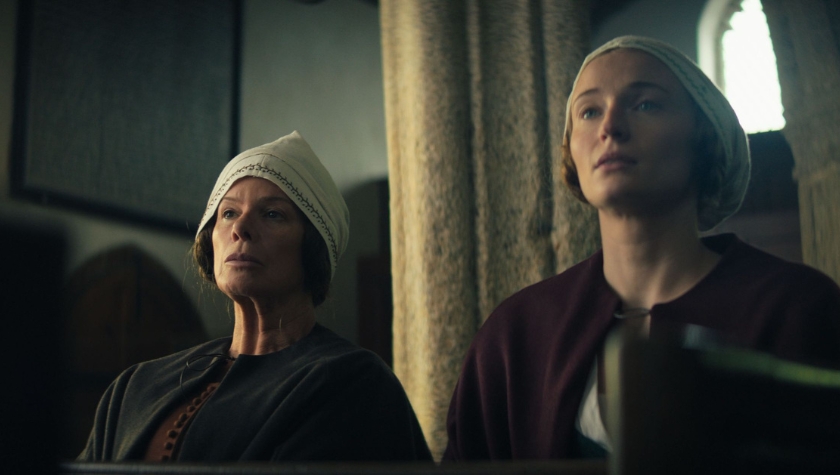
The film’s horror isn’t driven by jump scares, it’s driven by the dread of being forced to endure another person day in and day out with no escape. “There’s such intimacy between the two women. It’s not a sexual intimacy, it’s almost even more base than that. It’s a complete dependency,” she says.
This dependency pressure cooker is what makes the supernatural elements hit harder because there is no acceptable relief from the dread. In a world governed by scarcity and fear, dependency becomes a means of survival for the women. “It’s a very grounded and understandable codependency in any era but especially in the Dark Ages,” she says.
Kermani was also intentional about showing the female perspective of war. Typically, when you think of war stories you think of the soldiers on the battlefield and the men controlling them so it’s fascinating to see what’s going on at home with the women.
Survival as Story Engine
While survival is at the forefront of any medieval story given the harsh living conditions of the time, Marcia Gay Harden’s character Morwen is the film’s gravitational force. She’s a character capable of violence and cruelty without ever slipping into caricature.
“Morwen’s church is the church of survival,” Kermani told Harden at the beginning of shooting, urging her to, “Do what you need to do, use whatever you need to survive. The only thing that matters is getting to the next day.”
Harden took those words to heart and her performance is equally terrifying and riveting. “She’s really a fighter,” Kermani says. “That’s why a lot of people who watch the film really like the character so much, even though she does very nasty things throughout the film.”
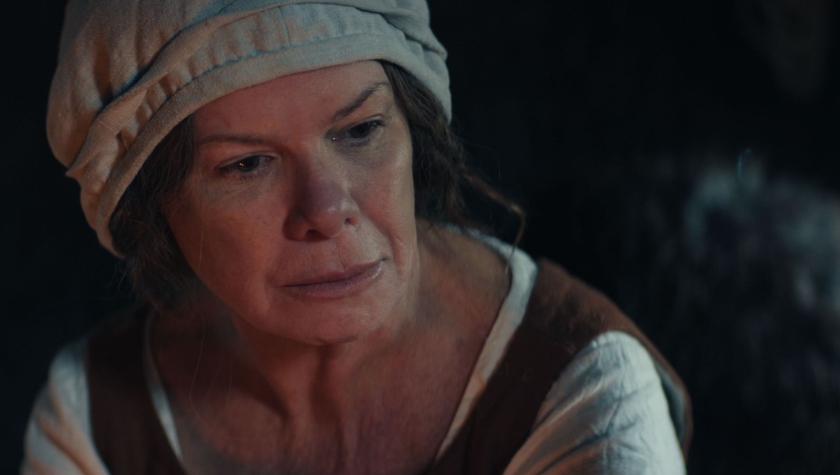
For writers, it’s a lesson in making the audience root for an unlikable character by creating a villain grounded in truth and deep ferocity. “Ultimately, she’s doing what she feels she needs to do to see the sun rise on a new day,” Kermani says. “I find her very relatable, very deeply human.”
As an actress, Harden’s approach intensified that dark side of humanity. “She was really excited to not shy away from the ugliness of Morwen but because she was always grounding it in this need to live, it never became grating or ugly in a way that we didn’t like watching her,” Kermani says.
The Knight as Metaphor
Enter the knight in shining armor – a character in the film who may or may not be real, and whose meaning shifts depending on your point of view. “He’s coming from war. He kind of becomes this god of war, the suit of armor becomes emblematic of this demonic entity that is war and greed and ambition,” says Kermani.
One of the script’s earlier titles was God of Greed, and points to the age-old hunger for power and conquest. But Kermani insists the story isn’t bound to the ancient world. “It is a story that could happen in any age,” she says. The medieval setting is stylistic, what she calls, “Painting with medieval colors. It’s an exercise in simplicity and expressionism. Using this imagery is just a way of purifying or distilling down the imagery of today, but just in more stark images.”
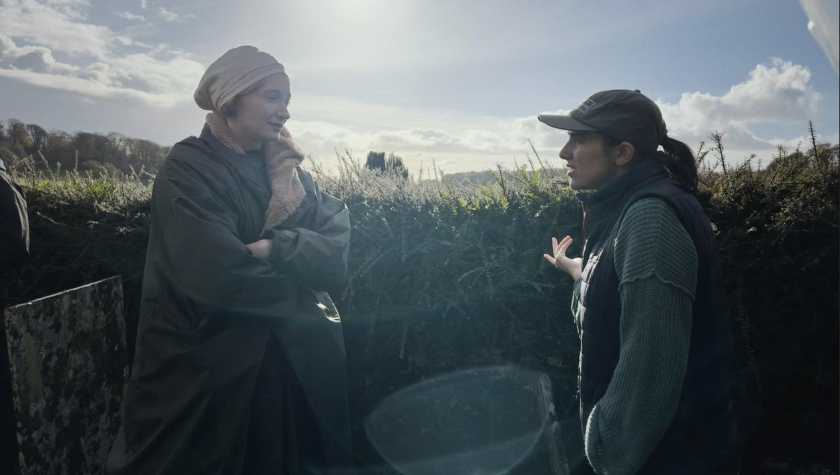
Shooting on location in Cornwall amplified the knight archetype on screen and off. “To be able to step outside of your hotel and be immediately immersed in this place. That ancient-ness helped me stay connected to the material. The legend is King Arthur was born there and that ethos was very helpful for me to stay in that gothic world,” she says.
The result is a film that feels timeless but also specific in texture and universal in theme.
Inventing a Language
Instead of insisting on strict historical accuracy, Kermani invented a dialect that’s a blend of Old English, Cornish influence and modern English. Her intent was to make the language feel like it was from a different time period while making it easy for today’s audience to grasp.
Kermani even wrote a full Old English version of the script before deciding it wasn’t practical. “You would have needed subtitles throughout the entire film,” she says. “So there’s definitely choices you make to make the film more accessible.”
Her advice to writers working in heightened worlds is: “Always start with what was the authentic reality, and then adjust from there. If we did decide to make a change, we’d ask, ‘What is the reason that we’re doing it? How does it serve our story?’”

The Power of Persistence
The Dreadful’s path to production was anything but linear. After a studio project she was working on fell apart, Kermani became determined to get The Dreadful made. But then came the SAG strike and it seemed like there was just one obstacle after another.
Kermani shared the emotional toll of development setbacks. “It’s a certain amount of ego death. You have to give it time and know that it’s a part of the process.”
What helps her now is being able to separate her home life from making movies. “You are not your work,” she says. “My relationships, my family, these things exist in a separate universe from my work.”
It’s advice that resonates deeply with The Dreadful itself considering survival isn’t just about endurance. It’s about your determination to keep going even when it seems impossible.
The Dreadful opens in theaters and on demand Feb. 20.