
After winning the Academy Award for his documentary Navalny in 2023, writer-director Daniel Roher found himself in a creative free fall. At just 29-years old, winning the Oscar left him frozen with anxiety and depression, completely shutting down his creative flow.
We sat down with Roher to find out how he got through his artistic gridlock and how he used his own fear to inspire his first narrative film, Tuner, starring Leo Woodall and Dustin Hoffman.
Whether it’s writer’s block, burnout, or imposter syndrome, all creative people go through an artistic drought at some point or another. Sometimes it’s brought on by repeated rejection, sometimes by the overwhelming pressure of success. Both can cause anxiety and make someone unsure how to move forward. That’s what happened to Roher.
“Creative paralysis is sort of my biggest nightmare,” he says. “It makes me really scared when I am not sure what I'm doing, or what I should do next.”
In that uncertainty, Roher began to see a larger pattern of the tension between order and chaos. That tension would ultimately shape Tuner, a film born from the same big question he was living: How do you restore meaning when everything feels out of tune?
His answer wasn’t to make another doc or quit filmmaking altogether. Instead, he stepped out of his comfort zone and made his first narrative feature.
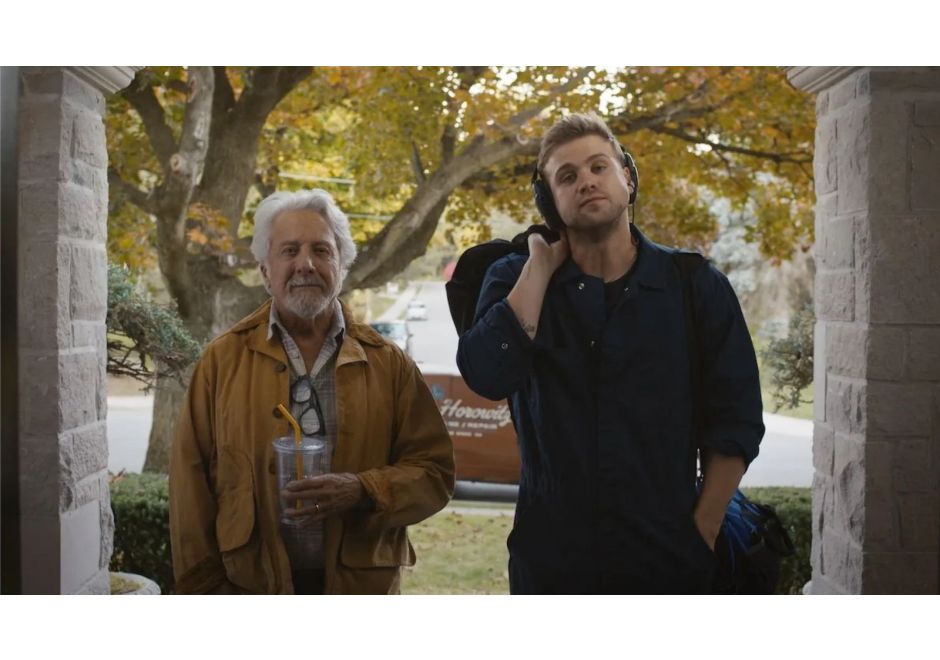
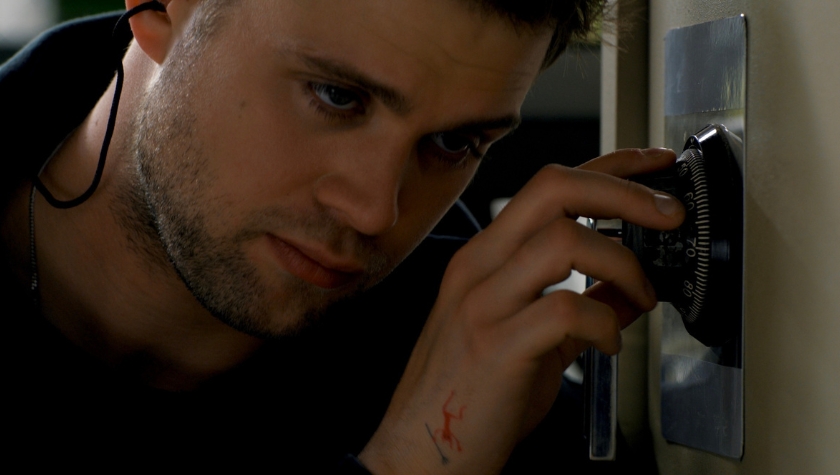
Tuner is a stylish crime thriller about a young man, Niki (Woodall), who was once a piano virtuoso. His career was cut short, however, after he developed hyperacusis, a hypersensitivity to loud noises. With the help of noise-canceling headphones, he now has a less glamorous career as a piano tuner, under the guidance of the ailing Henry (Dustin Hoffman). When Henry racks up $30k in hospital bills, Niki uses his acute hearing to enter the dangerous world of safecracking to pay Henry’s debts.
For Roher, Niki's character emerged from his personal experience of losing the ability to do what he loved. The result is a crime thriller that explores identity, creative output, and resilience.
The Struggle to Write
Roher doesn’t romanticize the writing process. He describes it as a psychological tug-of-war.
“Writing is a conflict between my crippling self-doubt and my stubborn conviction to finish,” he says. “The left hemisphere of my brain is saying, ‘Who are you to write a screenplay?’ And then the right hemisphere is saying, ‘Well, you started, you should probably finish.’”
That tension didn’t go away. He just learned to work through it.
“For me, it's just trying to muscle through both of those feelings. To have the courage to show up and face the blank page every day.”
The Piano Tuner as a Metaphor
The spark for Tuner came from a real-life encounter with a piano tuner named Peter White. What struck Roher wasn’t just the precision needed for the job; it was the philosophy behind it.
“He was talking to me about entropy and atrophy and forces of the universe that want to pull pianos out of tune,” Roher says. “And it's his job to restore order where there wants to be chaos.”
That idea became the thematic spine of the film. “The world is chaotic and scary. It’s hard to maintain order in a system that organically wants disorder,” he says. “The piano tuner is a microcosm for existence itself.”
From there, the story expanded into something more internal and more personal. “Niki is sort of a version of myself, a manifestation of my worst fear,” he says. “What happens if I can't do the thing that I love to do? My identity is hinging on my work. So if I couldn’t make stuff anymore, who would I be?”
Learning to Write by Doing
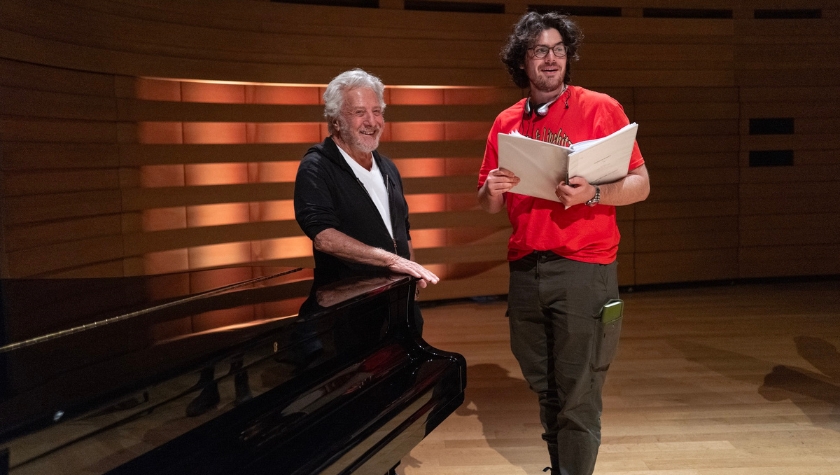
Despite his success as a filmmaker, Roher came into Tuner feeling like an outsider to screenwriting because he came up in the documentary world. “I felt ill-equipped, afraid that I wouldn't be taken seriously.”
But he banged away at his computer anyway, even when he felt he was living a lie. “I just kept showing up in the mornings and writing, even though it felt silly.”
Over time, something shifted. “I kept not being a writer for so long that I woke up one morning and I was a writer.” That transformation didn’t come from a breakthrough moment, it grew out of a routine.
“I've never had the ritual of getting up and writing every day, sitting there for a couple of hours, because that's not really how documentary filmmaking works. It's a different cadence. Once I identified that, I started to love it, and everything kind of came into focus.”
He compares writing a script to editing a documentary. “You're putting a puzzle together, you're putting pieces together, and that also really inspired me.”
The Joel Coen Lesson: Demystifying the Process
One of the most impactful moments in Roher’s journey came from a deceptively simple piece of advice from filmmaker Joel Coen.
“We were at a film festival in Croatia. I went up to him and said, ‘Mr. Coen, how do you start writing a script?’ And he thought about it and said, ‘Typically, we get into the office, and we'll write the first page. Then when the first page is done, we'll move on to the second. And then you do that until you have a scene, and then come back the next day and repeat the process’,” Roher laughs, but the lesson stuck.
“What he was really saying is you just sit your ass in the chair and do it. There's no mystery, just f*cking do it.”
From Play to Screenplay
Roher says his first draft of Tuner didn’t look like a movie. “It looked more like a play,” he says. The turning point came when co-writer Robert Ramsey joined the project, helping shape the material into cinematic form.
“He really puts a lot of emphasis on active writing, on writing in images, showing instead of telling. All these basic concepts that you learn if you go to screenwriting school, which I had never done, but Rob is an amazing professor at USC screenwriting school, a school that did not take me. They wouldn’t let me in, and so it's kind of meaningful that I got my own masterclass with the professor,” he says.

Breaking Creative Paralysis
When asked what advice he’d give to writers immobilized by self-doubt, Roher suggests trying a major disruption.
“Try to break your routine, do something completely different. Break the monotony of whatever you're doing. Impulsively ride a bike across Cuba. That was one of my earlier, breaking a rut techniques. Go to a new country, whatever your circumstance can allow. Just live your life at a totally different pace.”
And sometimes, the answer isn’t writing at all. “Don’t write for a week. Just watch movies, three films a day,” he says.
The Takeaway for Writers
Roher’s journey into Tuner was about giving himself permission to try something new. Permission to be bad before getting good. Permission to keep going despite doubt. His advice ultimately circles back to the simplest, most difficult truth about writing:
“Start with the first page, then the second. And if you do that 90 or 100 times, you’ll have a screenplay.”
Or, as he puts it more bluntly: “Just sit your ass in the chair and write.”
Tuner opens in limited release May 22 and wide release May 29.