
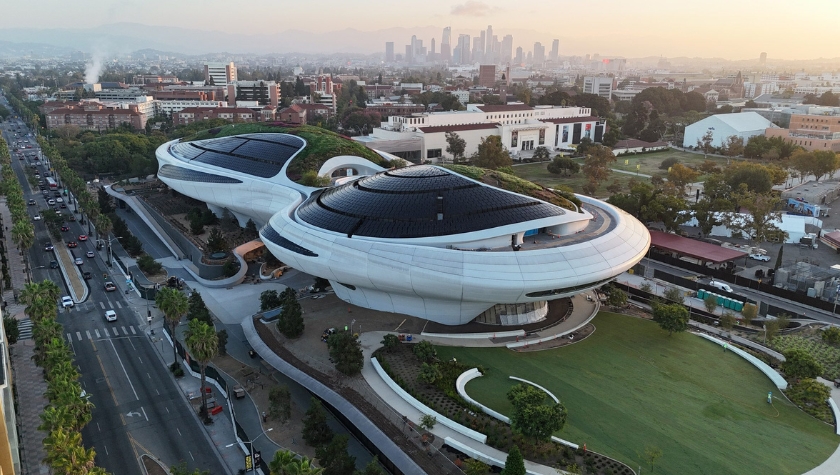
This fall, the Lucas Museum of Narrative Art opens at Exposition Park in Los Angeles with more than thirty installations drawn from its founding collection.
Among them, the cinema exhibition "Star Wars in Motion" stands out as an immediate centerpiece. Spanning vehicles, costumes, and props from the first six films in George Lucas's saga, the exhibition puts on display what makes the Star Wars universe so enduring: the physical objects that gave the galaxy far, far away its weight and texture.
To many fans, a lightsaber, Mandalorian helmet, or landspeeder are just as iconic as the characters using them. And for screenwriters working in sci-fi, fantasy, or any worldbuilding genre, the role these props play in the storytelling is a craft lesson in itself.
The Architects of a Galaxy
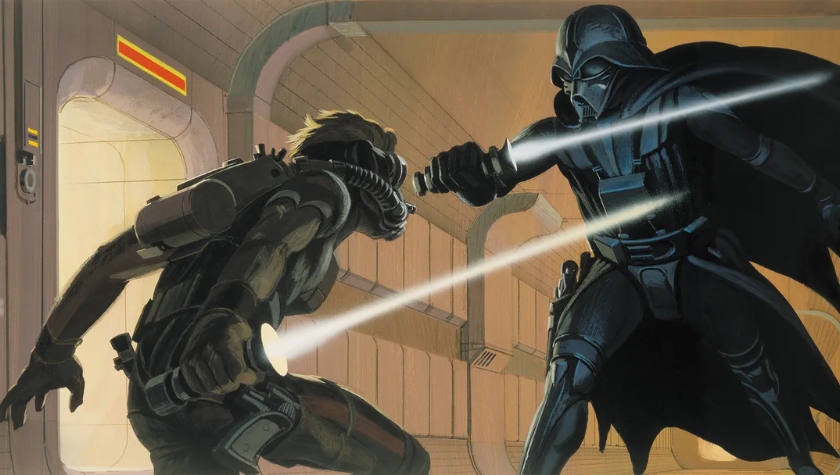
Before a single frame of A New Hope was shot, the Star Wars universe existed as paintings. George Lucas hired concept artist Ralph McQuarrie in 1975 to visualize what he could not describe fully in words. The results — Darth Vader striding through a corridor, C-3PO and R2-D2 lost on a desert planet, an X-wing banking against a starfield — were so vivid they convinced 20th Century Fox to greenlight a film that had no historical precedent.
McQuarrie designed nearly everything audiences now consider sacred. He gave Darth Vader the breathing mask after Lucas noted the character needed to survive traveling between ships in the vacuum of space. He combined a full-face respirator with a samurai helmet and produced, in a single sketch, one of the most recognizable character designs in cinema history. His C-3PO drew on the Art Deco robot from Fritz Lang's Metropolis. His Chewbacca concept later became Zeb in Star Wars Rebels. His early stormtrooper designs resurfaced in The Bad Batch. The visual DNA he established in the mid-1970s is still being replicated today.
When Lucas returned to Star Wars for the Prequel Trilogy, he needed a new architect. He found one in Doug Chiang, whom he selected in 1995 to head the art department for The Phantom Menace and Attack of the Clones. Where McQuarrie gave the Original Trilogy its worn, industrial, assembled-from-scraps aesthetic — a galaxy that looked lived-in — Chiang was tasked with designing the era before the fall: sleeker, more elegant, drawing on Art Nouveau and the chrome curves of 1950s American automobiles.
The guiding principle was that Prequel-era design should look like craftsmanship, while Original Trilogy design should look like manufacturing. The galaxy evolved between the two trilogies. So did the props.
What a Weapon Says
In Star Wars, you learn who a character is by what they carry. The lightsaber is the clearest example. It's the central weapon of the franchise and, by design, the most personal. A Jedi or Sith constructs their own lightsaber. The result is a weapon that is unique to its owner, and every visible difference communicates character instantly.
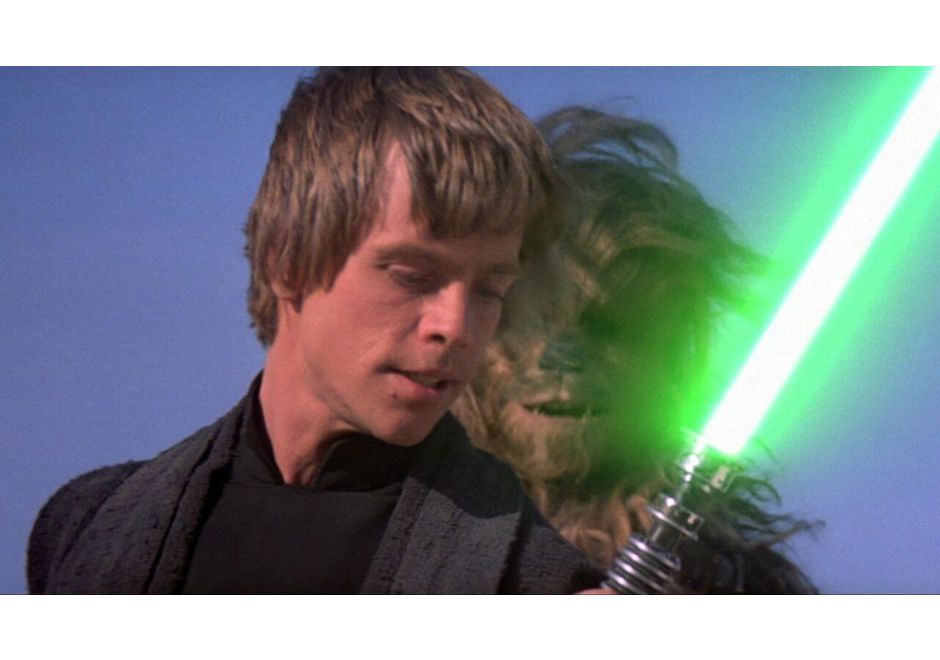
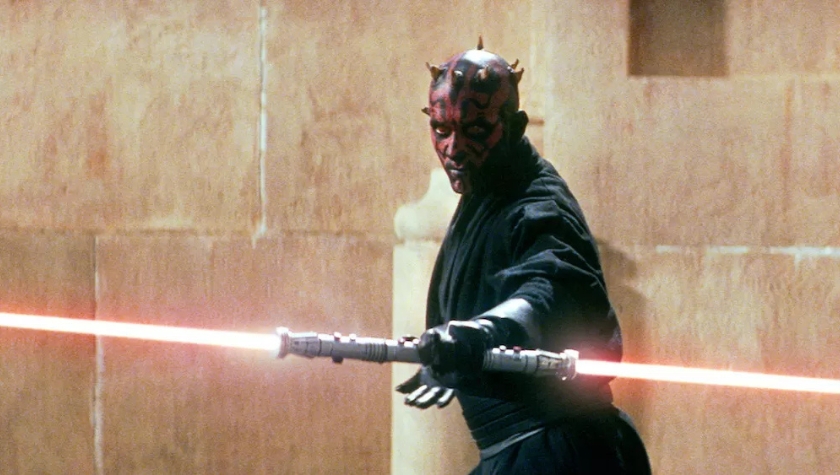
Luke Skywalker's first lightsaber, inherited from his father, is slender, almost unassuming: the weapon of a Jedi knight in "a more civilized age." Obi-Wan Kenobi's is clean and restrained, matching the man himself. Darth Vader's is industrial and heavy-looking: "more machine than man." Darth Maul's double-bladed saber tells you everything about his combat philosophy before he swings it: aggressive, relentless, built for spectacle and intimidation. Yoda's shoto saber, by contrast, is short; a weapon designed for a small body that moves like a hummingbird. Count Dooku's curved hilt signals a duelist's precision and aristocratic arrogance. Kylo Ren's crossguard saber, crackling with unstable energy, announces a young man barely containing something dangerous from within.
None of this requires exposition. The weapons speak before the characters do.
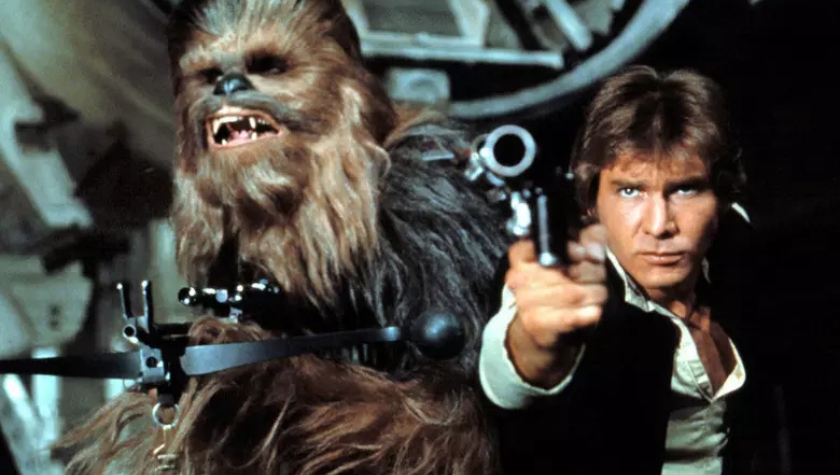
Outside the lightsaber, weapons serve the same function. Han Solo's DL-44 heavy blaster pistol is a gunslinger's weapon, fast and slightly illegal-looking; entirely consistent with the man who shoots first. Chewbacca's bowcaster is custom-built, cumbersome to anyone else, and delivers a bolt with a recoil that sends targets flying: a weapon that communicates size, loyalty, and barely controlled ferocity. The bowcaster is so distinctly Wookiee that when Han Solo fires it in The Force Awakens and reacts with pure delight, the moment lands without a single line of explanation.
The Helmet as Character
Helmets in Star Wars perform a function that goes beyond protection. They are masks in the theatrical sense: devices that transform the wearer into something larger, something archetypal, something that audiences read instantly across language and culture.
Darth Vader's helmet might be the most evocative object in cinema. It conceals everything human, fusing McQuarrie's samurai silhouette with a skull-like face plate to produce something that reads as death itself. The helmet not only makes Vader frightening, but it also suggests tragedy and makes the reveal in Return of the Jedi possible. Removing it is an act of radical vulnerability. Without the helmet's visual weight, that scene doesn't work.
Kylo Ren's helmet operates as a direct inversion of this. He wears it in The Force Awakens; destroys it in The Last Jedi after he's ridiculed and told he's not a formidable Sith, but then dons it again in The Rise of Skywalker. The helmet's destruction and reconstruction are the character's arc externalized. Kylo is in constant flux and struggling with his grandfather's legacy. No dialogue needed.
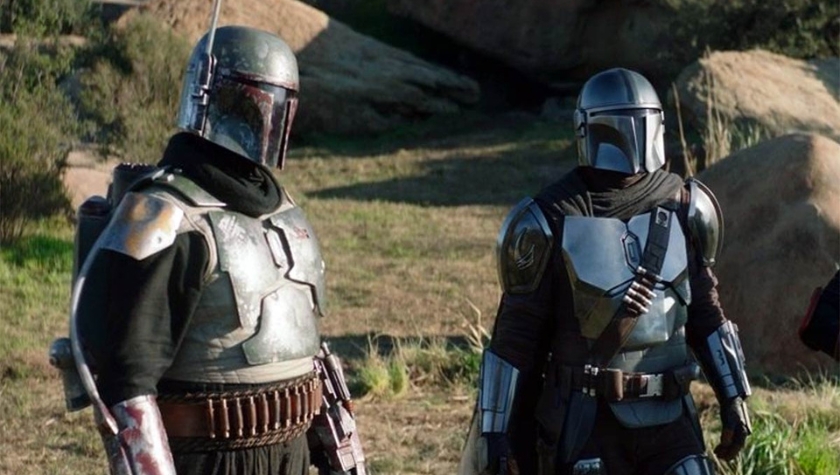
Mandalorian helmets — whether worn by Boba Fett, Jango Fett, or Din Djarin — carry an entire cultural mythology in their T-shaped visor. The design signals a warrior caste with a code of honor so strict that Din Djarin treats removing the helmet as a violation of identity itself. The helmet becoming the central dramatic object of The Mandalorian is a testament to how much a single prop can carry.
Stormtrooper helmets communicate the opposite of individuality. Identical, expressionless, interchangeable — they make the Empire's soldiers into faceless instruments of a machine. Clone trooper helmets have a similar assembly-line design, but are shown to be frequently personalized: unit markings, color designations, and hand-painted clan symbols. The visual distinction between the clone and the stormtrooper encodes an entire political transformation: the Republic's soldiers had identity; the Empire's don't.
Vehicles Built by Hand
When Industrial Light & Magic was launched in the mid 1970s and first worked on Star Wars, they constructed 75 physical models. The Death Star's surface occupied 1,600 square feet of detailed miniature architecture. The X-wings, TIE fighters, and Star Destroyers were practical objects shot on motion-control cameras with articulated wings, functioning cockpit lights, and engine glow. To film the trench run sequence, they dragged a model into the ILM parking lot to get natural light on the pyrotechnic effects.
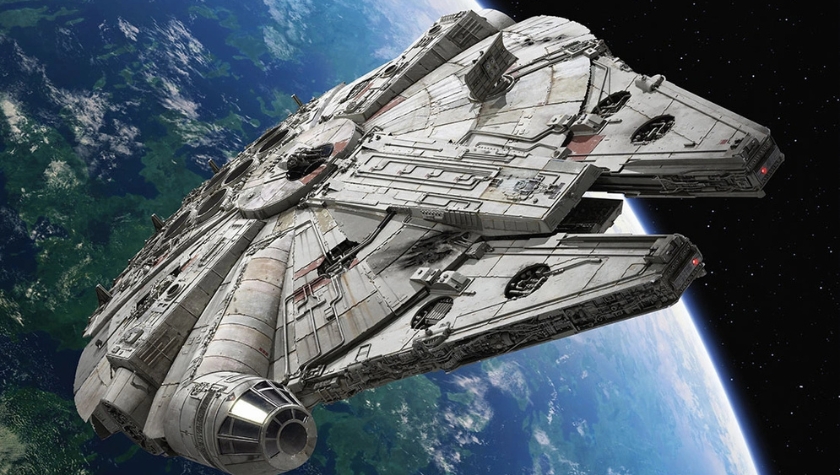
The Millennium Falcon started as a hamburger-shaped design rejected for looking too similar to the Discovery One from 2001: A Space Odyssey. The revision — asymmetrical and battered — became the most recognizable spacecraft in popular culture. Its beat-up appearance was a deliberate choice: a ship that had been through many rough spots, owned by people who had been through more.
Despite what some might think, the shift to CGI for the Prequel Trilogy didn't eliminate miniatures. In fact, more physical models were built for The Phantom Menace than for the entire Original Trilogy. The Mos Espa Podrace arena was a miniature set whose audience was composed of 450,000 painted Q-tips. ILM built miniature Coruscant cityscapes and miniature Theed for establishing shots, then composited digital elements on top. The CGI vehicles of the Prequels — the sleek N-1 Starfighters, the Trade Federation battleships, the Republic gunships — were designed with the same principles McQuarrie had established: functional logic and physical plausibility that made them feel real even when they weren't.
General Grievous's Wheel Bike, one of the featured objects in the Lucas Museum's "Star Wars in Motion" exhibition, is a good example of how vehicle design and character design converge. The Wheel Bike is a combat vehicle that moves by rolling; it communicates momentum and a mechanical menace that matches its driver. When Obi-Wan Kenobi chases Grievous across Utapau astride a giant lizard in Revenge of the Sith, the contrast between the organic and the automated says something about both characters — and, once again, without a single word of dialogue required.
Also featured at "Star Wars in Motion" is Luke Skywalker's landspeeder. This vehicle is the first evidence that Luke lives in a world too small for him: a worn and modified civilian vehicle on a desert planet, owned by a young man longing for something bigger. The landspeeder is bound, merely hovering a few feet from the surface. Luke won't truly be free until he climbs into the cockpit of his X-wing.
What This Means for Your Script
The lesson Star Wars offers screenwriters can be broken down to the following: props are character. Every object a character carries, wears, or operates should be a visual expression of who they are.
This is especially true in science fiction and fantasy, where worldbuilding demands that every invented object earn its place. A weapon that's just a weapon is a missed opportunity. A vehicle that's just transportation is production design, not storytelling. The question to ask about the props in your script is whether it does double duty: does it deliver both functionality and character information?
Every object, every line of description, is an opportunity to add depth to your story. Nothing should be "just a prop."
The Force is with Great Prop Design
The upcoming "Star Wars in Motion" exhibition at the Lucas Museum of Narrative Art is a reminder that the greatest props in cinema were storytelling instruments. From Ralph McQuarrie's foundational concept designs for the Original Trilogy to Doug Chiang's Prequel-era worldbuilding, the visual language of Star Wars was built on the principle that every designed object should communicate character, culture, and conflict at a glance. Lucas himself once said he thought of the Star Wars films as "silent movies — movies whose stories are carried forward visually." This is what makes Star Wars so cinematic: it's primarily visual storytelling.
Lightsabers encoded the inner lives of Jedi and Sith through color, hilt design, and blade behavior. Helmets transformed stormtroopers into symbols of erasure and Mandalorians into icons of identity. And vehicles — from the hand-built miniatures of ILM's original model shop to the CGI fleets of the Prequels — carried the visual logic of a galaxy with its own history and design evolution.
For screenwriters working in any genre that demands worldbuilding, the Star Wars prop legacy is a masterclass in how physical objects can make imagined worlds feel real and act as character expression.
The best props don't decorate a story. They help tell it.