
Can using voice over help or hurt your screenplay? Is it lazy storytelling, or a great device used by some of the best filmmakers in cinematic history?
The answer is yes and no. It all depends on how you use voice overs within the narrative of your story. This article will teach you how to write voice over in a script, including how to format your VO in your screenplay in Final Draft, as well as examples in film and TV that you can use for inspiration.
But first, let’s answer the age-old question about voice over in a screenplay.
What’s the Difference between Voice Over and Off-Screen?
Both voice over and off-screen dialogue are not spoken on camera.
- Voice over is narration or internal speech heard by the audience but not by characters in the scene – think inner thoughts, reading letters or storytelling commentary. Note that the character speaking the voice over does not have to be physically present in the location or time of the scene.
- Off screen dialogue comes from a character physically in the scene’s location but outside the camera’s frame.
What if someone is talking to another character on the phone? Do you write that character as a voice over (since they aren’t physically at the location) or off-screen (because they aren’t narrating, sharing internal thoughts, or reading)?
The answer is that most of the time screenwriters opt for (V.O.) next to the character name, however, there are some screenwriters who use (O.S.) in these situations.
- The Moneyball screenplay uses (V.O.) for phone calls
- Scott Pilgrim vs. the World screenwriter Edgar Wright used (O.S.)
How to Write a Voice Over in a Screenplay
Using voice over in your screenplay is fairly easy to implement. In Final Draft, follow these 4 easy steps:
- Press Enter to choose Character under the Elements menu
- Type the Character name
- Click the Space Bar after the Character name, then type (
- This will allow you to choose several options including (V.O.)
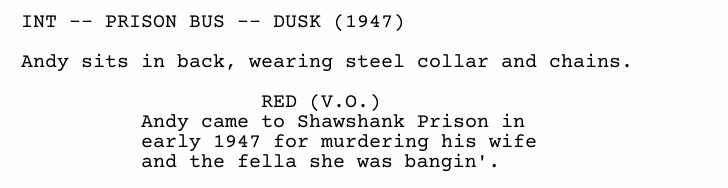
A script voice over example would look like this from The Shawshank Redemption:
If you need a reference guide to formatting your screenplay, check out How to Format A Screenplay.
Why You Might Use Voice Overs in Your Script
There are plenty of reasons that screenwriters will use voice overs in their screenplay and, when used correctly, it can be a powerful tool.
One of the most obvious uses of voice over is narration. However, it’s important to only use it as a means to deepen or add context to the story or push it into a new direction. What it shouldn’t do is repeat what the viewer sees.
In The Shawshank Redemption, Red’s (Morgan Freeman) narration adds depth to Andy’s (Tim Robbins) character. He doesn’t explain what the viewer sees on-screen, but rather expands upon Red’s view of him.
But there’s reasons beyond narration to use voice over.
- Get inside the character’s head. As you’ve probably heard multiple times, movies are about showing, not telling. So, while a voice over sounds counter-intuitive, it allows the audience to peek inside a character’s head, offering private thoughts, doubts or contradictions that might never be spoken aloud: an inner monologue. Voice overs can help viewers understand why a character makes certain choices, even when those choices appear irrational on the surface.
- Voice over as a guide. When a story spans years or jumps between locations, having a voice over can provide clarity and momentum without having to stop the story and drop in a character providing exposition on screen. Forrest Gump uses voice over to prevent the story from stopping for an explanation. Used consistently, it becomes part of the storytelling language rather than an interruption.
- Establishing tone. In the Oscar-nominated Train Dreams, there is a narrator that is not the main character or a present-day character looking back, but rather it’s used to set the tone of the story. It’s designed to provide rhythm or tone where there is often action with almost no context. Other examples include the beginning of Magnolia and The Assassination of Jesse James by the Coward Robert Ford, both of which have narrators who are never seen.
Whether you want to set a tone, guide an audience or peek inside a character’s mind, voice over can help push the plot forward and set the feel for the story.
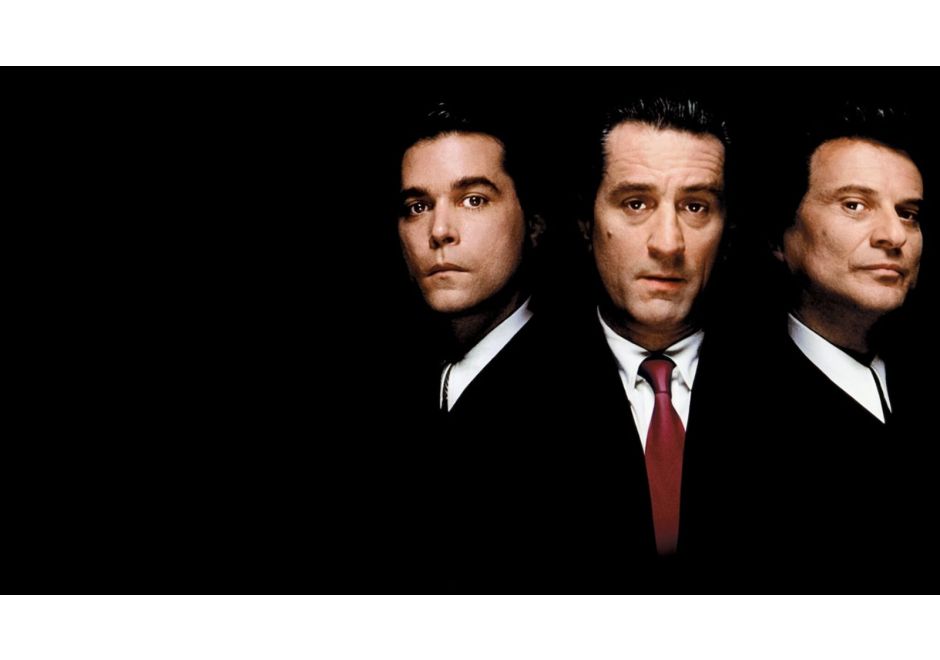
In Shawshank Redemption, Red’s tone is calm, and in the beginning of Goodfellas, Henry Hill (Ray Liotta) shows optimism and admiration for the gangster life he aspires to be a part of. Voice over is being used as a story engine, moving the plot forward while drawing the audience deeper into the world you’ve created.
Knowing how to write a voice over in a screenplay can start with watching some of the movies you love and seeing how they make narration work.
Examples of Effective Voiceovers in Film and TV
Voice over doesn’t always work, but when it does, it can be masterful. Here are some of the best script voice over examples used in film and TV.
'Sunset Boulevard' (1950)
Sunset Boulevard starts with its protagonist dead in a pool. The film (which won the Academy Award for Best Screenplay) is narrated by the deceased, a wannabe screenwriter who flashes back 6 months to tell how he arrived floating in a pool with three bullet wounds.
'Goodfellas' (1991)
Goodfellas created the post-Godfather resurgence of organized crime movies with Martin Scorcese setting up the mold for other filmmakers to follow. What is so intriguing about the voice over in Goodfellas is that it starts with Henry Hill but switches between characters throughout.
Note: If you’re going to watch this opening scene with voice over, it’s a bit bloody and has some salty language.
'How I Met Your Mother' (2005-2014)
The popular TV sitcom follows the voice over of a man sharing the story with his two children of how he met their mother. It’s a constant throughout the series but, really, how long can this story go? This is where the concept of the unreliable narrator comes into play as he continuously keeps his kids (and the audience) guessing on who he ultimately ends up with.
'Black-ish' (2014-2022)
Throughout the series, the viewer gets inside the lead character's heads. Dre (Anthony Anderson) voices the narration throughout the series as the character tries to gain the audience’s empathy by providing them with a glimpse inside his head.
Using voice over can be a powerful tool that makes a story better and allows the audience a means of knowing about your characters. If you find that you’re using voice over to explain something, then it’s best to find a different way to tell it. Movies and TV should always be a visual medium first; voice over should be a way to enhance the story.