
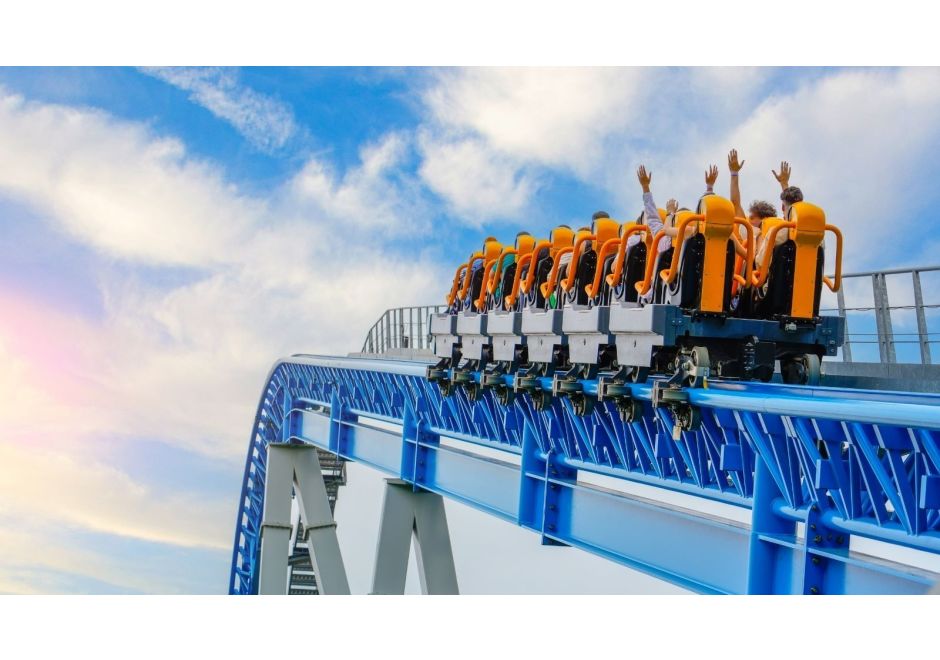
Thrillers are built on escalation. A great thriller should feel a lot like a great roller coaster ride. The experience isn’t one continuous drop at the same speed. There are climbs, falls, twists, turns, misdirects, and moments when you think the thrills are over, only to discover that there is one last climb towards an even bigger finale.
Thriller escalation works the same way. You need to give audiences the opportunity to recover from major suspense sequences, regroup, reset, and then take them on another thrilling run of climbs, falls, twists, and turns. But each recovery should lead to enhanced thrills that are more intense, more dangerous, and with even bigger stakes.
Here we share the general structure you can use to escalate your thriller, whether it’s an action thriller, horror thriller, suspense thriller, or supernatural thriller.
The Roller Coaster Analogy for Escalating Thriller Scripts
Let’s stick with the roller coaster analogy to make thriller story structure as accessible as possible before we dig a little deeper.
Compare your thriller structure to this roller coaster analogy:
1. The Slow Climb
Whether you love roller coasters or hate them, we all know the anticipation of the slow climb of a roller coaster ride. You stand in line, watching others launching away. Then when it’s your turn, you get in, get settled, and off you go. But it’s not a speed ride right away. There’s a brief progression as the roller coaster moves through the introductory portion of the ride. Most of them have themes or worlds attached to the concept of the roller coaster. You move through some of those elements and then begin the slow climb up.
Structuring thrillers follows the same type of beginning. You establish the characters, the world, and central conflict while steadily building anticipation for that conflict to hit the protagonist. The audience knows something is coming. They just don’t know exactly when or how it’s going to happen.
You accomplish this preferably within the first ten pages of the script. When we reference “slow climb” we’re not talking about taking the first thirty pages or more of the script to introduce the characters, the world, and the central conflict. When you get on a roller coaster thrill ride, you don’t want to slowly coast through bland aesthetics and set design. You want the ride to start right away and introduce those elements as things build.
- You offer a peek into the central conflict of the concept, possibly with some dramatic irony (where the audience knows information the protagonist doesn’t have yet).
- You show the protagonist in their ordinary world, knowing that the central conflict that has been teased is coming their way (the audience just doesn’t yet know how or when it’s coming their way).
- Then the story shows these two story elements - protagonist and the central conflict - and their worlds slowly approaching each other, ready to collide.
2. The First Drop
When you know the protagonist and the central conflict of the concept are going to collide, that’s when you know that big first drop is coming. When you’re on a roller coaster, you just don’t know how or when it’s coming, and what the effects are going to be. Playing with the anticipation of the audience is key in writing thrillers. The first drop in a roller coaster is extreme, but just a taste of what is to come. In thrillers, the first drop is where you deliver the first major thriller sequence that throws your protagonist into the central conflict that has been teased in the opening climb. This is where the ride truly begins and, for the protagonist and the audience, there’s no easy way to get off of the ride at this point.
When that first major thriller moment with the protagonist comes, the thrills don’t stop from then on. There may be moments where things slow down briefly, but that’s just the recovery period setting up the next thrill, and the next thrill, and the next.
3. The Brief Recovery
On a roller coaster, the moment after that first drop is thrilling. You have a moment to look over to your ride partner and share a reaction to what has just happened. Most of the time, it’s a thrilling laugh and wow followed by some smaller twists, turns, and drops that aren’t nearly as impactful, but keep you invested in the ride. But then you look forward and see more lifts, drops, twists, and turns coming your way.
For thriller scripts, this is where you give the protagonist (and the audience) the chance to process what has just happened in that opening thrill sequence. These brief quieter moments aren’t filler. This is when characters regroup, react, process, make plans, uncover information if possible, and prepare for what’s coming next. It’s a chance for the protagonist and other characters to think or ask things like:
- What just happened?
- Why did that happen?
- What does this have to do with me?
- Is it over?
- Are there more threats coming our way?
4. Bigger Drops, Twists, and Turns
When you’re given a brief chance to recover from that first drop, the roller coaster intensity begins to escalate. Things move faster. There are no more slow climbs to big drops. Instead, the coaster speeds up and sends you on a series of lifts, drops, twists, turns, and loop-de-loops.
In thriller scripts, each new suspense, action, or horror sequence should become more difficult for the protagonist to handle than the last because circumstances keep changing. The protagonist has to go through their internal and external arcs.
The external arc is represented by the physical challenges they are going through within the concept and construct of the story.
The internal arc is represented by what emotional and psychological struggles they are going through as a result of these constant challenges. That’s why it’s so important to briefly show the protagonist in their ordinary world in the beginning because it then becomes a litmus test once the core central conflict is thrown at them, as well as building, changing, and escalating challenges and conflicts they must face.
There may be fewer options of survival for the protagonist, higher stakes, greater danger, and more personal consequences for the protagonist to face.
Second acts in thriller stories are so important because you don’t want the “ride” to slow down. That’s not how roller coasters work, and that’s not how the structure of thriller scripts work either. This is the part of the ride where you throw as much conflict at the characters as possible. However, each scene or sequence must be an evolved and ever-changing part of the core central conflict. That’s what keeps things new and exciting, and that is what keeps script readers turning the pages of your script with pure investment and anticipation of what is going to happen next.
5. The Final Drop
All great roller coaster rides end with a bang, not a whimper. Everything builds to that final terrifying yet exhilarating (for some) drop before the ride is over. It’s what keeps people talking about the ride with others long after it’s easy. It’s what makes people tell their family and friends, “You need to go on this ride!”
The same thing is needed for thriller scripts. The final drop for a thriller is that thrilling ending that we didn’t see coming. Everything you’ve established and escalated leads towards the biggest confrontation of the story. This is where the protagonist faces the greatest danger with the most to lose.
The Climbs Are Just as Important as the Drops
Remember, the climbs are just as important as the drops. If a roller coaster did nothing but plunge for 90% of the ride, the sensation would be overly repetitive and eventually feel mundane. The climbs create anticipation for the drops. That’s the equivalent to where the inner character arcs of your thrillers show themselves.
The external arcs are the equivalent to the physical thrills and sensations of the drops, twists, turns, and loop-de-loops. In a thriller script, those instances would be where your protagonists are running away from threats, facing threats, being chased, being proactive and chasing others for answers, fighting, surviving, etc.
The climbs are where your character development comes into play, and you build that anticipation in the audience where they are caught up in the hows, whens, and whys of what is to come. The drops are where you deliver on those questions, only to create new and unexpected ones to keep them invested in the story and engaged in the thrills.
Jaws Thriller Escalation Structure
Let’s take a look at a perfect cinematic example of this roller coaster-like thriller structure with one of the greatest thrillers ever made, Steven Spielberg’s Jaws.
- The Slow Climb: We’re teased with the main threat/conflict of the concept with the shark attack opening - a perfect example of a roller coaster ride that starts with an initial burst of speed. We then meet Chief Brody in his ordinary world. We learn he’s new to the island community and that he’s afraid of water. He’s then faced with the discovery of the victim of the first shark attack. He wants to close the beaches but the town won’t let him.
- The First Drop: It’s the first day of vacation season. The beach is full. We see the shark beneath the water. A little boy is killed. There’s a killer shark on the loose. We’re introduced to Quint, who offers to hunt down and kill the shark for a hefty fee, but the town opts to wait before taking him up on his offer.
- The Brief Recovery: The beach is closed briefly. Chief Brody enlists the help of Hooper, who arrives amidst the locals trying to hunt down the shark themselves. A shark is caught. They think it’s over. But Brody and Hooper discover that the shark that has been caught is not the shark that killed the girl or the boy. Another attack happens. Brody’s son is almost killed. It’s time for Brody and the town to take up Quint on his offer to hunt down the shark. Brody and Hooper go along for the hunt.
- Bigger Drops, Twists, and Turns: The three go out to sea and begin hunting the shark, leading to multiple escalating thrills in the form of them seeing the shark for the first time, chasing the shark, attaching barrels to the shark to slow it down, only to have the shark take the offensive and start attacking them and the boat.
- The Final Drop: Quint is dead. Hooper is missing. The boat is sinking. Brody, despite his fear of the water, hangs onto the ship as it sinks and as the shark is coming his way. He’s taking rifle shots to try and blow up the air tank in the shark’s jaws. The tension builds and builds until Brody finally shoots the tank and blows up the shark.
This type of thriller structure can be seen while watching any great thriller, including movies like Jurassic Park, Die Hard, and even the latest horror thriller Obsession.
The Cinematic Tools You Use to Escalate the Thrills in Your Thriller
What’s next are the tools that you can use to enhance each section of this thriller structure.
- Twists and Turns
- Red Herrings
- Playing with Expectations
Twists and turns are something every script should have, thriller or not. Why? Because it keeps the audience on their toes. Routine storytelling gets boring real fast. Yes, the audience does like what’s familiar. But they especially love it when screenwriters and filmmakers offer something different with otherwise familiar concepts. And that’s where twists and turns come in.
You can also use red herrings to keep them guessing and to enhance those twists and turns. Red herrings are basically false leads where you present possible scenarios, suspects, threats, and conflicts to keep the audience guessing.
Finally, you use all of those elements to play with the expectations of the audience.
- Take them down routine story paths.
- Then open up new paths that the protagonist must choose from.
- Then have those new paths split into additional options.
- Finally, crash through the seemingly dead-end path you take them on for that final “drop” climax.
Mold the Rollercoaster Structure to Your Concept
The rollercoaster thriller structure is fairly simple to apply to escalate the thrills. There are no set page counts or formulas. The key thing is to mold this structure to your concept. Make it fit. There’s no denying that this is one of the most effective ways to structure a thriller. But it’s not a paint-by-numbers approach. Just apply the general rollercoaster structure to any thriller you write, be it action, suspense, or horror. Start with a slow climb and lead the audience to that first drop, let them recover briefly between drops while setting up character internal arcs, launch them into bigger drops/twists/turns, and then build to and end on an exciting and thrilling final drop to end your thriller with a bang, not a whimper.