
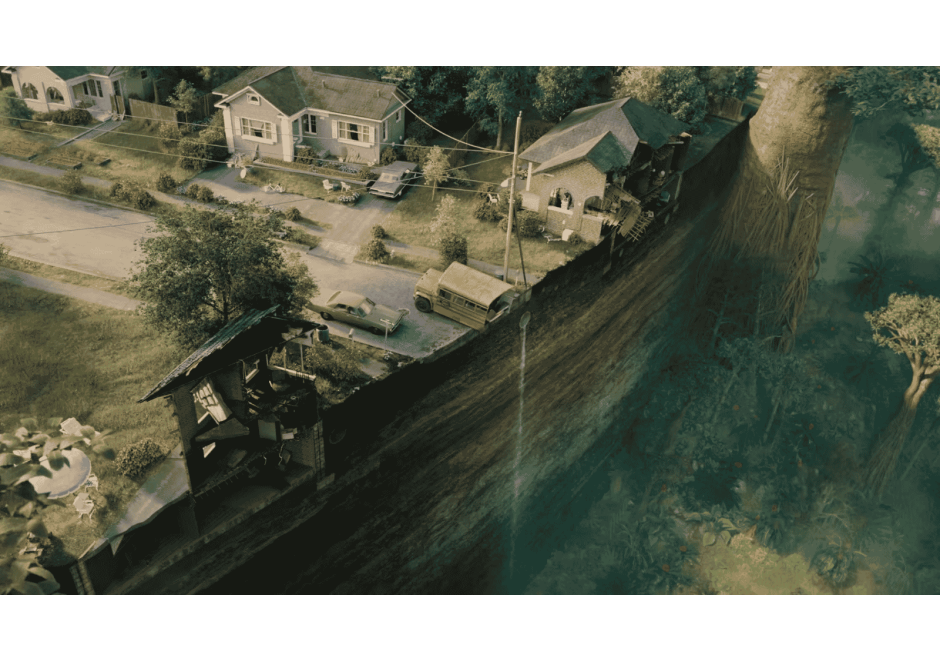
There's nothing quite like the safety of a suburban street in summertime. That is, until a cosmic event sends that neighborhood into a strange world where dinosaurs roam the earth.
The End of Oak Street has the Spielberg feel of the 1980s, combined with Hitchcockian suspense and Jurassic Park vibes from the 1990s. The film follows the Platt family as they navigate their new world, unsure where they are or how they got there, and trying to survive in a place where running water, electricity, and the telephone no longer work. While battling some of their own demons, the family of four must fight against invading dinosaurs while wondering if they can ever return to normal.
"It was an unexpected, bonkers script to read," Ewan McGregor, who plays Greg in The End of Oak Street, said in a SciFiNow interview, "a sort of Spielberg in the 1980s family movie, and I didn't know where it was going. But what I liked about it was that there was something not quite right about the couple, some unhappiness in their marriage amongst this 1980s perfect life. And then the dinosaurs come in, and I couldn't believe what was happening as I was reading the script."
Start with the Normal
How did writer/director David Robert Mitchell create such a compelling story? Let's first break down what makes the script for The End of Oak Street a type of story that fits into any genre, not a science fiction run-from-dinosaurs tale.
The Platt Family
The year is 1982, and the Platt family lives in a nice suburban neighborhood. Everyone seems to get along, for the most part. The mother, Denise (Anne Hathaway), is the typical matriarch in charge of the household duties while her husband is off at work. While raising two kids may have been satisfying, her children are now teenagers with one ready to leave the nest and go to college, and she's struggling to find meaning in her life. She's a bit of a pessimist and isn't finding happiness in her marriage.
"She's at a point in her life where she's beginning to wonder, is this all?" Hathaway said in the SciFiNow interview. "My kids don't need me so much. Is this how I see my life unfolding?"
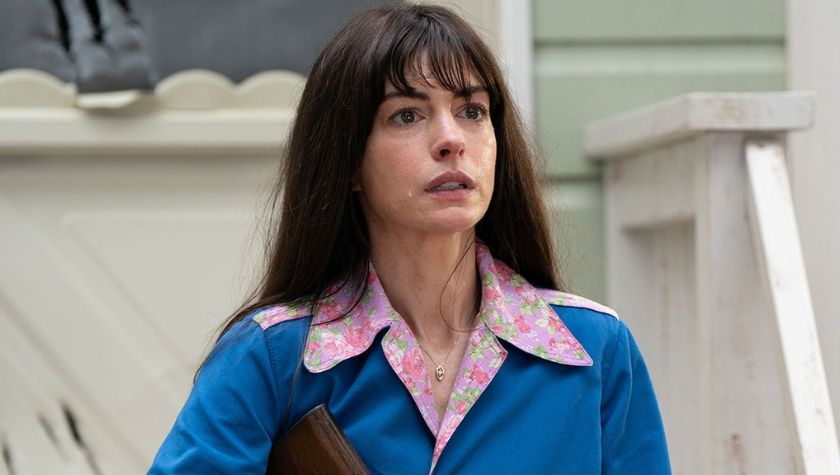
The father, Greg, is a typical 1980s patriarch. He's the sole breadwinner with a side hustle as a pizza delivery person, which he knows is a bit embarrassing for his wife. He has a couple of secrets, though, such as that he was laid off from his 9-5, and that he quietly drinks.
Despite the situation, Greg is generally optimistic. But there has been a growing not-so-hidden rift between Denise and Greg, and it looks like they're on the brink of divorce. The kids sense it and act out in different ways. These are pretty normal situations for families that you can put into any genre, whether on a floating space station, big city, or Pixar movie.
The Platt Neighborhood
The End of Oak Street takes place in a Detroit suburb, and having grown up in one in the 80s/90s about 13 miles from where the filmmaker grew up, I can attest that Mitchell's intentions felt familiar. It's safe, people mostly get along, and friends ride around on bikes.
"I'm just calling back (to) that feeling I had as a kid, where I could be in the yard looking over to the dead-end street nearby, looking down into the woods. There was this old brick or rock wall, and it was just imagining what's in the shadows," Mitchell said in an AU Review interview. "Just thinking about the films that I had seen, the stories I'd read, and imagining those things in my own suburban world, and then as an adult trying to remember that feeling." He adds, "This story is not autobiographical, of course, but there are elements of memory within the family and things that did inspire the story. I think that's an important part of it."
Youth is a great place to mine material because there is often a greater sense of innocence and imagination. It allows screenwriters to combine what they remember with the stakes and responsibilities they experience as adults. For instance, we may remember riding bikes or hanging out with friends, but now we better understand job loss, family responsibilities, community, and financial independence.
Let's Get Weird
Every story has its own version of "normal." It doesn't have to be an idyllic 1980s suburb, but "normal" establishes what everyday life looks like for your protagonist before you disrupt it; there's nothing "normal" about a bunch of toys who come alive when humans aren't around, but that's the natural situation in Toy Story.
The End of Oak Street literally places this neighborhood into another location, and now dinosaurs are part of their existence. There is no escape, and now these regular folks must survive or perish, as they witness many of their neighbors getting mauled by hungry predators.
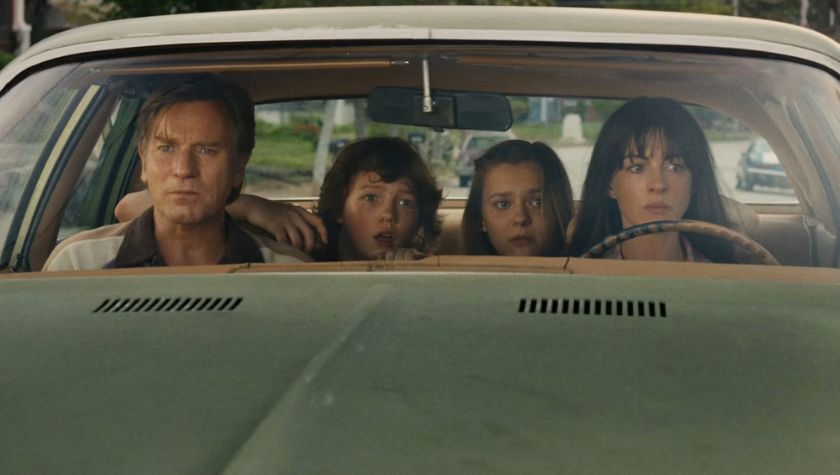
"All the Platt family members have their own issues, their own struggles, their own little secrets they are unable to share with each other. But when these people find themselves in a dangerous situation, with mortal stakes, it forces them to connect...or not," Mitchell said in the SciFiNow interview.
Any weird situation they're placed in means nothing if the audience doesn't empathize with the characters. If moviegoers can't see themselves in the situation, they won't care what happens; you accomplish this by establishing your characters' current situation. All spectacle with no story or character is simply a fireworks show that no one wants to watch for 2 hours.
The End of Oak Street proves that even the weird stories can feel familiar if the characters, relationships, and problems are well-defined and audiences can relate. So, before sending your protagonists into the unknown, give them something worth fighting for, or the ability to realize what was really important back home.