
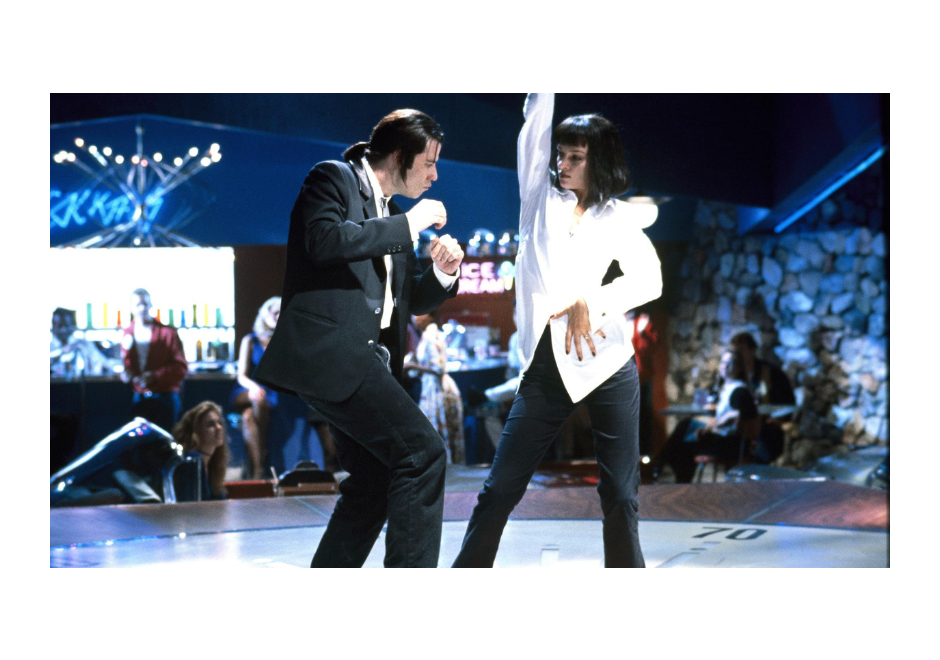
For younger movie-goers, there was never a world without Quentin Tarantino. His last four genre epics, Inglourious Basterds (2009), Django Unchained (2012), The Hateful Eight (2015) and Once Upon A Time In Hollywood… (2019), were all box office hit Academy Award winners starring A-list movie stars, and in all likelihood, his in-the-works tenth and self-proclaimed final film will be too.
In addition to directing, he has also written every movie he's ever made. But Tarantino’s 30+ long career was never guaranteed. After the phenomenal success of Pulp Fiction, his sophomore feature, there was plenty of public skepticism as to whether this film geek wunderkind was a flash in the pan or had what it took to be around for the long haul. Decades later, Tarantino has proven a remarkable ability to strategically navigate the industry in a way that’s allowed him to stay true to his artistic vision, while carving out longevity as a writer-director.
The story of how Tarantino broke into Hollywood against all odds in the 90s is worthy of study for any aspiring filmmaker. His strategic navigation of career scrutiny until he became an industry mainstay further cements his journey as a valuable case study for screenwriters and would-be auteurs everywhere.
Here is how Tarantino strategically played the long game during his first decade as a filmmaker to establish lasting relevance in the industry.
The $5,000 film school:
My Best Friend’s Birthday
Tarantino famously spent his 20s earning minimum wage as a Manhattan Beach video store clerk and religiously watching movies. When a new wave of small, independent films began hitting theaters in the mid-80s, like Jim Jarmusch’s Stranger Than Paradise (1984) and the Coen Brothers’ Blood Simple (1984), Tarantino realized that you didn’t need permission to make a small film that could actually get released in theaters. He co-wrote a screwball comedy called My Best Friend’s Birthday with his friend, Craig Hamman, for he and Hamman to star in, and borrowed a friend’s 16mm camera to shoot in black and white with the help of fellow Video Archives co-workers like collaborator Roger Avary. They’d shoot on the weekends whenever he had enough money saved for film, and couldn’t even afford to process the footage. When he finally got the film processed in 1987 after three years of shooting, he realized that the majority of the footage was amateurish and unusable, and abandoned the project.
After years of hard work and $5,000 that amounted to nothing, Tarantino could’ve well considered the venture a waste. But while Birthday never materialized into the breakout debut he’d hoped it would be, both its mistakes, and its occasional moments of brilliance, particularly in the footage from later in production, taught Tarantino how to be a filmmaker. The film acted as his film school, and he’d found his voice. Though it would take him 5 more years of struggle before his actual debut feature, he had become a filmmaker, and lit the spark that would drive him through a 30+ year career, as long as he didn’t give up.
Breaking into the industry, one connection at a time:
True Romance
Anyone who’s made it in Hollywood knows that most big breaks start with the fateful meeting of one person. For Tarantino, that person, who he met through a screenwriter friend, was filmmaker Scott Spiegel. Spiegel ran in the same indie horror circles as Sam Raimi, with whom he co-wrote Evil Dead II (1987). After bonding with Tarantino over a similar cinematic sensibility, Spiegel fell in love with his gifts as a screenwriter. Since the failure of Birthday, Tarantino had written three screenplays: lovers on the lam film, True Romance, whose protagonist is a Tarantino-like comic book store employee who loves Elvis Presley and kung fu films, its darker sister film, serial killers on the lam film, Natural Born Killers, and a contained heist thriller called Reservoir Dogs. To the extent that he could get anyone in the industry to read them, the qualities that would later make him a superstar, like the long, tangential dialogue scenes, nonlinear plot structures and graphic violence, repelled Hollywood readers.
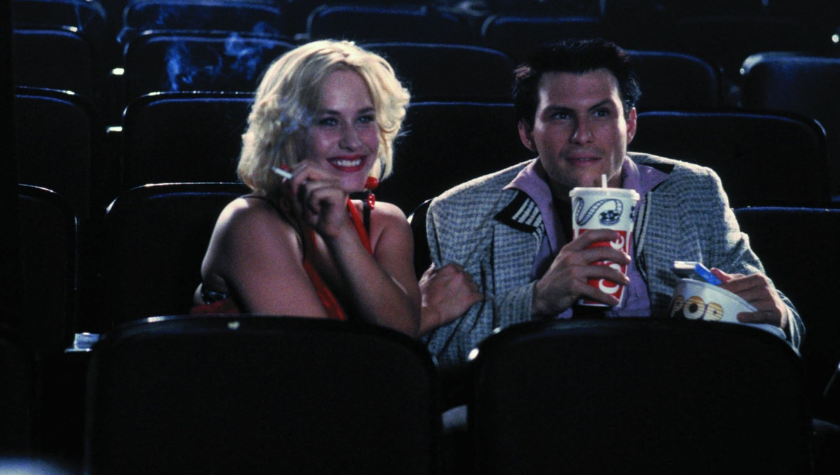
But Spiegel particularly liked True Romance and got it into the hands of New York filmmaker, William Lustig. Lustig had a deal with the company Cinetel at the time, and was interested in directing Romance, so he got the company to buy the script for what Tarantino refers to in a 10th-anniversary Reservoir Dogs interview as “the lowest amount of money they could legally pay me.” It was his first script sale, and while in the short term, Tarantino envisioned using his meager payday to finance a directorial project, Caitlin Knell, the head of development at Cinetel, became a huge champion of Tarantino’s, and eventually showed his writing to her former boss, famed Top Gun (1986) director, Tony Scott. Years later, Scott would become one of the few directors outside of Tarantino himself to helm one of his scripts, and brought True Romance to life in 1993 with Christian Slater and Patricia Arquette in the leads, and future Tarantino collaborators, Samuel L. Jackson, Brad Pitt and Christopher Walken, who shares the infamous “Sicillian scene” with Dennis Hopper, in supporting roles. Oliver Stone would eventually direct Natural Born Killers, which was released in 1994 around the time of Pulp Fiction, but Tarantino distanced himself from the film over its departures from his screenplay.
After years of rejection, Tarantino made his first, albeit very small sale by getting his scripts to the right person at the right time, a prime example of the importance of leaving no stone left unturned when networking on the outskirts of tinseltown. But selling one script wasn’t the endgame. With what little money he received, he planned on taking another shot at his directorial debut, and he had just the script to do it with.
If you want control, keep it small:
Reservoir Dogs (1992)
The genre market today is flooded with contained horror and thriller films, designed to be made on lower budgets by keeping the locations to a bare minimum. After writing two sprawling road movies, it’s with this contained strategy in mind that Tarantino wrote Reservoir Dogs, a lean, mean heist movie as chamber piece, set almost entirely in the warehouse where the planning and aftermath of a doomed diamond heist take place. Inspired by his favorite French crime movies of the 50s and 60s by Jean-Luc Godard and Jean-Pierre Melville, and from the more recent string of gun-crazy Hong Kong action films, in particular Ringo Lam’s City On Fire (1987), Tarantino envisioned being able to shoot it in a garage with a handful of his actor buddies using $30,000 of his True Romance sale.
Lawrence Bender had loftier ambitions for the film. The former dancer turned film producer hit it off with Tarantino at one of Spiegel’s barbecues and thought the movie was deserving of a bigger budget. Miraculously, Bender’s acting teacher’s wife managed to get the script to legendary New York actor, Harvey Keitel, a testament to the merit of sharing your work with as many people as possible. Keitel loved the script and attached to the film as an actor and producer, giving the project the necessary legitimacy to gain industry attention. Richard Gladstein of Live Entertainment, a company that was making low budget genre movies like the Silent Night, Deadly Night (1984) franchise by taking advantage of the booming home video market, liked the package and secured financing, giving a video geek with no directing credits to his name, the shot of a lifetime.
The package attracted a stunning ensemble of new faces like budding British star Tim Roth, New York theater actor Steve Buscemi and the recently deceased Michael Madsen. Madsen’s iconic “Stuck In The Middle With You” dance and ear-cutting scene cemented him into cinema history, and created enough controversy to make the little crime film the talk of the 1992 Sundance Film Festival. With his signature nonlinear storytelling, crackling postmodern pulp dialogue, bursts of stunning violence, and much of the budget going toward a now legendary soundtrack of “super sounds of the 70s”, Tarantino was able to establish his distinct voice in a slambang 99 minutes, and the industry took notice.
The development of Dogs is a testament to the strength of a truly great, makeable script, and the importance of networking with anybody you have access to. But the other advantage Tarantino had was leverage. He would’ve been more than happy to make the cheap, do-it-yourself version of the film with money that he already had, so if the financiers or executives wanted a more experienced director, or didn’t like the non-linear storytelling, or wanted the film to show the heist, Tarantino was able to say, “I’d rather do it my way,” and go direct it on his own. By maintaining this control, he was able to empower himself to make one of the most distinctive directorial debuts of all time. But while getting on the board is one thing, continuing to be able to play the game is another. With his sophomore film, Tarantino would continue to keep things small and stay true to his vision, and in the process, would wind up making cinema history.
Something to prove:
Pulp Fiction (1994)
Contrary to cultural memory, Reservoir Dogs was not a huge hit. It managed to make just under $3m world wide, comfortably doubling its small budget in the realm of many independent films. It did, however, make a cultural footprint, and its reputation grew once it hit VHS. So much so, that though Tarantino never met Kurt Cobain, he received a “Thank You” in the liner notes of Nirvana’s last album, In Utero in 1993, because they loved Dogs so much. And what’s more, Hollywood recognized the lightning in a bottle quality of the film. Studios began giving Tarantino offers to write on existing properties, but he was smart enough to avoid the temptation, and doubled down on the original style that got him there in the first place.
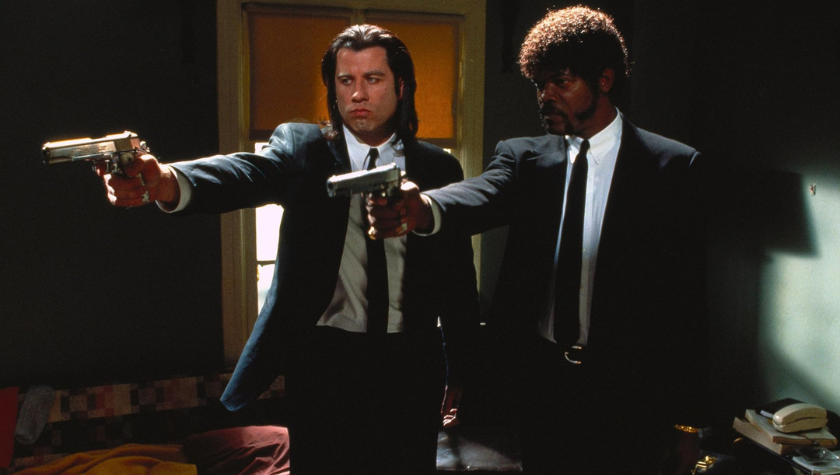
For his Dogs follow-up Tarantino doubled down on the love of movies and pop culture that made his name in the first place. With the help of his old video store friend, Roger Avary, he decided to write another offbeat crime film, but this one would tell three stories instead of one, in the serialized tradition of old Black Mask magazine issues that published pulp stories from Dashiell Hammet and Raymond Chandler or the Mario Bava horror anthology, Black Sabbath (1963). They called it Pulp Fiction, and given the chance to build on his success, Tarantino pumped every bit of film nerd inspiration he had into it. Jersey Films developed the film and Miramax, who distributed Dogs, agreed to finance it, the first film they ever fully financed. But Tarantino was smart enough to keep the budget low, with an $8m price tag that would make it hard to flop. The lower budget gave him the freedom to take risks, like casting John Travolta in the lead role as a mob hitman alongside lesser known Samuel L. Jackson and budding star Uma Thurman, or like telling the story out of order and featuring provocative scenes like the heroine overdose or the horrific pawnshop basement scene. And luckily for Tarantino, one of the biggest movie stars in the world, Bruce Willis, counted himself among the cult of Reservoir Dogs fans, and agreed to join the cast as well, bolstering its box office potential.
When the film finally screened for the public, fears of a flop quickly diminished. Pulp Fiction premiered at the 1994 Cannes Film Festival, off a print that they’d barely finished in time, and became the talk of the Riviera, winning the Palme d’Or and starting a cultural phenomenon. Unlike Dogs, Tarantino’s sophomore feature became a blockbuster smash, grossing over $200m worldwide, receiving 7 Academy Award Nominations including Best Picture, and winning Best Original Screenplay for Tarantino and Avary. By foregoing big studio allure in favor of his own muse and keeping things small and manageable, Tarantino made a masterpiece and firmly established his brand as a bankable celebrity auteur. But any “overnight celebrity” comes with a healthy public skepticism, and with a swath of the cinema intelligentsia suspecting he was just a flash in the pan, maneuvering through the next few years of his career would take incredible grace and restraint.
Avoiding the hype:
Jackie Brown (1997)
Tarantino’s Pulp victory lap took the form of loose, collaborative fun with friends. He had met Texas filmmaker Robert Rodriguez when his debut feature, El Mariachi (1992), did the festival run alongside Dogs, and in 1995 they each wrote and directed segments for anthology film Four Rooms, alongside fellow indie filmmaker friends, Allison Anders and Alexandre Rockwell. In 1996, Tarantino wrote and co-starred in George Clooney-starring vampire splatter fest From Dusk Til Dawn (1996), which Rodriguez directed. Working on these fast and loose films with friends may have helped to alleviate the pressure of following up Pulp on his own, but when it finally came time to make his next solo film as writer and director, Tarantino smartly decided to ignore the hype and not try to outdo himself.
Ever the student of cinema history, Tarantino had watched his boyhood heroes receive lessons in hubris when doubling down on their biggest successes. Big budget gambles like Martin Scorsese’s New York, New York (1977), Michael Cimino’s Heaven’s Gate (1980) and Francis Ford Coppola’s One From The Heart (1981), all underperformed and divided critics, contributing to the end of the creatively fruitful New Hollywood period that Tarantino grew up on. So it makes sense that he decided to go smaller and quieter, adapting a book from a crime writer who had influenced his own style, Elmore Leonard, on a budget only a fraction bigger than Pulp. In 1997, a year in which studio films routinely cost anywhere from $50-100m, he raised his budget to only $12m in adapting Leonard’s Rum Punch into the Pam Grier and Robert Forster-starring Jackie Brown (1997). Grier and Forster were hardly stars at the time, but Tarantino had loved their movies as a kid and recognized their star qualities. He also managed to cast his boyhood hero Robert De Niro in a laid back supporting role alongside Samuel L. Jackson. He shot the film in his LA South Bay hometown, maintaining the leisurely hang-out pacing of Leonard’s books, and showing a newfound maturity and restraint in his direction.
Amidst the pandemonium of Awards heavyweights Titanic and Good Will Hunting, Miramax slipped Jackie Brown into the December holiday corridor. It didn’t reach the heights of Pulp Fiction, but received good reviews, was a modest box office hit, and got some award nods for its actors, although Forster received the film’s only Oscar nomination for his subdued performance as Max Cherry. In so many ways, Jackie Brown is a perfect mold for following up a hit sophomore film. Tarantino stayed true to himself by going home to a community, author and lead actors he loved as a kid, and emerged with a well-respected hit film, enough to keep him on the board. The Pulp wunderkind quietly accomplished one of the most challenging tasks he would ever face, managing to gracefully and successfully follow up one of most famous and acclaimed films of all time. But now, with the world as his oyster, he had something even greater to prove - that he was here for good. It would be six years before he released another film, and those years out of the spotlight, patiently writing, would lead to a two-part genre epic that would buy him the rest of his career, assuring his place at the upper echelon of the industry.
Here to stay:
Kill Bill, Inglourious Basterds and beyond…
Tarantino’s first order of business after Jackie Brown was to set about researching and writing a long dreamt-of WWII adventure film, Inglourious Basterds. The project proved so inspiring, however, that he wound up getting the opposite of writer’s block. He couldn’t stop writing. What would eventually become Basterds had gotten to an unwieldy miniseries length with no end in sight when he ran into his old collaborator, Uma Thurman, who asked him when they were going to make Kill Bill.
It was around the time of Pulp that Tarantino and Thurman had dreamt up an old-school exploitation style action film starring Thurman as a wedding dress-clad Bride on a bloody revenge rampage. Tarantino wrote about 30 pages at the time before putting it down for his other directing duties. In the midst of his never-ending Basterds writing process, returning to those 30 pages proved a fun antidote to Tarantino. But clearly, the inspiration he was bursting with couldn’t be tamed in a small revenge film. Kill Bill quickly ballooned into a genre-spanning epic that saw Thurman’s The Bride fighting her way through kung fu, samurai, yakuza, anime and American exploitation genre homages on her journey to face the titular antagonist, Bill, until there was enough material to span two full-length features.
The smaller side project wound up being as gigantic and confident a Jackie Brown follow-up as anyone could have imagined, and after six years, Tarantino’s long awaited return took the epic form of Kill Bill: Vol. 1 (2003) and Kill Bill: Vol. 2 (2004). The films were the grandest realization of the genre mash-up style that Tarantino had introduced in Pulp Fiction, an explosion of cinematic invention that expanded his scale from tense dialogue scenes to globe-spanning action extravaganza. Both films were box office hits, and seemed to finally quash any suggestion that Tarantino’s initial run had been a fluke.
This post-Jackie wave of creativity carried itself through another Rodriguez collaboration, Grindhouse (2007), an homage to exploitation double features in which Rodriguez wrote and directed the sci-fi/horror film, Planet Terror, and Tarantino handled the back half with Kurt Russell/Rosario Dawson-starring slasher film by way of high octane car chase, Death Proof. While the 3 hour double feature proved too long and niche a commitment to become a box office hit, Death Proof contains some of Tarantino’s coolest musical and action scenes, and one of the greatest car chases in cinema history. Its failure shook Tarantino, though. He’d never had a film underperform, but rather than dwell on the failure, he decided to use the fast and loose filmmaking energy he’d thrown into the impromptu Grindhouse to finally tame Inglourious Basterds into a shootable script, and got it into production as quickly as possible.
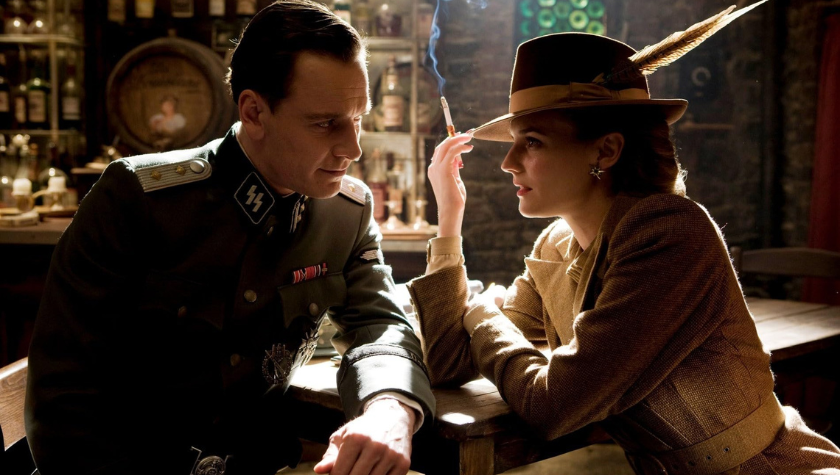
At the end of Basterds, Brad Pitt’s Nazi-scalping Aldo Raine smirks as he tells his subordinate, “You know something, Utivich? I think this just might be my masterpiece.” When the film that he’d begun writing in the late 90s finally premiered at the 2009 Cannes Film Festival, the cocky final line rang true. Basterds went on to outgross Pulp Fiction and received 8 Academy Award nominations. This creative run that started in the late 90s and took Tarantino through exploitation homages Kill Bill and Death Proof, had finally culminated in a masterpiece worthy of his last Oscar winner 15 years earlier. By taking his time and trusting his muse until he had work that could top his 90s run, Tarantino solidified his place in the industry and film history, and he’s been steadily cranking out acclaimed hits ever since.

Takeaways from Tarantino’s journey
The long path from shooting 16mm with his video store friends to achieving industry veteran status is a complex one, but here are some key pointers from Tarantino’s remarkable career to keep in mind as a filmmaker. If you want to prove your skill when you’re starting out, you have to create the work on your own by any means necessary, like My Best Friend’s Birthday or the scripts for True Romance and Natural Born Killers. And if they amount to nothing, take what you’ve learned and keep improving.
Once you’ve proven your skill, the only way to then get the work seen is by meeting and promoting yourself to as many people around the industry as humanly possible, until someone like Scott Spiegel gets it into the right hands. When a break then finally comes, invest in yourself, like Tarantino did by planning to self fund Reservoir Dogs. Think about the long game, do the work, and continue writing what inspires you.