
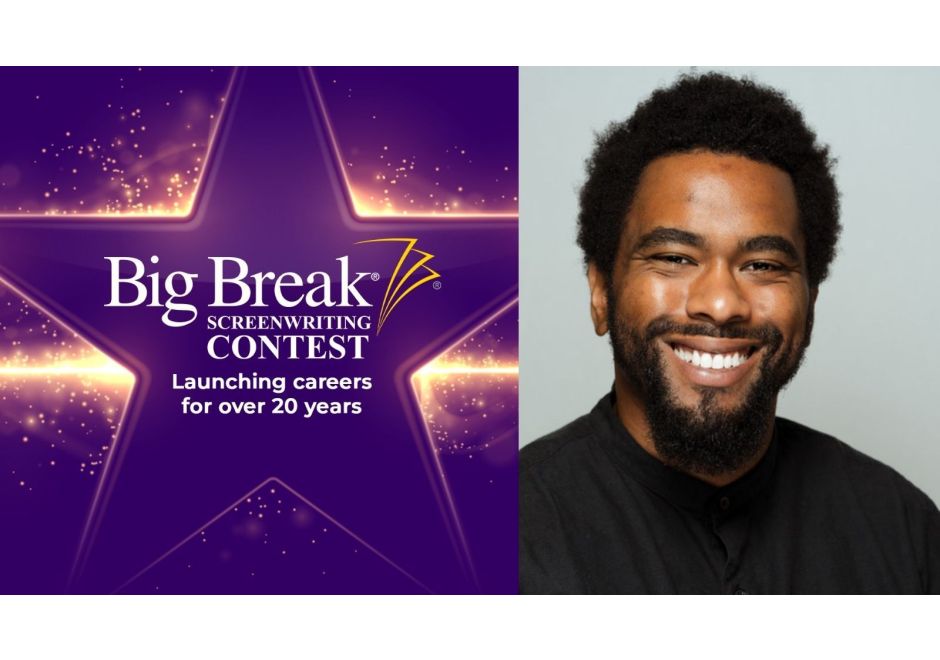
Many emerging screenwriters hope their script will win a major competition like the Final Draft Big Break Screenwriting Contest. For writer/director Xavier Burgin, not only did that hope become a reality, but it also became something even more exciting: a produced film.
Burgin won the 2023 Big Break Diversity Category with his screenplay On Time, which would go on to become the Lifetime movie Give Me Back My Daughter. Obviously, the script was already very good when he entered it. But according to Burgin, it was the validation, momentum, and industry access that helped push his script across the finish line.
Validation That Cuts Through the Noise
By the time On Time won Big Break, Burgin was a working writer. He already had credits across television and film, including writing for Starz’s Heels and directing the acclaimed documentary Horror Noire: A History of Black Horror. He even had representation.
But as he explains, none of that guarantees your script will break through.
“Just because you have an agent and a manager, it doesn’t mean that everybody’s going to watch the stuff or that everybody is automatically going to see it,” he says.
That’s where Big Break made a big difference. For Burgin, the competition served as a trusted stamp of approval, one that got gatekeepers to pay attention.
“The validation of knowing that people behind this saw merit in this [script] only pushed me more to want to try and get this done,” he says.
This is a critical distinction for emerging writers: Contests aren’t just about discovery, they’re about buzz. A script can circulate for years, but the right endorsement can suddenly reposition it as viable and worth reading.
Getting the Script into the Right Hands
Burgin emphasizes that On Time had already been making the rounds. It wasn’t a brand-new script written specifically for competition submission; it was a project he had been developing for years. It was the Big Break win that ultimately helped unlock the next step.
When new industry interest began to percolate, his team leveraged the competition as evidence of quality, making potential buyers more willing to read the script.
That small shift, getting someone to actually open the PDF, can be the difference between a script stalling out and moving forward.
The Myth of the Finish Line
It’s easy to assume that having a produced film, especially one tied to a popular network like Lifetime, would change everything overnight. But Burgin offers a more grounded perspective.
“What’s true for the film industry is it almost feels like you knock something out and it’s like resetting,” he says.
That “reset” mentality is one of the most important career truths for working writers. Each success creates opportunity, but it doesn’t replace the need to keep generating new material.
Which is why Burgin immediately returned to writing.
Since the film’s release, he’s completed a sci-fi script, written a romantic comedy, and continues to develop projects across multiple genres. Rather than narrowing his focus post-success, he’s expanding it.
Writing Across Genres (Even If You’re Told Not To)
One of the more surprising aspects of Burgin’s approach is his refusal to stay in a single lane. While industry advice often encourages writers to specialize in a single genre, especially for branding and marketing purposes, Burgin has built his career by following his creative instinct instead.
“I write what I want to write and what actually brings me joy,” he says.
His credits reflect that philosophy: Horror, sci-fi, drama, romantic comedy, and wrestling. For Burgin, the connective tissue isn’t genre, it’s personal passion.
“I’ve never really tethered myself to trying to write in one category,” he adds.
He’s also realistic about the trade-offs. He acknowledges that this approach may make marketing more complex, but for him, the creative payoff is worth it and keeps him unstuck.
For screenwriters, this raises an important question: Are you building a brand, or are you building a body of work? Burgin’s career suggests there’s room for both, but only if the writing itself is strong across genres.
Craft Advice: Clarity Over Cleverness
When it comes to advice for writers entering Big Break, Burgin doesn’t get philosophical; he gets practical. His biggest advice is to have efficiency on the page.
“Go through all your scripts. See how efficient the pages are. Ask yourself if you can get across eloquently what you have to say with less words,” he says.
This note comes directly from an understanding of how scripts are actually read in the industry. Readers are busy. They’re often looking for reasons to stop reading rather than continue.
“If they see that big wall of text, there’s a good chance they’ll skip over it.”
In other words, readability is a strategic factor.
This speaks to a broader industry truth: the best scripts are not just well-written; they are well-engineered for reading. Clean action lines, purposeful dialogue, and visual clarity all contribute to a smoother read and a better shot at holding attention.
The Intangible That Actually Matters
Beyond technical execution, Burgin points to something harder to quantify: Passion.
“I think what [competitions] recognize is passion, if the story feels like it’s truly them, if there’s soul underneath it,” he says.
This is where many writers go wrong. Instead of writing the story they care about, they try to reverse-engineer what will “win” or “sell.”
Burgin rejects that idea.
“Just write the story that matters to you, versus saying, ‘I should write this thing, and this will be the thing that gets me to the next level.’ None of that works,” he says.
It’s an accurate assessment. Competitions like Big Break aren’t just evaluating structure or concept, they’re responding to your voice. And your voice is impossible to fake.
Learn more about entering Final Draft’s Big Break Screenwriting Contest.