

Directed by Steven Soderbergh and written by Ed Solomon, The Christophers is a brilliant dark comedy that follows a twisty path in search of the place where art, commerce and family intersect. The story centers on Julian Sklar (Ian McKellen), who was once the prime rabble-rouser of London’s 1960s art scene. Now in his 80s and totally broke, he spends his days recording messages for fans on Cameo instead of painting.
When his two adult children (James Corden, Jessica Gunning), hire Lori (Michaela Coel), an art restorer and former forger to access “The Christophers,” eight unfinished canvases Julian has buried deep in the attic, they concoct a plan to ensure a six-figure inheritance. We spoke with screen writer Ed Solomon about crafting this witty, dialogue-driven script that’s an exploration of art in the age of reality TV that ultimately revealed a deeply personal story he hadn’t set out to tell.
An Unexpected Influence
For a writer whose career spans everything from the dude comedy Bill and Ted’s Excellent Adventure, to the high-concept spectacle of Men in Black, to the experimental storytelling of Mosaic, Ed Solomon has always wanted to explore new avenues of storytelling.
But beneath the highbrow artistic premise of The Christophers is something far more personal. For Solomon, the story wasn’t just about the art world, it was about unresolved relationships that had been quietly shaping his work for years.
“I have always wanted to tell a story about my relationship with various mentor figures in my life,” Solomon says. “Several of whom gave up for different reasons.”
With a prompt from Steven Soderbergh, Solomon was excited to finally get to explore this idea in the art world. Only recently did he realize just how close to home the story really was.
“The whole time, without ever realizing it until about two weeks ago, it struck me that my mother is also an artist,” he says. “A painter who did give up for a little while to be a parent and take a day job. It was very painful for me. I was like, holy moly. This informed so much of the story, and yet I didn't even realize it.”
Now 94, he says his mother had to give up painting because her painting style was very physical. “She's no longer able to do that, but what she did every day is what I do every day, I realized. She would go into her studio and spend the day there. Enjoying the freedom from the world, enjoying the chance to be lost in self-expression, and then come home.”
Though he hadn’t consciously put his mother into this story, her artistic life and choices clearly made an impact on Solomon. He was telling a story he didn’t know he needed to tell. Perhaps even she needed him to tell. Sometimes, the meaning of art reveals itself after the fact, not before. More on this in a bit.
Writing as Discovery, Not Control
If there’s a single idea that defines Solomon’s approach to The Christophers, it’s this: Writing is less about imposing structure and more about uncovering what already exists within the concept.
“The thing that Steven [Soderbergh] and I talk about a lot is: What is the thing itself, and what does it want to be?”
For Solomon, this has become less of a metaphor and more of a method. He compares the process to parenting.
“You realize your job is not to force that child into what you think they ought to be, but rather help shepherd them so they can be the best manifestation of who they want to be,” he says. “That is our job as writers as well.”
This mindset stands in direct contrast to rigid outlining or elaborate plotting. Instead of forcing characters through pre-planned beats, Solomon allows them to evolve, even if that means deviating from the original plan.
The Power of Constraints
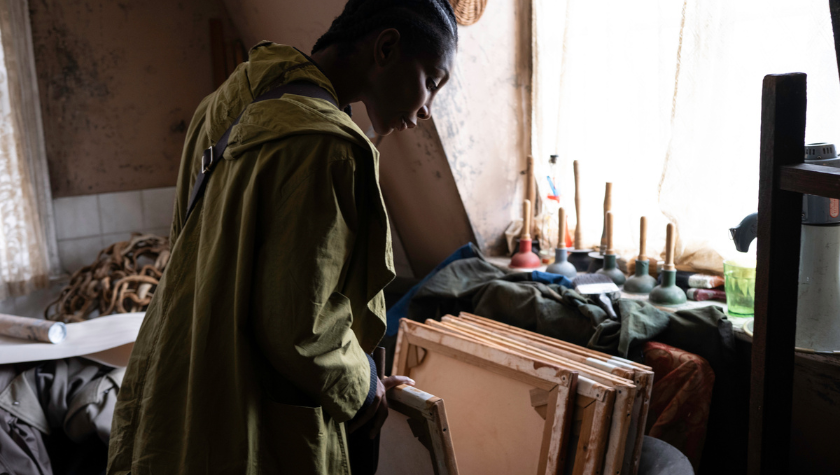
Because The Christophers was designed as a contained project with limited locations and minimal characters, Solomon found himself working within strict guidelines. But rather than limiting possibilities, those constraints elevated his creativity.
“When you’re given limitations, the creativity that comes out of that can sometimes be more inspired, more unusual, more exciting,” he says.
Solomon likens it to writing exercises or even reshoots, any time where restrictions force unexpected solutions.
“Having prompts, having rules, can really free you,” he says.
For writers working on contained films or low-budget specs, it’s crucial to remember that limitations aren’t a compromise, they’re a creative tool.
Let Your Characters Be Ahead of You
One of Solomon’s most practical insights comes from how he approached character dynamics in the film.
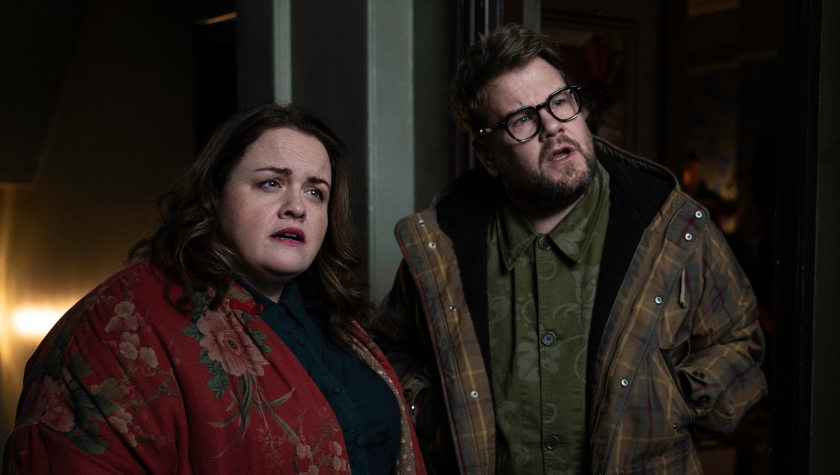
“Another lesson I learned was how valuable it is when characters are a little bit ahead of where you might think they are. I thought, ‘What if Julian and Lori had a history that he didn’t know about, but she did?’ The more personal it gets, the more charged it gets,” he says.
This led to a stunning moment when Julian reveals he is actually familiar with Lori due to a reality TV show called Art Fight where she was a contestant. We assumed she had the upper hand, and are shocked when Julian reveals he knows more than he’s letting on. It’s a great example of the dramatic impact from a character being ahead of you.
“The more you know, sometimes the better,” Solomon says. “Don’t hoard your reveals.”
Emotion Over Intellect
If there’s one concept Solomon returns to repeatedly, it’s this: Writing is not an intellectual exercise.
“For me, it is 100% about feeling,” he says.
That philosophy becomes especially critical in a film like The Christophers, which relies heavily on dialogue and interpersonal dynamics rather than plot. To sustain that kind of storytelling, Solomon emphasizes a deep emotional understanding of character.
“Understand their history, their dreams, their desires, what breaks their heart,” he says.
In practical terms, this means writing with a full sense of a character’s past and future, even if those elements never explicitly appear on screen. It also helps solve one of the biggest challenges of contained storytelling: Maintaining momentum without big spectacles or action scenes.
Collaboration and Trust
Solomon credits much of his creative evolution to his ongoing collaboration with Soderbergh.
He describes Soderbergh as, “The most in-control and yet the least controlling director I’ve worked with.” He adds that Soderbergh is someone who creates an environment where experimentation is not just allowed, but expected. For Solomon, growth is the most exciting part of the work.
“Sometimes, you’re just outside your comfort zone but you have to grow in order to achieve it,” he says.
When Life Imitates Art
Going back to Solomon’s mom: Just a couple weeks ago, he was able to take his unexpected muse to see The Christophers at the Sonoma Film Festival, which isn’t too far from her home.
“She’s in a wheelchair now, but she got all dressed up. It was really lovely to see because my dad passed away just two months ago. But I was telling her how much she inspired this movie, but also how much she has informed how I view my craft. It was such a great experience to share that with her. Very moving,” he says.
The Christophers is currently playing in theaters.