
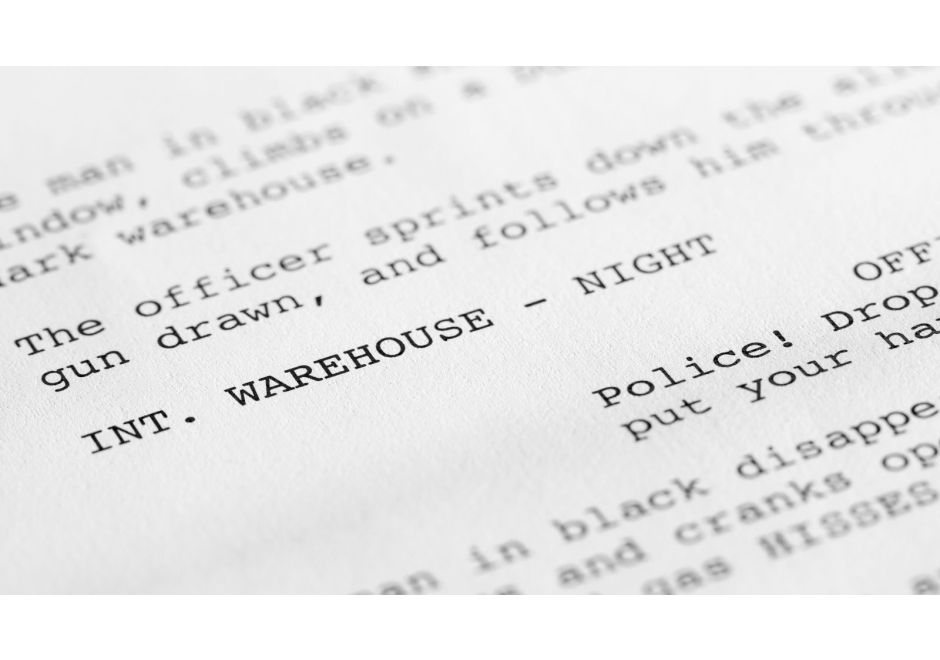
Open any professional screenplay, and you’ll notice that, yes, all of the scene headings are in all CAPS. Why? Where did this “rule” come from? How do screenwriters learn how to properly format scene headings?
Let’s dive into this subject and offer some simple explanations and breakdowns so you know your way about not just scene headings, but the overall standard industry-preferred format.
What Is a Scene Heading?
A scene heading tells the reader where and when a scene takes place, and it requires three elements to do so.
- INT. (Interior) or EXT. (Exterior)
- LOCATION
- DAY or NIGHT
INT. and EXT.
Readers and producers need to know whether they are shooting inside or outside a location. This comes into play when visualizing a scene and eventually shooting it.
- When a reader reads a scene, they need to know what to visualize.
- When filmmakers and crew members read a scene, they need to know what type of location to build or find (inside or outside, how to schedule within the shoot, etc.)
LOCATION
Once again, readers need to know what to visualize. Thus, they’ll need to know where the scene takes place. Production will need to know which scenes they can build sets for and which locations they can find through location scouting, etc.
DAY or NIGHT
Readers will need to know whether to visualize a scene shot during the daytime or visualize something at night. For productions, this is a very important element because it will determine whether the shoot is scheduled for the day or night.
It’s always best to use DAY or NIGHT rather than variations like DUSK, DAWN, MORNING, EVENING, etc. You can use the scene description to offer more details.
The only other acceptable variance is writing SAME or CONTINUOUS.
SAME
You can write SAME in place of DAY or NIGHT when the scene is meant to be taking place at the same time as the previous scene heading. Once DAY or NIGHT has been established, if you have consecutive scenes taking place at that established time, simply write SAME until the next scene heading that takes place at a different time.
CONTINUOUS
You can write CONTINUOUS in place of DAY or NIGHT when the camera is meant to follow a character or characters from one location to the next with a continuous shot. For example, if they are walking through a door leading from inside a location to the outside of that same location, CONTINUOUS can be used to communicate that seamless transfer of a character into an adjoining location.
What Should Scene Headings Look Like?
Scene headings are very simple to format. They go in the left margin on their own line.
Examples:
INT. BAR - NIGHT
EXT. PARK - DAY
INT. CAR - NIGHT
INT. OFFICE - NIGHT
EXT. OFFICE - SAME
INT. OFFICE - CONTINUOUS
As you can see, yes, all of the scene headings are in CAPS.
Why Are Scene Headings in CAPS?
The standard screenplay format has been around for decades. The format’s sole purpose is to communicate how the script should be visualized and later produced. Screenplays are blueprints for cinematic interpretations. These blueprint documents communicate what filmmakers and crew members need to make the story come to life.
Scripts aren’t just about characters, themes, stories, plots, arc, and dialogue. They need to share information and direction to make those elements come to life.
Cinematic stories are told in scenes. Scene Headings tells us what to envision with each scene. And because each scene is set in a different or altered location, those headings need to stand out from the rest of the screenplay elements, such as scene description/action, character names, dialogue, and transitions.
Putting them in all CAPS makes each scene heading easier to find.
- Readers use them to quicken the reading experience.
- Producers and crew members use them for location scouting and scheduling.
These days, screenwriting software like the industry-standard Final Draft does all of that formatting for you. You don’t even have to worry about hitting the caps lock key. Just go to the screenplay elements on your script document and select Scene Heading.
What Else Can Go in Scene Headings?
Beyond ensuring that all Scene Headings are in all CAPS, it’s helpful to remember to keep your Scene Headings as simple as possible.
Sticking to INT./EXT. - LOCATION - DAY/NIGHT is always the best common practice. But sometimes you can add additional elements to convey a specific location. Let’s say that in your script, there are characters in a house. However, they will be in various rooms of that house throughout a sequence or the entire script. Here is how you would format such Scene Headings.
INT. HOUSE - BEDROOM - NIGHT
INT. HOUSE - KITCHEN - NIGHT
INT. HOUSE - LIVING ROOM - NIGHT
Once again, if sequential scenes occur at the same time, you can use the SAME element in place of DAY or NIGHT once either designation has been established.
INT. HOUSE - BASEMENT - SAME
Note: Always avoid putting dates or any other information in the Scene Headings. Use the scene description for additional necessary details. And always keep Scene Headings as short as possible. You don’t want a single Scene Heading to bleed into another line. Each Scene Heading should only take up one line.