
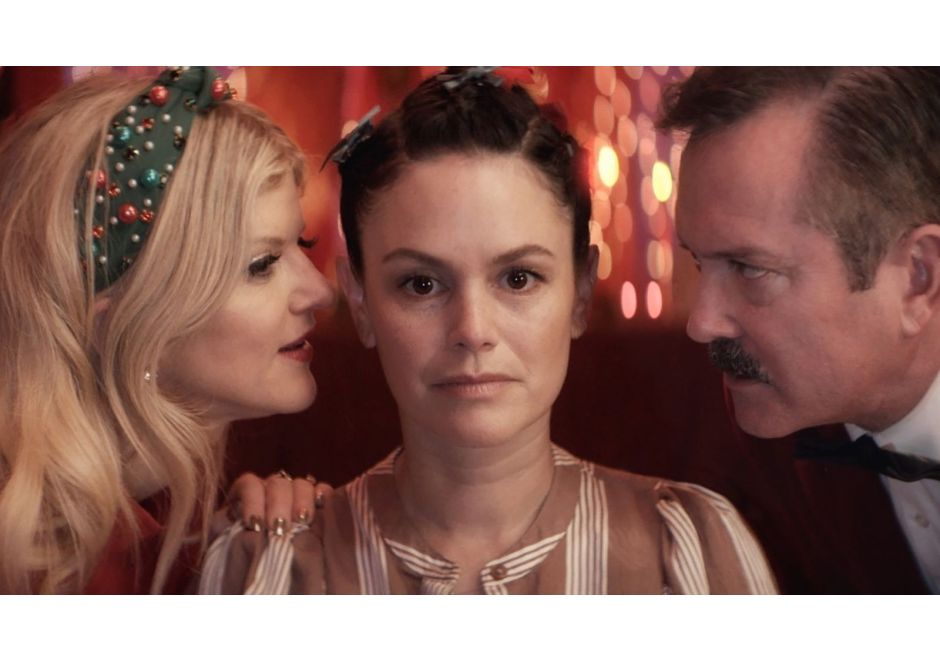
Imagine that your new neighbors love Christmas so much they celebrate it every single day of the year. At first, it might seem charming. Who doesn't love twinkling lights, Mariah Carey's "All I Want For Christmas is You" on repeat and biting the heads off freshly baked gingerbread men? But what if those same neighbors belonged to a sinister Christmas cult determined to recruit your family? Suddenly, those matching Christmas pajamas don't seem quite so adorable when you notice they're stained with blood.
That's the delightfully twisted premise of Christmas at the Kringles, a new action-horror-comedy written by Zack Imbrogno (Slayers) and directed by Kevin Lewis (Willy's Wonderland).
The film stars Ron Livingston and Rachel Bilson as Mark and Julie Severson, a married couple hoping for a fresh start when they move to a quiet suburban neighborhood with their son. Unfortunately, their new neighbors, the Kringles, take their devotion to Christmas to terrifying extremes. When the Kringles begin drawing the Seversons into their bizarre holiday cult, Mark must team up with an alcoholic mall Santa (Rob Riggle) to save them. For Imbrogno, the challenge was creating a story that could deliver outrageous comedy, genuine scares and, perhaps most surprisingly, the true spirit of Christmas.
A Spec Script Finds Its Dream Director
Imbrogno began writing Christmas at the Kringles in 2021, the same year he saw Lewis's horror-comedy Willy's Wonderland, starring Nicolas Cage. He immediately recognized Lewis as the ideal director for his screenplay. But there was one small obstacle: Imbrogno didn't have an agent or manager to send the screenplay to Lewis. So he contacted the director's lawyer himself.
"Legitimately, that is how I did it," Imbrogno says, laughing at the unconventional approach. Having worked as a producer on previous projects, Imbrogno wasn't afraid to take matters into his own hands. "I understand a bit of outreach and hustling on my end can be an important part of things," he says.
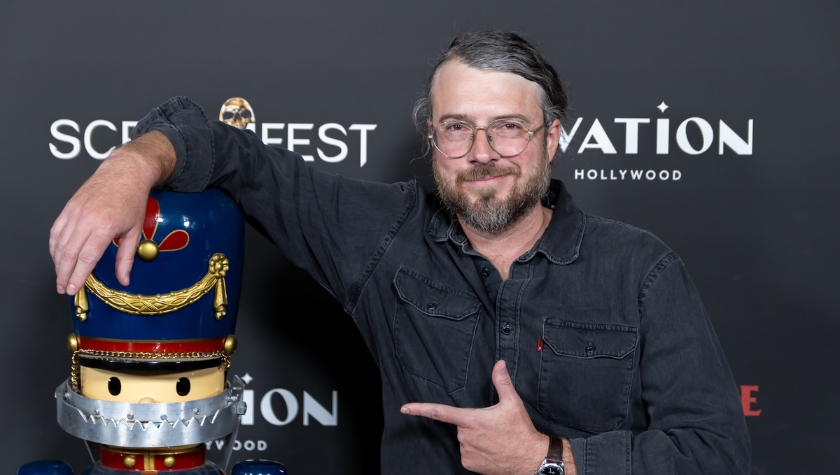
Fortunately, Lewis responded almost immediately. "I saw the pitch, and I was like, wow, okay, this is interesting," says Lewis.
The director was particularly drawn to the idea of taking something as familiar as overly enthusiastic neighbors and pushing it to absurd extremes. He even had his own experience with a neighbor he jokingly called "Father of the Year," a man whose elaborate family activities and holiday decorations seemed designed to impress the neighborhood.
Lewis also recognized a little of his own family's holiday traditions in the screenplay. His wife loves Christmas, complete with gingerbread parties, matching pajamas, and elaborate family photographs. "When I read the script, I was like, I'm in. I have to do this," he says.
Four years later, the movie is finally reaching theaters. But Lewis says it wasn't always easy to protect Imbrogno's original vision. Some producers wanted to attach a major action star and turn the story into a more conventional action movie. Lewis and Imbrogno resisted. "We always thought this was an ensemble piece. It's an ensemble comedy," Lewis says.

A Hallmark Movie Gone to Hell
For Lewis, Christmas at the Kringles was an opportunity to explore the darker side of holiday cheer without completely abandoning what makes Christmas special. "To me, this movie was always a Hallmark movie gone to hell," he says.
That meant gleefully deconstructing familiar Christmas traditions, from decorating the tree to celebrating Christmas eve with family. But Lewis was adamant that the film couldn't simply become a blood-soaked holiday spectacle. "I have to have the magic. I've got to have it," he says. "That magic, I think, is key to being a Christmas movie."
Imbrogno agreed. Even as the screenplay became increasingly outrageous, the characters needed to remain grounded in recognizable human wants and emotions. "It always had to come back to that," Imbrogno says.
That emotional foundation is particularly important for Mark Severson (Livingston), whom Imbrogno describes as an aloof husband and father who has lost touch with his family. Casting Livingston was an important step. "He's kind of the most lovable asshole you could find," Imbrogno says.
Mark may be neglectful and oblivious, but Livingston makes him sympathetic enough that audiences can root for him. When Mark realizes his wife and son are falling under the influence of the Kringles, he's forced to confront his own shortcomings. Suddenly, saving his family means more than defeating a dangerous cult. It means becoming the husband and father he should have been all along. "That's really his growth arc in this," says Imbrogno.
Creating a Cult Obsessed With Joy
While the story takes place at Christmas, Imbrogno's fascination with cults helped shape its central conflict. The writer says he even spent several years involved in what he describes as a "quasi-cult," an experience that contributed to his interest in how seemingly positive messages can become tools of manipulation.
For Christmas at the Kringles, he created a cult with its own rules, rituals and belief system, including 12 axioms that govern its followers. The cult's central promise is simple: Why experience the joy of Christmas only once a year when you can experience it every day?
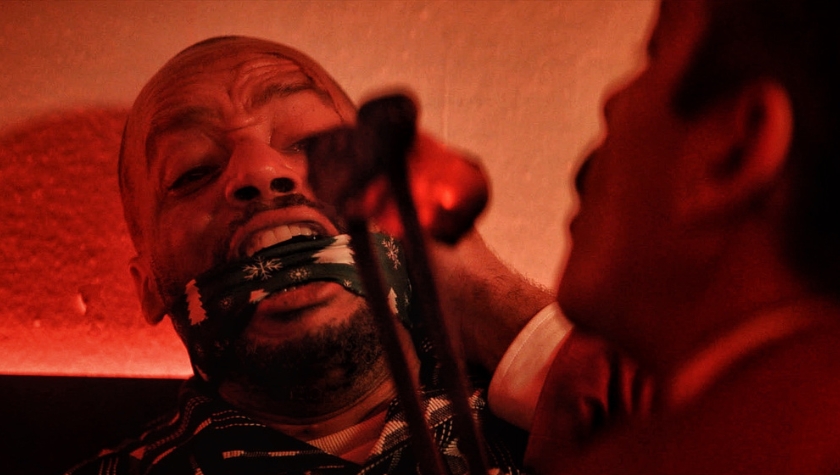
"Here's this great promise of Christmas all year, eternal joy. Of course, that's the false promise, right?" Imbrogno says. The Kringles exploit people searching for happiness and belonging, blurring the line between genuine joy and manipulation. "That's when a cult goes from a nice message or being helpful or therapeutic to, 'No, we want to control you,'" Imbrogno says.
Ironically, Mark's encounter with the cult forces him to recognize how much joy is missing from his own life. His struggle against the Kringles becomes a journey toward rediscovering what really matters.
Finding Comedy in the Most Uncomfortable Places
One of the film's most unpredictable characters is the alcoholic mall Santa played by Rob Riggle. Imbrogno deliberately created a character whose loyalties would initially be difficult to decipher. "Especially in a horror-comedy situation, it's important to question who are your allies and who are your enemies," he says.
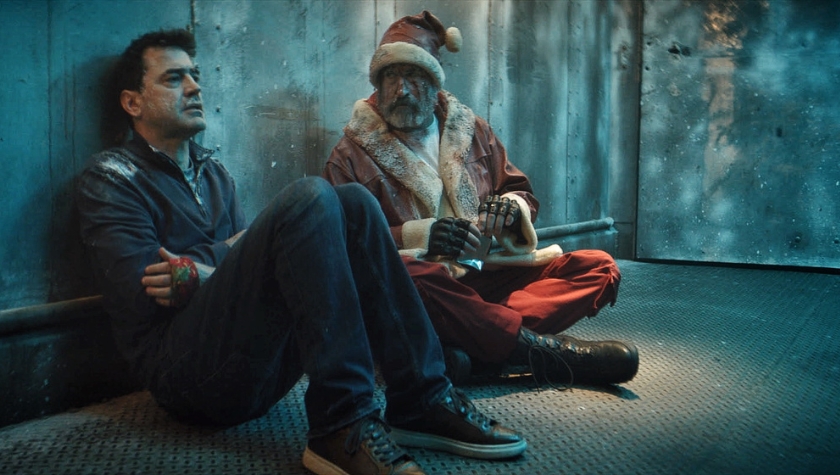
The disheveled Santa knows more about the Kringles than anyone realizes. Riggle was the first major cast member to sign on, helping attract Thomas Lennon, Arden Myrin and Beverly D'Angelo as the Kringles. Riggle's combination of comedic ability and physicality made him particularly well-suited to the role. But casting actors capable of moving between humor and genuine evil was essential. Imbrogno points to Lennon, who plays Nick Kringle. His character can shift from a cheerful, Ned Flanders-like neighbor into someone truly frightening. "Tonally, horror-comedy is always a hard line to walk," Imbrogno says.
For screenwriters attempting the genre, he recommends starting with a premise that naturally accommodates both fear and laughter. "Find the idea that you kind of know from the start that the story engine can balance things out tonally," he says. He cites American Psycho and Get Out as examples of films that push audiences into uncomfortable territory, sometimes making them question whether they should be laughing at all.
Lewis agrees that the best horror-comedy doesn't necessarily rely on jokes or clever dialogue. "When we laugh, it's not always because something's funny. We laugh out of nervousness, or we're uncomfortable," he says.
Lewis also believes that even the most outrageous premise needs a recognizable connection to everyday life. That's ultimately what Lewis and Imbrogno hope audiences will experience with Christmas at the Kringles: A wild, unpredictable ride that feels familiar but also delivers laughs, scares and even a little holiday magic.
"I still wanted that empathy and that heart and that magic to shine through," Lewis says.
Christmas at the Kringles is now in theaters.