
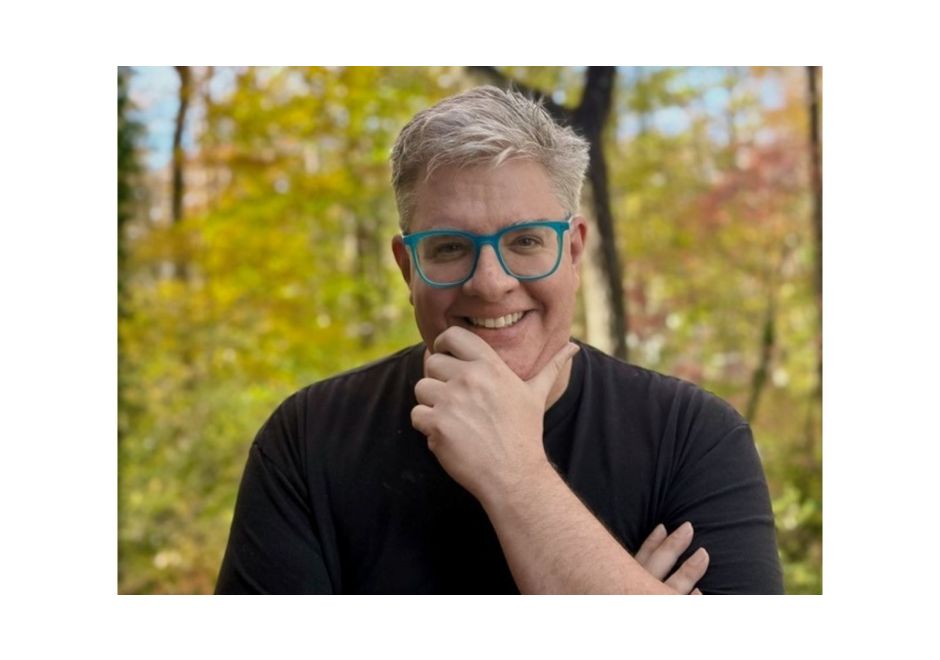
Buddy is the kind of movie that makes you wonder what bad thing happened in writer-director Casper Kelly's childhood to write something this wonderfully bizarre.
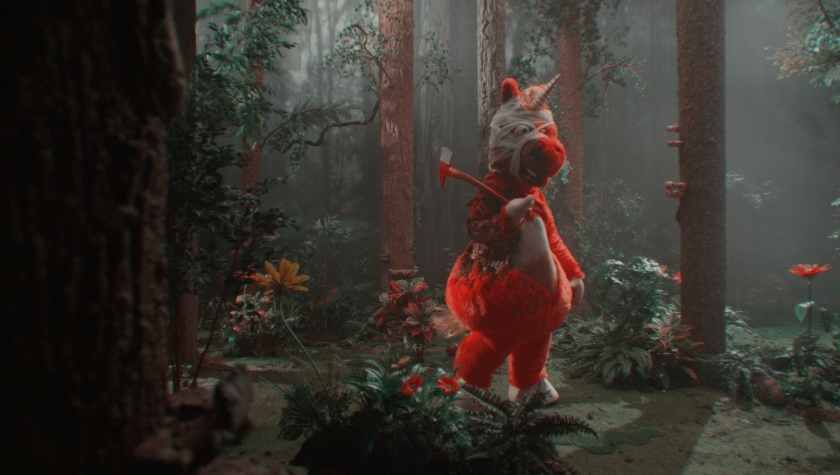
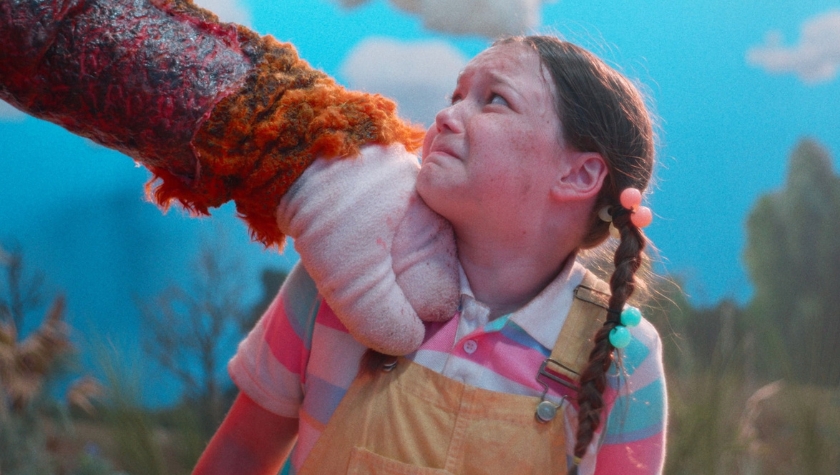
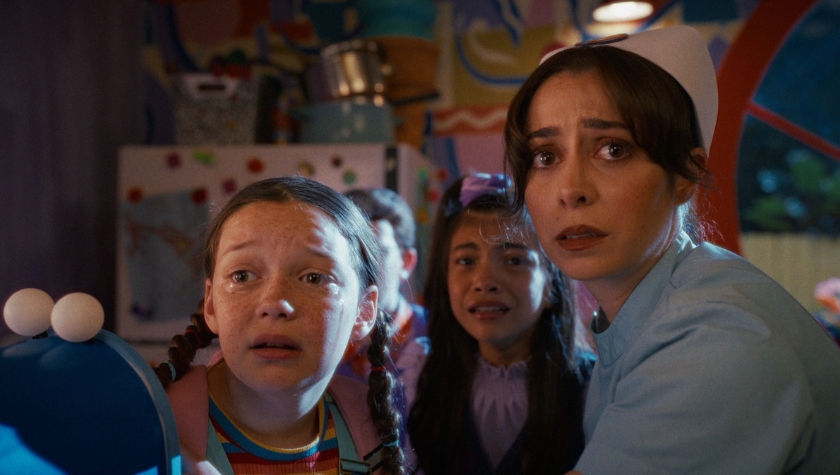
The slasher-comedy centers on a group of children trapped inside a surreal 1990s-style television show hosted by Buddy (voiced by Keegan-Michael Key), a giant orange unicorn who is a lot less cuddly than he initially appears. Also starring Cristin Milioti, Topher Grace, Michael Shannon and Patton Oswalt, Buddy gleefully mixes children's television, horror, comedy and nostalgia into something totally bonkers.
For Kelly, who co-wrote the screenplay with Jamie King, that strangeness is the whole point. The inspiration came partly from watching children's television with his own kids, including Barney, Dora the Explorer, Blue's Clues and Pee-wee's Playhouse. What fascinated him was just how rigidly pleasant those worlds could be.
"Everyone's always so well-behaved in these shows, and there's always something sinister about that," Kelly says. "When something's too perfect, it seems like there's often something sinister underneath."
That disquieting undertone helped inspire the character Buddy, who Kelly imagined as the star of a fictional 1990s kids' show similar to Barney. But instead of a purple dinosaur, he chose a unicorn because unicorns come with their own weapon. The filmmakers considered several colors before settling on Buddy's distinctive orange. Purple was obviously too close to Barney, blue seemed too calm, green didn't feel right, and red was too aggressive. It's a funny example of how much thought can go into creating something that ultimately feels completely unhinged.
Take the Absurd Seriously
One of the most useful lessons in Buddy is that an outrageous premise or character needs to be fully developed to create emotional stakes.
"I do want people to feel things in this movie," Kelly says. "It's absurd, but I want people to get feelings from it, and a real emotion, and in a way, I take it seriously, as absurd as it is."
Kelly sees the movie partly as a parable about nostalgia and authority, particularly what happens when someone exists inside a world where they have very little power. That structure could be a family, a company or even a country. Someone once pointed out to him that being trapped is a recurring theme in Kelly's work. "I was like, 'Oh, that's really interesting. I wonder where that comes from.'"
Even though most writers have a theme in mind when they sit down to write something, sometimes new themes emerge during the writing of the piece, and that can be exciting.
The Weirder the Movie, the More Structure Matters
Kelly built his career working in short-form television, including 30- and 60-second promos and 11-minute shows for Adult Swim. Expanding into features created a different storytelling problem. "The biggest challenge is always structuring the story for 90 minutes," he says.
With Buddy, Kelly and King had to make sure the story continued escalating while still surprising the audience. Whenever a pattern began to feel predictable, they looked for a way to "Zag away from that. The nuts and bolts of it is always the hardest part," he says.
That's important when writing something as strange as Buddy. Audiences might accept a murderous orange unicorn, talking trains and an emotional mailbox, but the screenplay still needs to move the story forward.
Getting the Movie Made Was Another Horror Story
Kelly already had an established career when Buddy went out for financing, but he faced a new challenge. "It wasn't easy. It never is easy, unless you're Christopher Nolan," he says with a laugh.
BoulderLight Pictures came aboard, but even the company behind films including Barbarian, Companion and Weapons struggled to secure financing. Eventually, Low Spark Films stepped in and helped get the movie made.
Kelly takes some comfort in knowing that plenty of beloved films were rejected repeatedly before somebody finally took a chance on them. "Many movies we love, no one wanted to make it until one person did, and now it's a cult classic."
As all the "Nos" kept coming, his strategy was to just keep writing. Kelly worked on other projects, including Adult Swim Yule Log 2: Branchin' Out and a segment of the V/H/S horror franchise. You can't control whether someone finances your screenplay. You can only control whether you write the next one.
When the Horror Followed Them Onto the Set
As if the fictional world of Buddy wasn't creepy enough, Kelly says something strange happened during production involving one of the movie's marionettes. In one part of the film, the characters encounter figures inspired by Western-themed kids' shows like Howdy Doody. But apparently one of those characters became a little too lifelike on set.
"The marionette, whenever it was set down, it would seem to be in a different position," Kelly says. "We went to go get him, he'd be in a different place, and it was like, 'Is someone playing a joke on us? What's going on here?'" No one ever figured out exactly why the marionette seemed to be moving.
For a filmmaker already twisting the supposedly safe and cheerful world of children's television into nightmare fuel, having a potentially haunted puppet on set seems strangely appropriate.
Push an Idea Until It Scares You
Perhaps Kelly's best advice for writers comes from his approach to pushing genre boundaries. Sometimes he'll have an idea and immediately think audiences will love it. "Usually they don't," he says.
The problem, he believes, may be that trying to predict what audiences want doesn't give them enough credit. A much more interesting signal comes when his own idea makes him uncomfortable. "When I get an idea of, like, 'Oh man, I like this idea, but there's no way I can do it. I'm too scared to do this,' that's probably a better indicator."
His advice is to keep digging until you reach something that makes you slightly nervous about sharing it. "Keep pushing and digging into yourself until you're a little scared to put it out there. It's probably a good direction."
Buddy is in theaters August 28th.