
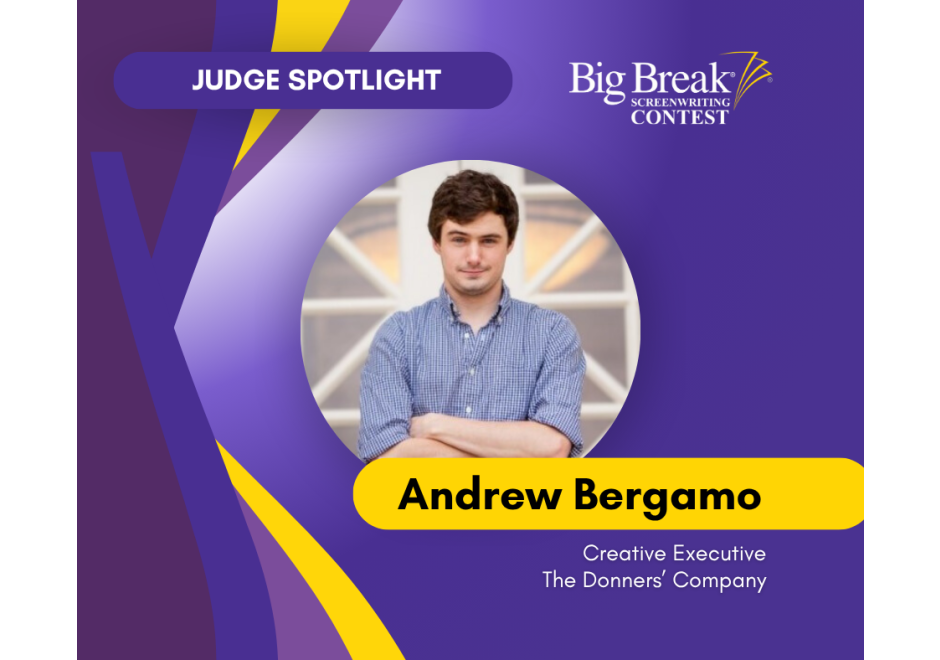
For Andrew Bergamo, Director of Development at The Donners’ Company, judging scripts for the Final Draft Big Break Screenwriting Competition isn’t about what’s currently selling or finding the next blockbuster idea. It’s about instinct, feeling and purpose.
“I’m always looking for an authentic voice behind the script,” Bergamo says. “There’s a difference between a screenplay that hits all the beats you’re supposed to hit, and one where you feel a real personal connection to why the writer wrote it.”
That distinction between competence and connection guides how Bergamo reads. And it’s shaped by a career built on collaboration, deep research and character-driven storytelling, from his early days at Marvel Studios to his current role at The Donners’ Company.
When Bergamo sits down to evaluate Big Break submissions, he’s not asking whether the writer understands structure. He’s asking something far more subtle: Does this story have a purpose?
Purpose Over Polish
Bergamo is quick to acknowledge that many of the scripts he reads are good. They’re well-written. They’re professional. Some could easily get made. But many don’t linger after the read.
“There’s no real purpose behind it,” he says. “You don’t feel that personal connection the writer has to the material.”
The scripts that stand out have an emotional life. Even if Bergamo can’t immediately articulate why they work, he knows when something feels true.
“It’s almost something you can’t tangibly point at. It’s just something you feel when you’re reading a story. The purpose for why they wrote it.”
For writers entering Big Break, that’s an important distinction. The competition isn’t just evaluating whether you can execute a three-act structure. It’s evaluating whether your voice is clearly yours.
Characters Are the Entry Point
If purpose is the thing that sparks Bergamo’s interest, characters are the thing that keeps him reading.
“The other main thing I’m looking for are the characters,” Bergamo says. “Are they interesting? Are they compelling? Are they grounded?”
Even in heightened genres like superhero films, character relatability matters.
“You can be telling a story in a totally other universe, full of alien creatures, but is the emotional journey of those alien creatures something a person sitting in their seat on a Saturday afternoon going to care about?”
That question sits at the heart of Bergamo’s development philosophy. Spectacle may draw attention, but character is what sustains it. If a character isn’t relatable, Bergamo wants to know whether that lack of relatability is meaningful or worth caring about for a two-hour movie.
The One Red Flag He Sees Again and Again
Despite the high caliber of writing seen in Big Break scripts, Bergamo does see recurring missteps, especially among newer writers. His biggest pet peeve is the overuse of frenetic openings from scenes later in the script.
“It’s the tried-and-true starting in the middle of a crazy thing happening,” he says. “A big action scene, a big dramatic moment, then it stops and jumps to ‘two weeks earlier.’”
While the device can work, Bergamo sees it as a warning sign when it’s used reflexively.
“If you have to start your story that way, then you aren’t confident in where your story actually begins,” he says.
He compares it to narration: powerful when used intentionally, damaging when used as a crutch.
“There’s great narration,” he says, “and then there’s relying on it to tell us what’s going on instead of adding another layer to the story.”
For writers, it’s a simple lesson: trust your opening. Trust the moment where your story truly starts. If it’s not exciting enough, then maybe start the story at another point.
When a Competition Script Becomes a Real Project
One of Bergamo’s most striking Big Break stories underscores why the competition matters. He recalls reading a pilot from an unknown writer that immediately grabbed him.
“I read this pilot and thought, ‘I want to see this TV show. I want to make this show.’”
Bergamo reached out to the writer. They connected. He brought the script to producer Lauren Shuler Donner.
“She said, ‘I don’t really have any notes on this. We should just try to develop this.’”
That kind of outcome is rare, but it’s not accidental. Bergamo emphasizes that Big Break creates real access because its judges are actively looking for material.
“It’s not just, ‘Oh, this is a great writing sample,’” he says. “I’m always looking for stuff to develop. This competition is a great resource for finding undiscovered writers.”
The Feeling He Chases
Ultimately, Bergamo comes back to a single emotional gauge.
“There’s this genuine, grounded emotion that fills you up as you’re reading and you think, ‘I just want to share this with other people.’”
That feeling, the urge to pass a script along, to champion it, to protect it, is what Big Break judges are chasing. Not perfection or trends. But resonance.
For writers entering the competition, the advice is clear: write the script that only you could write. Trust where your story begins. Build characters who feel emotionally alive. And above all, make sure there’s a reason behind every page.
Because when that purpose is there, Bergamo says, “That’s when a screenplay really sings.”
Final Draft’s Big Break Screenwriting Contest opens March 23, 2026 for entries. For more information visit finaldraft.com/big-break-screenwriting-contest.