
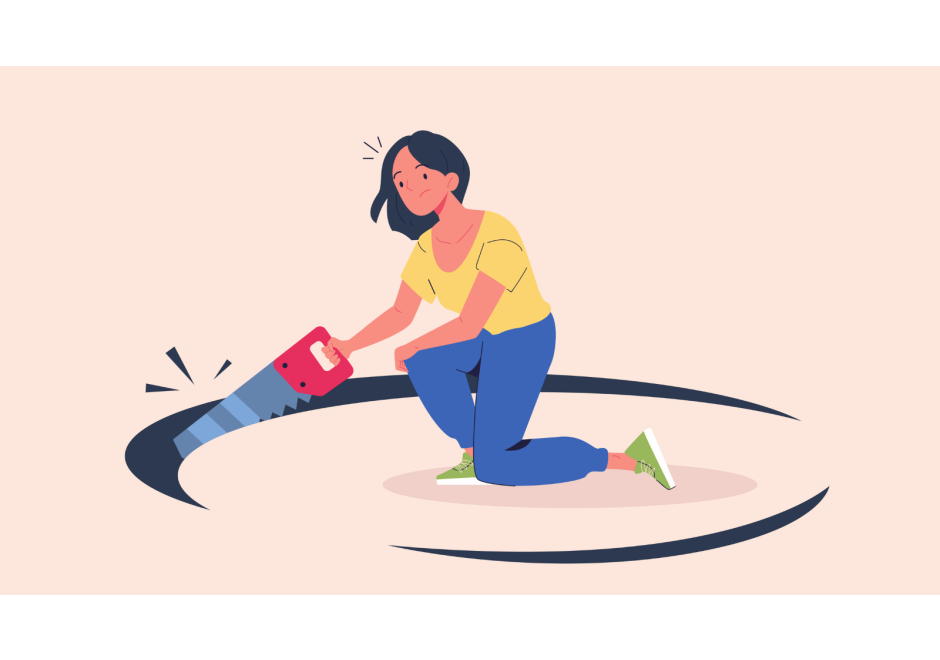
Chasing the Hollywood dream can feel difficult at times. So much lies outside our control as writers, and when disappointment hits, it's easy to spiral into disillusionment.
But there's one thing we can control: how we conduct ourselves as writers. And I don't mean in the room, or in a networking sense. I mean not letting our writing practices drag us down, but instead push us forward. This is the only thing we truly control on the path to production—not the "yes" we covet or the "no" that stings. Yet so often, we sabotage ourselves along that path without even realizing it.
Let's break it down and find the antidote. Nothing magic—just you, and how to stop the self-sabotage in your screenwriting.
1. You take writing too seriously (or not seriously enough)
If screenwriting is your all-consuming point of reference, perhaps it's time to take a step back. Writing needs personality, and the only way to have a personal point of view is to live outside the writing bubble and get out into the world.
On the flip side, if you don't take screenwriting seriously enough and think you can skate by without knowing or employing industry-standard screenwriting conventions, you're sabotaging that wonderful idea of yours. If you take shortcuts in your writing and don't give your craft the time it needs to grow, that will show in the work.
The way forward is to find balance. You may be a Writer with a capital 'W', but as a human, there's always room for levity, criticism, and growth. We don't know it all and never will. That's the beauty of it all.
2. You don't get out in the real world enough
Let's talk a little more about how important it is to get out into the 'real world'. How can you accurately depict human nature, or even subvert it in your stories, if you're not regularly exposed to it?
There's a certain amount of truth to "write what you know". But even if your story is set in outer space, the characters will all be experiencing very known emotions. The point is, we need to feel the emotions that ground our adventures on the page. Yes, an incredible imagination gains big points in a story, but those human qualities are what will draw your audience in and keep them. If you don't have those experiences, your writing will lack an authentic quality.
3. You think your writing has to be perfect
Your writing does not have to be perfect. If you think it does, you're sabotaging yourself.
The reality is, to get forward in your writing, the first step is to actually finish what you started. Sometimes that means leaving the idea of perfection behind.
If you're always waiting for your screenwriting to be perfect—just one more revision round, one more "what if" idea inserted into act three—that wonderful idea of yours is doomed to live out its days in the cloud forever. Imperfection, sometimes, is the voice that puts a unique spin on a familiar concept that makes it fresh and invaluable.
4. You're scared to show your work to other people
We can write and re-write for the rest of our days, chasing the perfect script. But believing our work needs to be perfect before we show it to anyone is an action largely driven by fear, not perfection. Fear of the 'no'. Fear, even, if we really look deep, of the 'yes', too. That means more hard work and life-changing consequences; we say we want them, but do we? It's amazing what we can talk ourselves out of.
So we talk ourselves out of showing our work to begin with, using a myriad of excuses: It's not good enough, I don't know what I'm doing, It's not as good as Friend A's, or my favorite: What if they say I'm not good enough and RIP my screenwriting dream forever?
Here's the thing: That's one person's opinion. There is a certain amount of human bias that goes into every Hollywood decision, and that's just the way it is. The thing about fear is that if we face it each time, it gets a little easier the next.
5. Showing your work too soon
On the flip side, showing your work before it's ready can also be a mistake. In our eagerness to share our work with the world, we hit the 'send' button a little too soon, and the opportunity we were so eagerly chasing gets blown because we didn't give the script one more proofread.
You'll never get a second chance at a first impression. Perfection isn't the goal, but showing your best self is. Everyone appreciates effort, honesty, and respect. Respect their time by taking yours in ensuring your script is the best it can be.
6. You let rejection affect you
No one likes hearing no. It hurts. But it's hard enough out there without being hard on yourself.
So the next time you feel yourself slipping into one of these self-sabotaging mindsets, take a breath and step away from the laptop. Drink that overpriced latte and shut the thing entirely; take a look around you. What do you see, hear, smell, feel?
Take it into your next writing session. Get into the work faster through practiced routines. Separate the writing from your identity and treat it like work: Show up, do your best, submit it, and move on. Guaranteed you'll do better next time, with practice.
It also helps to find your people, commiserate a little, and keep a little file if you need to. Success is built on top of all types of journeys, not just the smooth ones.
You've got this.
Keep writing.