

Ryan Murphy has spent more than two decades building one of the most prolific track records in television history. Glee, American Horror Story, Love Story and numerous other successful series have proven Murphy’s strength as a producer (he has also directed and co-written several episodes of his various series). His latest series, The Shards, is an adaptation of Bret Easton Ellis’s acclaimed 2023 novel, and contains many Murphy signatures: style, melodrama and murder.
The Shards is also vintage Ellis (Less Than Zero, American Psycho), and he co-wrote the first two episodes of the new series. Seventeen-year-old Bret, a stand-in for the author himself, starts his senior year at an elite school in Los Angeles. He’s a closeted bisexual, wealthy, and largely unsupervised, moving through a friend group built on money, beauty, and carefully managed secrets. In addition to all of this, a serial killer known as the Trawler has started targeting local teenagers, and an enigmatic transfer student named Robert Mallory arrives at Bret’s school bringing a past nobody can verify.
Just a couple of episodes in, the series has much to teach writers: worldbuilding, mystery, character, and tone are all handled skillfully and effectively. Whether you’re working on a screenplay or a TV pilot, here are five things you can learn from The Shards.
1. Capture a Specific Time Period
The Shards transports us back to 1981 Los Angeles: the Sherman Oaks Galleria, Hamburger Hamlet on Sunset, and L’Ermitage in Beverly Hills are just some of the real-world locations featured in the story. Bret and his friends meet up and hang out at these iconic LA locations, and every spot is recreated with meticulous detail.
The costuming is likewise detailed and authentic: Gucci loafers, Ralph Lauren button-downs, and endless Calvin Klein basics on kids who wear their wealth like a uniform. Even the set dressing is precise, right down to the Foreigner 4 poster in character Matt Kellner’s bedroom.
The needle drops are just as on point. Each episode is wallpapered with songs you would’ve heard on KROQ Los Angeles in 1981. In one scene, Susan dances excitedly to Human League’s ‘Don’t You Want Me’ as her friends cheer her on from a hot tub. The movies Bret watches are also cultural markers and intertwined with the plot (most memorably Stanley Kubrick’s The Shining in the series’ opening scene).
When you’re writing a period piece, resist using general references. Be specific. Name the mall. Name the poster on the wall. Details like this earn your reader’s trust and make them believe in the world you’ve built. Capturing a time period can also trigger nostalgia, especially if it’s an era that’s remembered fondly or romanticized.
2. Create Mystery From the Beginning
The first episode opens with a preamble set in 1980. Bret is catching a matinee of The Shining at the Village Theater in Westwood. In the cinema, he spots Robert Mallory for the first time and is immediately entranced by this handsome young man. Bret’s voice-over makes it clear this is a significant and possibly foreboding event.
We then jump to the fall of 1981 and senior year. There’s talk of a “new kid” going to Bret’s school. During lunch, he introduces himself to Bret and his friends Susan and Thom (the most popular couple at the school) and Debbie (Bret’s girlfriend and daughter of a Hollywood producer). The new kid turns out to be Robert Mallory. Bret recognizes him instantly and brings up seeing him at the Village Theater the prior year. Robert flatly denies it, claiming he’s never seen The Shining and only moved to the area recently after his mother’s death.
The denial only escalates things. Bret follows Robert after school, and the pursuit turns into a car chase that ends in the parking structure at the Sherman Oaks Galleria, where Robert confronts Bret directly, goading him. This unnerves Bret and increases his paranoia tenfold. He’s convinced Robert is a liar and might even be mentally unstable.
Also introduced in the first episode is a serial killer terrorizing local teens known as the Trawler. Bret’s fixation on the case runs parallel to his suspicion of Robert, and the two mysteries blur into one. Even before Bret inevitably comes to the conclusion, the inference hangs in the air: what if Robert Mallory is the Trawler?
Mystery is always a great way to hook your audience, and it’s best to do so as early as possible. The Shards also shows us that two mysteries running side by side are more engaging than just one. Plant multiple mysteries at the jump, and let your protagonist slowly connect them.

3. An Insider Reveals Their World and Its Secrets
Bret narrates The Shards from within the privileged world he’s describing, giving the show access to places a more distant narrator could never reach: the hidden corners of Hollywood wealth where parents are often absent and nobody is watching the kids.
The party at the Schaffer home is a great example of an insider’s spotlight. Terry Schaffer, Debbie’s father and a powerful film producer, throws a lavish gathering built around a screening of his new movie, Continental Divide. Terry feigns interest in the novel Bret is writing and suggests they do lunch to talk screenwriting. Despite seeming aware of the predatory undercurrent, Bret sees the offer as an opportunity and agrees. In the early 80s, it’s not hard to imagine this kind of thing happened often, and it plays out with insider authenticity.
An insider narrator can add more depth to your story because they’re part of the world they’re exposing. When your protagonist belongs to a specific subculture or organization, let them narrate it with the knowledge and fluency of someone who has lived within its rules.
4. Distinct Characters with Different Agendas
Every major relationship in The Shards is built on an ironic mismatch, with Bret at the center of nearly all of them. What each person wants from him rarely lines up with what he wants from them.
Debbie wants Bret to be a real boyfriend, whereas Bret sees their relationship as casual. Her father, Terry Schaffer, seems aware of this and exploits it. His pursuit becomes more overt at the lunch he promised at his party. After wooing Bret with various entrées at L’Ermitage, Terry pushes the conversation from writing into sex. He asks Bret about his sexuality and doesn’t hide his lecherous intent. The young man doesn’t fully engage, but at the same time is careful not to offend this powerful producer. They’re trying to get something different from one another, and they both know it.
Bret’s relationship with Matt Kellner is another one that’s incongruent. For Bret, they’re genuine lovers. Matt sees things differently: to him, what they’ve been doing is a casual indiscretion he’s ashamed of. Bret is investing real feeling into a connection Matt is actively trying to disown. This ultimately leads to anger and resentment from Bret. After arguing with Matt, he drives off, and his voice-over informs us this is a recurring pattern in his life.
Robert Mallory is the most complicated relationship of all, because Bret’s feelings toward him are split. He doesn’t trust Robert and becomes increasingly convinced that something is wrong with him and he’s dangerous. At the same time, ever since that first charged look across the Village Theater, Bret is drawn to Robert in a way he can’t separate from the suspicion. That transference, desire into paranoia and back again, drives the entire narrative.
Robert, for his part, treats Bret with something close to mischievous contempt, needling him with hints that he sees straight through his public front. He also makes sure Bret knows he’s got his sights on Susan, which stirs a jealousy Bret can’t fully name and reroutes into anxiety about his social circle coming apart.
Distinct characters with different agendas are essential to any good story (regardless of genre). It creates dramatic irony and generates conflict: two things that propel a narrative and keep people interested. Decide what your protagonist wants from each character, what they want in contrast, and play into the messy drama of it all.
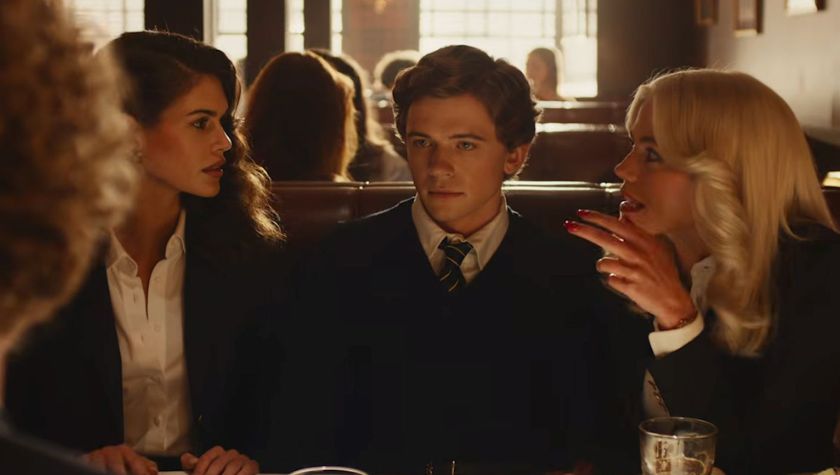
5. Serial Killers Still Fascinate People
The Trawler storyline works as more than an impending threat; it’s arguably the most commercial hook of the series, tapping into an appetite that’s been profitable for decades. Serial killers occupy a strange place in the cultural imagination: terrifying up close, magnetic at a distance; a safe way to look at the darker side of humanity.
Also, serial killers themselves are an extension of 1970s-1980s pastiche, being most prominent and discussed in our culture during that period. As a result, there’s a nostalgic element at play here as well (along with the setting, fashion, and music). In a contemporary world of mass shooters and global pandemics, being scared of a serial killer almost seems quaint by comparison.
Ryan Murphy has built many TV shows on the fascination with serial killers. His Monster series, which explores notorious killers like Jeffrey Dahmer, the Menendez Brothers, and Ed Gein, was a massive hit. Similarly, Bret Easton Ellis’s American Psycho was a bestseller and turned into a classic film directed by Mary Harron. Not surprisingly, The Shards is his most acclaimed and popular novel since American Psycho, and no doubt the serial killer subplot was a factor in its success. Murphy and Ellis both know the public’s appetite for this darker content.
There’s an easy lesson here: serial killers are highly marketable. If you can find a story about a killer that hasn’t been told or a fresh approach to a familiar one, you’ll likely have a concept people will be interested in.
Picking Up 'The Shards'
Nostalgia, mystery, insider access, tangled character agendas, and a serial killer at large: The Shards shows how to make use of these time-tested storytelling devices. Apply just one of them effectively, and you might come up with a winning screenplay or TV pilot.
Apply more than one or all, and who knows? You may have the next big hit on your hands.