
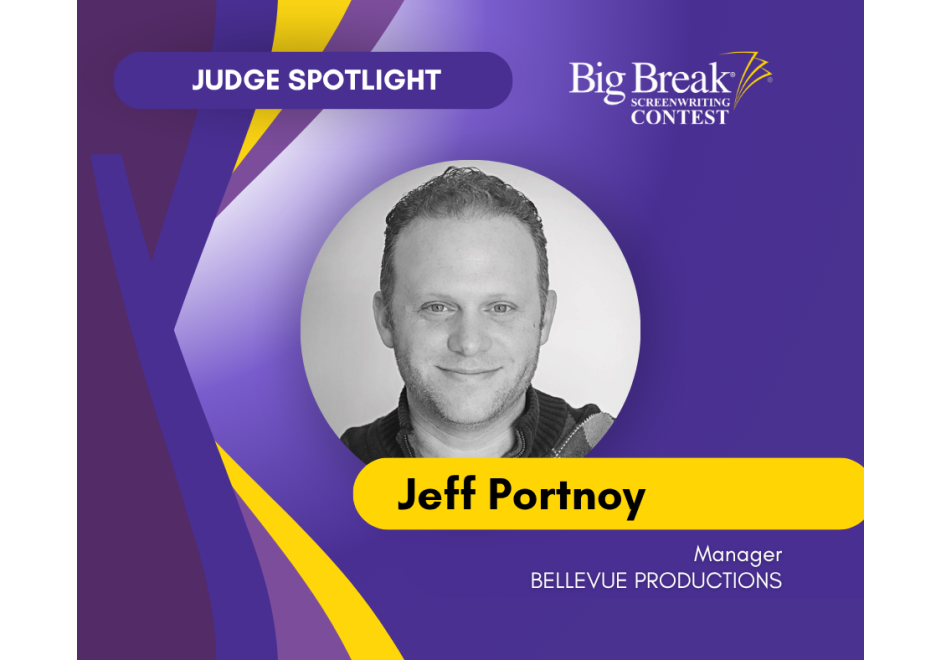
Before Jeff Portnoy judges a Big Break script, he approaches it the same way he would any project crossing his desk at Bellevue Productions. He asks himself: Is this a writer I could build a career with?
Portnoy represents writers across both film and television, guiding material from early development through packaging and production. Over the course of his twenty-year career, shaped by stints at Creative Artists Agency, The Gotham Group and the Resolution talent agency, he has read thousands of scripts at every stage of readiness.
Over time, his evaluation process has distilled into five core areas, or what he calls his five “buckets.” Together, they form the internal checklist he uses to decide not just if the script is good, but is this a writer worth investing years of development in?
We sat down with Portnoy to find out more about the five buckets he uses to evaluate a script and writer.
1. Character and Dialogue
This is Portnoy’s top priority, and the one he’s least interested in fixing after the fact.
“Character and dialogue are the hardest things to help a writer improve upon after you’ve signed them,” he says. “So I’m looking for them to be strong in that zone.”
For him, this means characters who feel three-dimensional on the page and dialogue that carries specificity, rhythm, and subtext, not just information. A script can have structural issues or conceptual gaps, but if the characters don’t feel alive, it’s a much steeper hill to climb.
When a writer gets this right, Portnoy notices immediately.
2. Plot and Structure
The second bucket is more technical, but also still coachable.
“Plotting and structure are easier to help clients with,” Portnoy says. “It’s more mechanical. You want this [event] to happen on page 25, this on page 50.”
At this point he’s still evaluating whether the writer understands movement, escalation, and pacing, but he’s less alarmed if those elements need tweaking. Structural problems can often be diagnosed and repaired. Still, if a script is all over the place, it signals more developmental work will be needed ahead.
3. Idea Generation and Originality
Next comes the idea itself. Not just the execution, but the writer’s ability to consistently generate concepts that stand out.
“Are they good with coming up with unique ideas?” he asks. “Are they finding things that are going to move the needle?”
Portnoy notes that some writers are excellent with character and structure but struggle to come up with loglines that distinguish themselves from the many other writers. While this is another area he can help develop, he’s always paying attention to whether a writer has a natural instinct for novelty and market awareness.
4. Prose and Voice on the Page
This bucket isn’t about story mechanics, it’s about the reading experience.
“It’s not plotting, it’s not the characters and how they speak,” Portnoy says. “It’s just the way they articulate it on the page for the reader.”
He’s quick to point out that most of this won’t survive the transition to the screen. But before a script ever reaches production, it has to travel through managers, producers, executives, and financiers. Voice, clarity, and energy on the page matter because they make people want to keep reading.
“It’s how they made reading the script fun for me, fun for producers, fun for the executives,” he says.
5. Personality
The final bucket isn’t on the page at all, it’s the writer.
“How they come off in a room or on a Zoom, or over the phone,” Portnoy says. “Are they good at taking notes? Are they good at trying to implement notes? Are they a team player?”
Personality, he notes, is especially critical in television, where collaboration is constant. In features, it can be less determinative, but it still affects employability. By the time he’s meeting a writer, this trait is largely “baked in,” but it plays a role in whether a long-term partnership makes sense.
“The more of the boxes are checked across those five things,” Portnoy says, “the more likely it is I’m going to engage.”
And then, in true manager fashion, he doesn’t leave writers there: he immediately pivots to what they can do to improve their odds.
The most common mistake: Act 2 happens too late
If Portnoy could slap a Post-It reminder on every emerging writer’s desk, it might be this: Get to Act 2 earlier.
“One of the more common mistakes I see is not breaking into Act 2 early enough,” he says. This is important because of the high number of scripts people in the industry are reading.
“They’re probably really only doing 20 to 30 pages of each one,” he says. “You have to hit that break into two at the right spot.”
His rule of thumb: no later than page 25. It’s not written in stone, but for newer writers without credits, they should take it to heart.
Portnoy’s definition of the break is also refreshingly simple: it’s the moment the protagonist makes a decision and actively enters the “extraordinary world.”
“What makes us feel that subconsciously is when characters make decisions,” he says. “It’s a movement based on decisions.”
He even offers a clean horror example: Act 2 is “flight,” Act 3 is “fight.” Different genre, same principle: the gears shift when the character shifts.
Breaking Through the Gates
Portnoy’s presence as a Big Break judge matters for a reason beyond taste: he represents the part of the industry writers are trying to reach. So, when he reads, he isn’t just handing out points. He’s evaluating whether a writer is ready to enter a professional relationship based on development, strategy, and long-haul career building.
That’s why Big Break isn’t just a contest in his mind. It’s the first real filter in an industry built on filters.
“Contests like Big Break are the first line of defense,” he says.
For writers, that’s both sobering and hopeful. Yes, funnel is real but Big Break is one of the rare places where the funnel widens just enough for new voices to slip through and land on a manager’s desk not as a cold query, but as a vetted read.
In a business where time is scarce and attention is currency, that difference can change everything.
Final Draft’s Big Break Screenwriting Contest opens March 23, 2026 for entries. For more information visit https://www.finaldraft.com/big-break-screenwriting-contest/.