
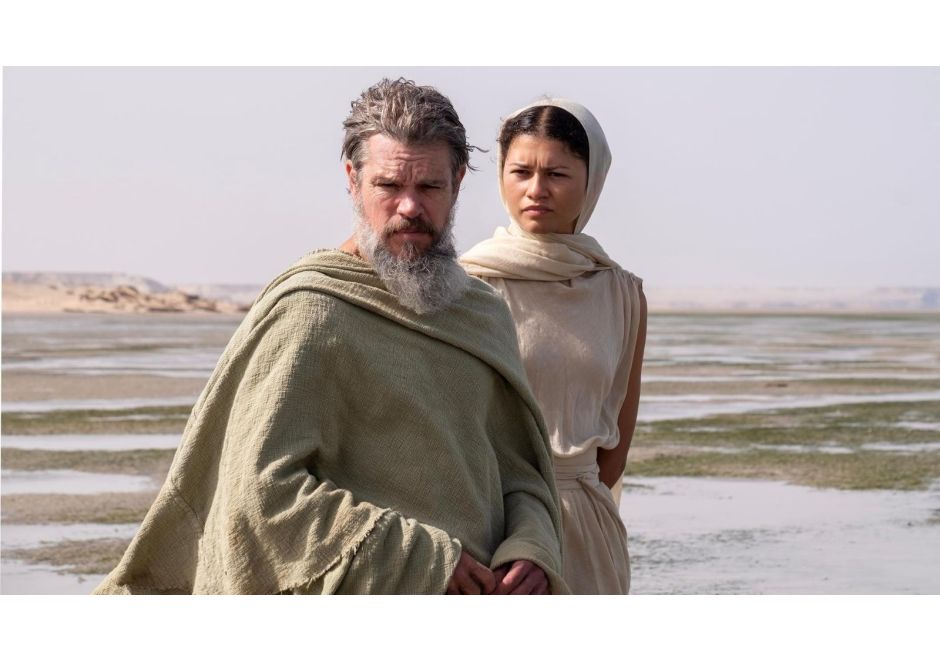
Christopher Nolan's The Odyssey ihas hit the silver screen and inevitably will become one of the biggest and best movies of 2026. Whether the adaptation of one of two major epics attributed to Homer is wholly faithful to its source material has been much debated, but it really defeats the purpose of transforming one art form into another. But the debate had me thinking: what are some of the best adaptations based on the Odyssey?
While I haven't seen Nolan's 13th feature film (which I'm sure is stellar based on Tom Holland saying it's the best script he's ever read), let's rank some of the best adaptations of Homer's work and break down what makes them great.
What Is the Odyssey About?
Homer's Odyssey follows Odysseus, King of Ithaca, on his ten-year journey home from the Trojan War. From battles with monsters and interference from gods to a journey to the edge of the Earth and a longing to reunite with his wife, Penelope, and his son, Telemachus, who barely knows him, this great epic is devoted to the physical pleasure and pain of war.
Fitting an entire epic that is nearly three centuries old is like adapting the Bible or Huckleberry Finn. These are pieces of literature that are so complex and so deeply woven into the fabric of storytelling that some part of us isn't satisfied when they are externalized as spectacle. As David Denby writes for The New Yorker, "We want some equivalent to what Homer provides—not just a sense of awe at natural and supernatural events but also a profound realization of the physical sensations of men and women." Writing an adaptation of a literary masterpiece is not an easy task, and there are many poor examples to point to. So, let's instead look at what makes a good adaptation of the Odyssey.
What Makes a Good Odyssey Adaptation?
Knowing that the Odyssey is so difficult to adapt, breaking down exactly what makes a film based on the epic good requires identifying the key ingredient in any solid adaptation. Does it need to keep true to the central characters? Does every major plot beat have to be intact scene-for-scene? Or can a film borrow the shape of the hero's journey and still earn the label "faithful"?
Adaptations are not about matching the source material's plot beat-for-beat. Instead, it is about whether the screenwriter understands why the story has endured for so long and can translate those themes visually.
With that in mind, here's the criteria I used to build this list, with a screenwriting lens:
- Thematic fidelity: Does it wrestle with the epic's core ideas: homecoming, identity, the trauma of war, loyalty tested by time?
- Character and narrative arcs: Are Odysseus's cunning and weariness, Penelope's endurance, and Telemachus's coming-of-age still recognizable, even if the names and setting change?
- Visual translation of emotion: Can the film show longing, guilt, and transformation, rather than just narrate them?
With that framework in mind, let's look at five adaptations that earn their place on the best adaptations of the Odyssey list.
5. Ulysses (1954)
Mario Camerini's Ulysses, starring Kirk Douglas, is the granddaddy of modern Odyssey adaptations. It's a lavish, Technicolor, Hollywood-meets-Roman epic that set the template nearly every swords-and-sandals Odyssey movie since has borrowed from. Douglas fills the frame as Ulysses as he slowly rediscovers who he truly is. But the film's compression of the source material flattens the epicness of Homer's poem.
As mentioned, the seven screenwriters take great liberties with the source material to make it more digestible for audiences at the time. Rather, the writers have Ulysses slowly rediscover his own name, dramatizing the poem's obsession with disguise, recognition, and identity after the war is over. It's not a subtle film, and it's not the most textually accurate one, but as a piece of classical-epic screenwriting, it understood the assignment: give the audience a clear emotional throughline even when the episodic source material doesn't naturally hand one to you.
4. The Odyssey (1997)
Andrei Konchalovsky's two-part NBC miniseries is the most conventionally "epic" adaptation on this list. While some critics called 1997's The Odyssey an "adventure tale without insight or depth," it is an entertaining three-hour watch. Armand Assante's Odysseus journeys through battles with monsters, threatening caves, and sets that are beautiful to look at. This miniseries, while bloated, hits nearly every major beat of the poem.
Where the miniseries earns its spot is in a choice most adaptations skip entirely: Odysseus's internal conflict between pride and wisdom is externalized through dialogue, and the structural strength of his motive (returning home to Penelope) has real stakes behind it. This piece of populist screenwriting is faithful to the poem's incident while providing a strong emotional through-line to land. Audiences have a reason to invest in and follow Odysseus throughout his journey home.
3. The Return (2024)
Director Uberto Pasolini and screenwriters John Collee and the late Edward Bond made a deliberate, almost defiant choice: adapt only the second half of the poem, keep Odysseus silent, and cut every god, monster, piece of magic out of it entirely. No Cyclops, no Circe, no Poseidon's wrath. It's the most grounded adaptation of the epic, focusing heavily on the post-traumatic stress disorder (PTSD) Odysseus (Ralph Fiennes) suffers from after the Trojan War.
While this is a more modern, empathetic look at a hero, it is a more emotionally analytical adaptation of the epic. By removing the mythology, the film forces itself to answer a question the poem doesn't dwell on: what does two decades of war actually do to a person, and to the people who waited for them?
2. L'Odissea (1968)
This eight-episode Italian miniseries, directed by Franco Rossi, is the most textually faithful adaptation on this list, and the best one ever made. Following the plot closely, Ulysses's (Bekim Fehmiu) adventures are told in flashback as a narration to his hosts before he returns home to deal with the suitors.
The miniseries format is the secret weapon here. Because Rossi wasn't compressing the story into 120 minutes, the show could let scenes breathe, giving Penelope's suffering, Telemachus's growth, and Ulysses's homecoming room to build rather than racing to the next set piece. The best episode to study is Episode 4, "Polyphemus and the gift of Aeolus," for lingering on the dread of Ulysses's encounter with the Cyclops rather than just checking off a mythological story beat.
1. O Brother, Where Art Thou? (2000)
While O Brother, Where Art Thou is likely the furthest film from a "faithful" adaptation, the Coen Brothers' Depression-era comedy is still the best adaptation. Ulysses Everett McGill (George Clooney) escapes a chain gang and treks across 1930s Mississippi to reclaim his wife, Penny, before she marries a suitor. Along the way, he meets a blind prophet, three river sirens, and a one-eyed con man, a bluegrass earworm of a song, and a lot of contemplation about "the nature of man."
The Coens didn't adapt the plot of the Odyssey; instead, they adapted its architecture. Every major beat has a structural cousin: the episodic road trip, the trials that test the hero's cleverness over his strength, the homecoming that isn't guaranteed to go well. Tonally, it nails something the poem actually has that often gets flattened out in most adaptations: the trickery and dark comedy of Odysseus's journey. Everett is vain, garrulous, and constantly talking his way out of trouble with his wits rather than his fists. It's a very fun, very accurate translation of Odysseus's defining trait: polytropos, the man of many turns.
Special Mention: EPIC: The Musical (Soundtrack)
While an adaptation of Jorge Rivera-Herrans's concept-album musical is coming, it is currently just a soundtrack that fully commits to Odysseus's moral arc. Across the album's "sagas," Odysseus goes from a man trying to get his crew home safely to someone willing to lie, manipulate, and sacrifice others to survive. The music tracks that decay in real time, right down to the way his vocal performance changes over the course of the story.
Once adapted, EPIC: The Musical will feature one of the greatest screenwriting assets that every great adaptation needs: a clear character arc. That is single-handedly the hardest thing to translate from the poem to any other medium.
So where does Nolan's The Odyssey fit into this ranking? Impossible to say until it's actually in theaters, but it's got a high bar to clear. The best adaptations on this list didn't win by being the most faithful; they won by knowing which piece of the poem to hold onto tightest, whether that's Penelope's endurance, Odysseus's trickery, or the simple ache of a twenty-year absence.
Nearly seventy years after Kirk Douglas first washed up on Scheria, filmmakers are still finding new interpretations of Odysseus's journey. If Nolan's script really is as good as Tom Holland claims, it'll be because it found its own answer to what it means to come home.