
When we talk about classic horror movies, we usually list the same titles year after year. Horror movies like The Exorcist, John Carpenter’s Halloween, John Carpenter’s The Thing, The Shining, A Nightmare on Elm Street, Psycho, the Universal Monsters movies (Dracula, Frankenstein, The Mummy, The Wolf Man, Creature of the Black Lagoon), and The Texas Chainsaw Massacre.
They have rightfully earned their place in horror history. Generations of horror genre screenwriters have studied and emulated them. But some of the best lessons can also be found in horror movies that never quite received the kudos and the same attention. They are either forgotten by the masses, or are massively underappreciated. Some were box office disappointments while others were poorly received by critics. Many also had the misfortune of following horror movies that were impossible to live up to, or were just forgotten as time went on.
With that in mind, here we share ten underrated classic horror movies. When we say classic, we’re not listing any horror selections beyond the early 2000s, and most of our selections are from the 1990s and 1980s. While there are many, many more great options not listed, we’re also looking into options that offer great horror screenwriting lessons, as we also explain why these movies actually work, despite being dismissed or forgotten.
Use this list for your latest horror movie binges, and also as a study syllabus for writing effective horror movies.
1. April Fool’s Day (1986)
College friends gathering at an isolated island mansion for spring break discover that someone is apparently killing them one by one.
Directed by Fred Walton and written by Danilo Bach, April Fool’s Day arrived under the height of the 1980s slasher boom when audiences had been accustomed to the masked killer craze and elaborate body counts in horror movies.
Produced for around $5 million, the Paramount release earned roughly $13 million domestically. While it was hardly a financial disaster, it never became a horror staple like Friday the 13th or A Nightmare on Elm Street. Its rather unusual twist (we won’t spoil it here) also divided audiences who expected a more conventional slasher flick.
Why It Works
April Fool’s Day understood its audience’s expectations and used those expectations against them to create something familiar but different, which is exactly what most screenwriters should be doing in any genre, but especially horror. The screenplay for this flick knows we’ve seen slasher movies before, so it allows us to make assumptions about what we’re watching before pulling the rug out from under us with a mind-boggling twist that we hadn’t seen before.
Beyond that, the horror cult classic has a great contained setup:
- A small group of characters
- An isolated location
- No easy escape
- A Killer among them
Genre conventions are storytelling tools for screenwriters. If you give audiences something familiar and then let them become comfortable with the rules, you can then give them a more cathartic and visceral experience by throwing them some curveballs and surprising them.
2. The Changeling (1980)
After losing his wife and daughter in a tragic accident, a grieving composer moves into an old mansion where he discovers that a murdered child's spirit may be trying to communicate with him.
Directed by Peter Medak, written by William Gray and Diana Maddox (story by Russell Hunter), and starring the late, great George C. Scott, The Changeling is one of the greatest (but most forgotten) atmospheric haunted house movies of all time. The Canadian production reportedly cost around $6.6 million and earned around $12 million at the box office. It turned a small profit but it’s a horror movie that most have either forgotten about or never heard of. The script ignores the more obvious shock effects of the haunted house sub-genre, and instead favors a restrained and more classical approach to horror instead.
Why It Works
A bouncing ball. A wheelchair. Strange noises inside an empty house. The Changeling was one of the first haunted house movies that demonstrated how little a horror movie has to do to scare an audience. Screenwriters can watch this movie and learn that instead of constantly showing something terrifying, you could be just as effective by embracing the anticipation of terrifying things happening and being just as (if not moreso).
It also introduced a way to make a haunted house movie an effective mystery as well. The protagonist isn’t trying to simply survive the haunting. He’s investigating what happened to the ghost. That transforms the movie into a genre blend of a supernatural horror story and a mystery. This gives the scares more narrative purpose and depth. Contemporary haunted house movies have utilized that “trick” effectively since.
3. Dark Night of the Scarecrow (1981)
After a group of vigilantes murders an innocent man hiding inside a scarecrow, the men responsible begin dying under mysterious circumstances.
Dark Night of the Scarecrow didn’t have a theatrical release. Instead, it was a television movie of the week. Movies of the week were very big back in the 1980s. These days, they’re mostly relegated to Lifetime and Hallmark. But back then, the major networks released movies made specifically for television debuts.
Directed by Frank De Fellita from a screenplay written by J.D. Feigelson, the movie premiered on CBS in October of 1981 during Halloween season. Feigelson had originally intended the film to be an independent horror movie until CBS bought it. Only minor changes were made so it could debut on television. Without a traditional theatrical release, and no box office numbers to track, it’s one of those horror titles that has been somewhat forgotten, even amidst rebroadcasts and a home video release during its day.
Why It Works
What stands out most about this TV horror movie is its simplicity. You don’t always need mythology and detailed explanations and backstories. We know someone did something bad. We know they deserve to suffer the consequences of their actions. What we don’t exactly know is what is coming after them. We never really learn why, or how, the answer to that can come after them. The script and movie offer an excellent example of how a horror icon can be created without overexplaining it. Sometimes the more you explain the monster or killer, the less frightening it becomes - the lesson of which is that you can allow the audience to fill in some of the blanks in your scripts. You can also leave things a mystery without overexplaining it in the end. Sometimes not knowing how and why this terrifying thing is happening is even scarier than knowing.
4. The Exorcist III (1990)
While investigating a series of ritualistic murders, a police lieutenant discovers a terrifying connection between the killings and events surrounding an exorcism seventeen years earlier.
Written and directed by William Peter Blatty from his sequel novel, Legion, to the best-selling novel The Exorcist (he wrote both), the third film in the Exorcist franchise had the impossible task of carrying the name of one of the most famous horror movies ever made. George C. Scott took over the role of Detective Kinderman (formerly played by Lee J. Cobb in the original). The story focuses on him as he mourns the anniversary of the death of his friend Father Karras (who died in the original) while also trying to solve a murder case that is similar to the Gemini Murders years prior. He discovers a hospitalized mental patient claiming to be the dead serial killer. To Kinderman’s horror, the patient looks uncannily like Father Karras. With a budget of $11 million, the film earned around $39 million worldwide, making it a very modest hit. But nowhere near the $305 million the original took in. The poorly received Exorcist II: The Heretic didn’t do the second sequel any favors going in. It has since become somewhat of a cult classic.
Why It Works
If you’re looking for a masterclass in building tension, watch the famous hospital hallway sequence. It’s now known as one of the scariest scenes in cinematic history. Blatty lets the audience stare at a largely static frame while almost nothing happens, and that’s exactly why the scene becomes so unbearable. We know something is coming. We follow every single movement of the security guard, the nurse, and then the empty space. We begin scanning the frame, waiting for something to change. And we still never see it coming.
The screenplay was written in a way proving that horror can emerge from dialogue, performance, withheld information, and stillness. There doesn’t have to be constant action and scares. The script allows scenes to breathe and is meticulous in how information is given. Horror screenwriters can sometimes rush to the scare. This movie proves that you don’t need to do that.
And here’s one surprising strength of this screenplay - the dialogue. It is some of the best dialogue you’ll hear in a movie, especially the banter between Kinderman and Father Dyer. Watch this movie for the great atmospheric horror and scares. But also watch it to study the dialogue.
5. Fire in the Sky (1993)
After disappearing following a mysterious encounter in the Arizona wilderness, a logger returns five days later with a terrifying account of alien abduction.
Directed by Robert Lieberman, written by Tracy Tormé, and based on the true accounts of Travis Walton’s alleged 1975 alien abduction, Fire in the Sky takes science fact/fiction of alien abduction and merges that subgenre with horror, at least in the truly terrifying flashbacks of Travis in the alien ship. The film earned just $20 million from a $15 million budget. With marketing costs, the movie lost money. But it has stood the test of time. Much of the film plays more like a mystery and drama than traditional horror, but the abduction flashback sequence is the stuff of nightmares.
Why It Works
The alien abduction scene is horrifying because it takes something traditionally portrayed as mysterious or wondrous (Close Encounters of the Third Kind) and makes it invasive, claustrophobic, and terrifying. In fact, the sequence uses phobias like the fear of confined spaces, the fear of aliens, the fear of abduction, and the fear of needles, all in one single sequence. We also spend much of the story wondering what happened to Travis as his buddies and co-workers are questioned about his disappearance. That anticipation creates a question that the audience desperately wants to answer. That mystery drives the narrative and keeps the audience invested. When the movie finally provides that answer, it makes that payoff count with one of the scariest and triggering movie scenes in history. Screenwriters should remember that sometimes one truly unforgettable, unique, and original horror sequence can define an entire movie. But the setup has to be worth it and build to it.
6. Halloween II (1981)
After surviving Michael Myers' Halloween-night killing spree, Laurie Strode is taken to a hospital, unaware that Michael has followed her there.
While the original Halloween was directed by the great John Carpenter, this sequel was only written and produced by him and Debra Hill, with director Rick Rosenthal taking over directing duties. Made for around $2.5 million, the sequel took in $25 million domestically, well below the $70 million worldwide the original took. The sequel was a commercial success but continues to live in the shadow of the original.
Why It Works
Location, location, location. The original took place in the openness of a town. The sequel takes place in the contained location of a hospital at night. Hospitals normally represent safety and healing. Turning one into a hunting ground for a masked killer is unsettling.
- Long corridors
- Dark rooms
- Fluorescent lights
- Elevators
- Stairwells
All of these contained location dynamics give the horror of Michael’s next killing spree an entirely new type of playground. The movie shows how a sequel can maintain continuity while changing the environment around the protagonist and antagonist, giving the audience something familiar, but different. The basic threat hasn’t changed. The audience gets to see Michael stalk and kill again. They also get to see the original’s protagonist face off against him again. But the circumstances have changed. If you find yourself developing a sequel to a movie, or are taking the familiar concept of a masked killer wreaking havoc, it’s a great way to learn how to keep the regular genre engine going, but in a different way so things feel new at the same time.
7. John Carpenter’s In the Mouth of Madness (1994)
An insurance investigator searching for a missing horror novelist discovers a town where the boundary between fiction and reality is beginning to disappear.
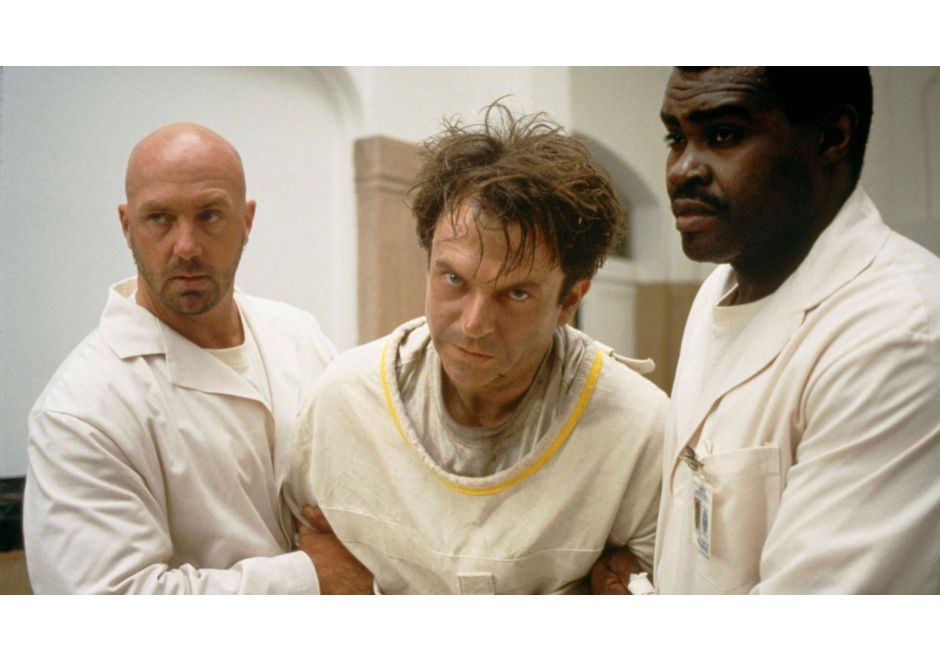
Directed by John Carpenter and written by Michael De Luca, In the Mouth of Madness stars the late Sam Neill as insurance investigator John Trent. The film was produced for around $8 million and only took in $9 million at the box office. The film is now regarded as the third installment of John Carpenter’s Apocalypse Trilogy (John Carpenter’s The Thing and John Carpenter’s Prince of Darkness). It has since developed into a cult horror movie.
Why It Works
The core concept of the movie is excellent. What if a writer’s fictional world became reality. The movie continually makes the audience question what’s real and what’s not, what’s imagined and what’s not, and whether that distinction matters in the world of this creepy and atmospheric horror flick. The script doesn’t just put the protagonist in danger. It destroys the understanding of reality itself, which is the whole point of the movie.
Some of the greatest concepts come from asking, “What if…?” The story also becomes a contained horror movie once the protagonist is trapped in a town he can’t escape. Disturbing visuals and beats are then used to constantly unsettle the audience, which makes for a more memorable horror movie experience.
8. The Island (1980)
A journalist investigating mysterious disappearances in the Caribbean becomes stranded with his son on an island inhabited by a hidden society of modern-day pirates.
Directed by Michael Ritchie and adapted by Jaws author Peter Benchley from his own novel, The Island stars Michael Caine as the protagonist, and David Warner as the villain. Universal thought Peter Benchley’s name, as well as Michael Caine’s casting, would elevate the movie’s chances for box office success, but on a then-high budget of $22 million, the film only grossed a little over $15 million. It remains to be one of those hidden gems though. Not a straightforward horror movie - but a horrifying suspense thriller.
Why It Works
The concept is great. Another excellent example of using the What If question to find a great concept. What if Caribbean pirates existed today? A protagonist ventures where they shouldn’t, discovers people who shouldn’t still exist, and realizes there’s nowhere to run. The movie is also a great example of a genre blend. It combines thriller, adventure, and psychological horror. The pirates aren’t supernatural monsters. They’re frightening because they have developed their own isolated society with rules completely detached from the modern world. And this man and his son are caught in the middle. The story teaches screenwriters that horror doesn’t have to be about supernatural threats. Discovering a hidden world operating by its own terrifying rules is scary enough. The story also explores the horror of a parent seeing their son brainwashed. That element is perhaps the most horrifying part of the story. It’s also the most human and character-driven part of the story as well, which also teaches screenwriters that horror can also derive from human relationships being thrust into turmoil.
9. John Carpenter’s Prince of Darkness (1987)
Scientists investigating a mysterious cylinder hidden beneath an abandoned church discover an ancient force that may represent the physical embodiment of evil.
Another underrated John Carpenter horror flick. Carpenter wrote and directed the movie for around $3 million. It would go on to earn more than $14 million domestically, technically making it a modest success. As mentioned above, this was part of Carpenter’s Apocalypse Trilogy. The movie stands out primarily because of its utter uniqueness and originality, combining science with faith and supernatural elements.
Why It Works
Science and religion are usually presented as opposing explanations for the unknown. John Carpenter’s Prince of Darkness asks what happens when both collide and eventually arrive at the same terrifying conclusion. That’s what makes the concept so effective. It’s unique. It’s original. There are elements of science, time travel, philosophy, dimensions, religion, good versus evil, etc. Carpenter also uses a contained location as well. His characters are trapped inside an abandoned church after gradually closing off their avenues of escape. It creates a contained horror setting, but with a much larger apocalyptic threat. There are also recurring dream transmissions from the future that all of the characters are experiencing on their own. But not all of the information is shared. As the story moves on, we see and hear more and more of the transmission, building to a shocking payoff. These dreams are strange, grainy, unexplained, and unsettling. Carpenter understands that scary visuals don’t necessarily need to make complete sense. The point in horror is that they shake us to the core.
10. Session 9 (2001)
An asbestos-removal crew working inside an abandoned psychiatric hospital begins to unravel as disturbing recordings reveal the institution's horrifying past.
Our sole underrated horror classic from the twenty-first century. Directed by Brad Anderson and co-written by Anderson and Stephen Gevedon, Session 9 was filmed inside the real abandoned Danvers State Hospital in Massachusetts shortly before portions of the deteriorating facility were condemned. Made for around $1.5 million, the independent horror movie only received a limited release, earning just $378,000 domestically. Home viewing on DVD and later streaming helped it earn back some of its budget. It’s now known as a cult horror classic.
Why It Works
Once again, location is everything for some horror movies. Abandoned mental institutes and hospitals are notoriously creepy. Danvers doesn’t look like a production designer’s idea of an abandoned hospital, it is one. But the location isn’t the only strength making this creepy film work. It’s the characters. The story gradually reveals fractures within the crew, while haunting recordings of psychiatric sessions provide another layer of dread. The true strength of the script is that instead of announcing what kind of horror story we’re watching, the screenplay keeps us guessing. Is it haunted? Is there a monster or killer within? Is one of them a killer? Is the threat psychological, supernatural, or human? By withholding information, the movie forces the audience to keep questioning what we’re seeing until those possibilities converge.
What These Underrated Horror Movies Can Teach Screenwriters
Sometimes certain forgotten or underrated horror movies need time to find the audience that understands what they were trying to do.
These ten examples, and plenty beyond them, showcase tools and tricks of the trade that can turn your otherwise conventional horror script into something different, special, unique, and original. The horror genre is infamous for utilizing the same trends and tropes over and over. But the best of them find ways to offer something familiar, but different.
Use these examples to add to your horror tool belt.